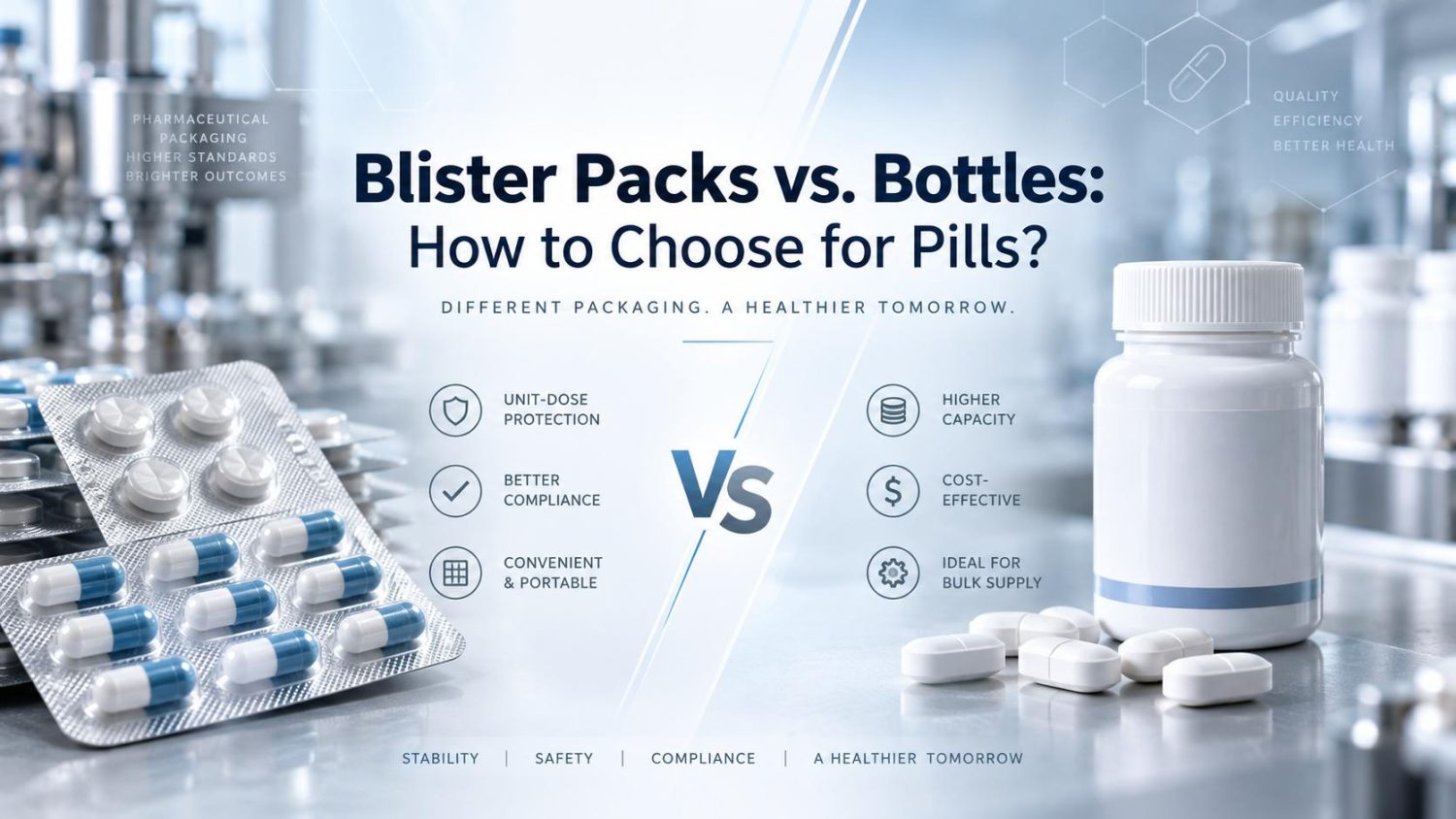
Blister packs and bottles are the two most common packaging formats for pharmaceutical industry. One seals each pill individually, while the other stores multiple pills in one container. For pharmaceutical manufacturers, suitable pill packaging is a key factor. It affects product stability, production efficiency, packaging costs, logistics, regulatory compliance, etc. Because of these considerations, there is no one packaging solution that fits every product. Therefore, when choosing between blister packs and bottles, you should conduct a comprehensive evaluation. It helps you better understand which packaging type suits your products best.
Blister packs vs bottles at a quick check
Blister packs focus on individual doses and have good control of medication. On the other hand, bottles are often preferred for high-volume packaging and everyday convenience. The table below provides a quick comparison of the two packaging formats. Although it highlights the main differences, the best choice depends on your product characteristics, production requirements, and commercial goals.
| Factor | Blister packs | Bottles |
|---|---|---|
| Product protection | Each dose is packed individually and won’t affect others when opened for use. | All the pills are packed together and may be exposed to the air while the bottle is open. |
| Patient convenience | Easy dose tracking and carrying | Resealable but everyday counting needed |
| Typical pack sizes | Small to medium pack counts. | Medium to large pack counts. |
| Production flexibility | More tooling changes required for different pack designs. | Easier to change product counts and bottle sizes. |
| Packaging cost | Higher material and tooling costs. | Usually good price for high-volume production. |
| Sustainability | More limited | Widely recyclable materials are available. |
| Best applications | Prescription drugs, clinical packs, sensitive products. | Vitamins, supplements, OTC medicines. |
Which protection do your products need?
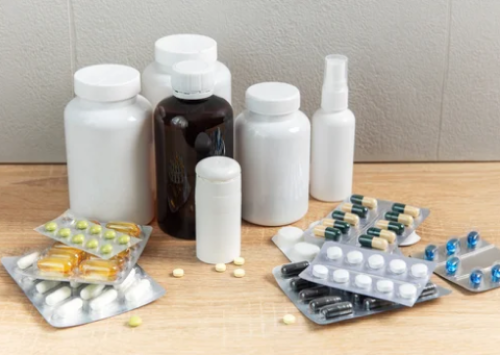
The right packaging depends on the product itself. Products with different properties are usually not suitable to be packed in the same packaging type. Before comparing costs or production efficiency, manufacturers should first understand what their product needs throughout storage, transportation, and daily use.
Moisture barrier
During packaging, this is an important consideration. Blister packaging and bottles have a big difference in moisture barrier. Blister packs seal each dose in a separate cavity. When one tablet is removed, the remaining doses are still sealed and protected. This design could maintain consistent protection throughout the product’s use. So, blister packs are a common choice for moisture-sensitive prescription medicines. Bottles protect all tablets or capsules as one package. They are capped tightly and may be sealed with a sealing foil. There is also a desiccant placed inside the package to keep it dry. After opening, however, the remaining product is exposed to fresh air each time the cap is removed.
Although blister packs have less moisture exposure than bottles, they are not the only solution for moisture-sensitive products. A bottle with appropriate closure and sealing foil may achieve the same protection for a specific product. For moisture-sensitive products, manufacturers should not judge only by packaging format. You need to check whether the complete packaging system can maintain the required shelf life. Common checks may include stability testing, seal quality inspection, and moisture barrier comparison between materials, such as PVC, Alu-Alu blisters and HDPE bottles.
How to use blister packs and bottles?

The way consumers store, carry, and use the product can also influence the best packaging choice.
Dose tracking
Blister packs separate each tablet or capsule into an individual cavity. It is easy for users to see whether a dose has already been taken and how many doses remain. There is a calendar blister type. It supports printing the dosing schedule on the package. It can help patients follow short treatment courses or prescription plans. Bottle packaging stores all doses together in one container. Users need to count the tablets for use or to check remaining doses. It is a little tricky but not a big problem for long-period consumption. No one packaging type can guarantee better medication adherence. However, if dose tracking is an important consideration, blister packs offer a more visual way to organize and monitor medication.
User convenience

Blister packs are compact and easy to push out for each cavity. They can also be divided for the flexible number of doses customers need and keep good protection. This is useful for travel or short-term treatments. Bottles are easy to reseal, suitable for products that are opened frequently and large-volume packaging. Customers can quickly get multiple tablets, but it needs careful counting for accurate doses.
Ease of opening should also be considered. Some users, particularly older adults or people with limited hand strength, may find blister packs difficult to open. On the other hand, child-resistant bottle caps can also be hard to open if they are not designed with senior-friendly features. The proper choice depends on the target user group and packaging requirements.
Pack size
The number of tablets or capsules in each package can also influence packaging selection. Blister packs are commonly used for prescription medicines that are supplied as a fixed treatment course. Examples include antibiotics, starter packs, and clinical trial products. In these cases, an accurate number of doses helps simplify dispensing and treatment management. Bottle packaging is often preferred for products sold in larger quantities, such as OTC medicines and dietary supplements. There are many bottle sizes, such as 60, 90, or 120 tablets per bottle, for long-term use.
Hospitals and healthcare institutions may choose one format based on how medicines are dispensed. Blister packs can simplify medication distribution in some situations. And bottles may be more practical for pharmacy repackaging or bulk inventory.
Which type is easier for manufacturing?
Manufacturing efficiency depends on many factors. Every step would influence the final output. Blister packs and bottles follow different production workflows. Each has its own advantages in terms of automation, flexibility, and production capacity.
How are blister packs made?
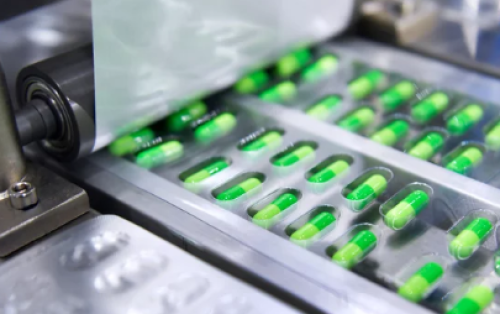
A blister packaging machine makes blister packs from a roll of film, places products into each cavity and seals the package. Although machine designs may be different, the basic working process is similar in most production lines. Here introduces you to the working process of an automatic blister packaging machine.
Forming. At first, the machine heats and forms the blister material into cavities. The cavity size and shape must match the product dimensions for safe production. Depending on the required barrier properties, manufacturers may use thermoforming films, such as PVC or cold-form aluminum materials.
Feeding. After the cavities are formed, pills are automatically fed into each pocket. The feeding system should be accurate for the correct orientation and product placement. Efficient feeding depends on both product characteristics and proper machine adjustment.
Sealing. Once the filling process is completed, a backing material, usually aluminum foil, is sealed to the formed cavities. Temperature and pressure need to be strictly controlled for a tight seal.
Cutting. Finally, blister cards are cut to the required size and transferred to the further processing, like cartoning.
Here is a video about how blister packs are made automatically.
The blister packaging process combines several steps into one continuous line. It can achieve high output with consistent package quality if every setting is proper. However, production efficiency depends on more than machine speed. Different blister forms, cavity sizes, or packaging materials often require tooling changes and machine adjustments. For manufacturers who produce many products in small batches, these changeovers can increase downtime.
How is bottle packaging made?
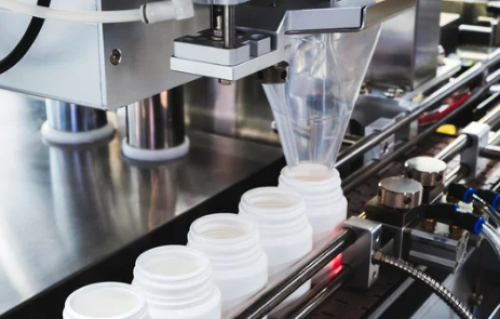
A bottle packaging line fills a required number of pills into bottles. Compared with blister packaging, the process is simpler. Most bottle packaging equipment can be designed with different functions depending on the product and packaging requirements. Here is the basic working process of automatic bottle packaging machines.
Bottle feeding. At the beginning, a bottle unscrambler is often used. It automatically separates bottles, turns them into the correct upright position, and feeds them onto the conveyor. Bottle feeding needs to remain stable throughout production. If bottles tip over or jam on the conveyor, downstream equipment such as the counter machine may stop automatically until the problem is cleared.
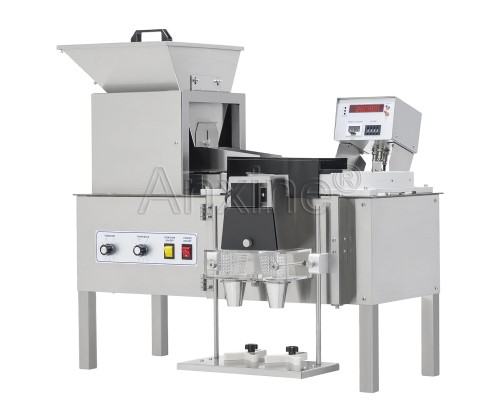
Counting. After the bottles are transferred to the pill counting machine, tablets or capsules are counted and filled into each container. Modern counting machines usually use optical sensors to count products as they pass through channels. Consistent product flow is essential at this stage.
Desiccant insertion. Some products require extra protection from moisture after the bottle is opened. In these cases, a desiccant is inserted into each bottle before capping. Not every product needs a desiccant. The decision depends on the formulation, the required shelf life, and the barrier performance of the bottle packaging.
Capping. The filled bottles then move to the capping station. The caps are placed and secured. Screw capping is one of the most popular capping methods. It requires a careful a control of the applied torque. A consistent torque makes a tight and safe capping. If the torque is too low, the cap may loosen during transportation. If it is too high, consumers may have difficulty opening the bottle. Most automatic capping machines support adjusting the torque for different bottles and caps.
Induction sealing. At this step, an induction sealer bonds the foil liner to the bottle opening. It is used to create a tamper-evident seal to provide extra protection against environment factors like moisture. A poor seal may peel away during transportation or let moisture enter the package. Therefore, many manufacturers usually verify seal quality as part of routine production checks.
Labeling. Once the bottle is sealed, labels are required. They often contain product information, barcodes, and dates. The labels should be positioned correctly and kept clear. After labels are completed, bottles can go to the next step, such as cartoning.
You may check the table to see the manufacturing differences between blister packaging and bottles.
| Key point | Blister packaging | Bottle packaging |
|---|---|---|
| Process | Blister cavities are formed from a continuous roll of film during production. | It uses pre-made bottles transferred to the line. |
| Product loading | It places one pill into each cavity. | It counts a required number of pills into each bottle. |
| Sealing | The blister is sealed with backing foil. | It closes the bottle with a cap and usually an induction seal. |
| Printing | Prints on the packaging web before or after cutting. | Different types of labels could be applied on the bottle surface. |
| Inspection focus | Empty cavities, sealing defects, product position, and print quality. | Tablet count, cap position, seal integrity, and label accuracy. |
Blister packaging provides more flexibility for unit-dose packs. The number and size of cavities could be customized. Bottle packaging is often more efficient for larger pack counts and high-volume production. There is no best choice. It depends on the product, packaging requirements, and production objectives.
How do blister packaging and bottle packaging cost?
Material costs cover a large part of the total packaging cost. Besides, equipment investment, daily operation, and transportation also need to be considered. Let’s break it down to have a rough understanding.
- Packaging material costs. A blister pack mainly uses forming film and backing foil. Higher-barrier materials increase the package cost but may provide better product protection. Bottle packaging requires many components. They often include the bottle, cap, label, and, in some cases, an induction seal and desiccant. So, the total material cost depends on the complete packaging system rather than a single component.
- Equipment investment. Blister packaging lines are generally more complex because they form, fill, seal, and cut the package in one continuous process. Different blister layouts often require new forming and sealing tools. Bottle packaging is usually more modular. Manufacturers can often change bottle sizes or product counts with fewer tooling changes. But it also requires more budget if you want to add some advanced functions.
- Operating costs. Daily operating costs include labor, energy, packaging waste, cleaning, and changeovers. Blister packaging may generate more material waste during setup. The film and foil need to be aligned before production starts. Bottle packaging usually has simpler startup procedures. Sometimes it may involve more equipment modules to clean and maintain. This increases the costs.
- Logistics and storage costs. Packaging size affects transportation and warehouse costs. Blister packs are lighter and require less space. And bottles may take more storage and transport space in some cases, especially for large pack sizes or rigid containers. For large-scale distribution, these differences can increase warehouse and transportation costs for bottle packaging.
Are blister packs and bottles recyclable?
As awareness of environmentally friendly packaging rises, more customers choose sustainable packaging types. Blister packs may use less material for each dose for some small pack counts. But many traditional blister structures combine plastic films with aluminum foil. It makes recycling more difficult. Bottle packaging often uses HDPE, PET or glass, which could be recycled in many countries. However, bottles usually require more plastic per package, such as caps. Now the packaging industry is developing more sustainable options for both types. Examples include mono-material for blister structures, post-consumer recycled (PCR) plastics to make bottles and lightweight packaging designs that reduce material use.


