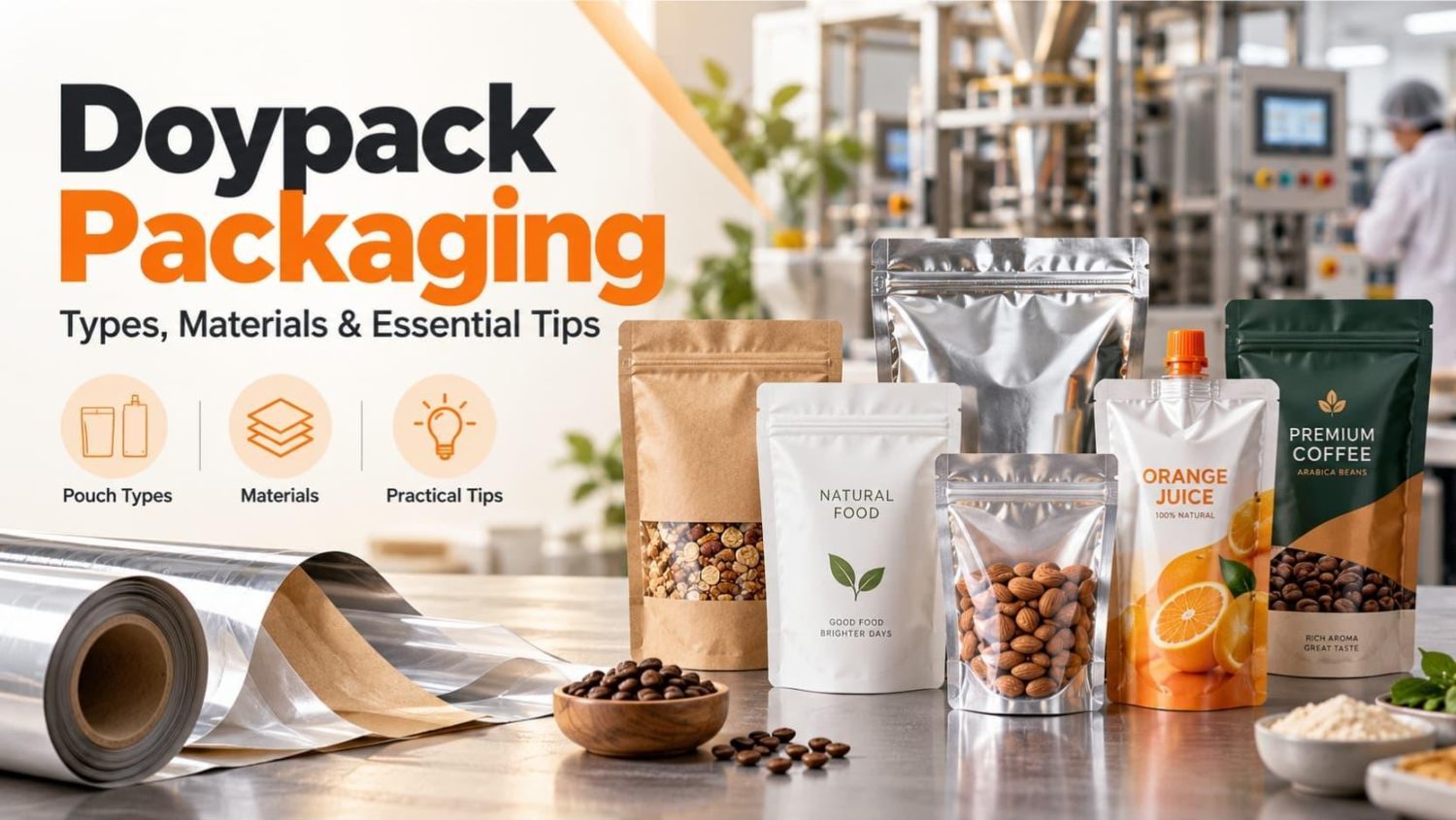
Doypacks are widely used for food, beverages, supplements, cosmetics, and household products. They are light and easy to use. The name Doypack comes from DOYen PACKaging. It was created by Louis Doyen, who developed this stand-up pouch design in the early 1960s. Over time, the design has been widely used in the packaging industry. And the name “Doypack” is often used informally to describe stand-up pouches.
What is a doypack?
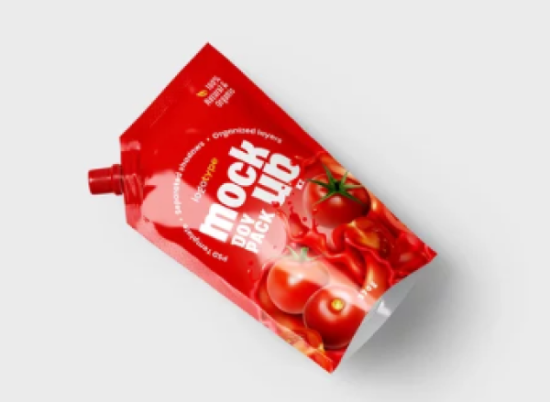
A doypack is a type of flexible packaging designed with a bottom gusset. The bottom of a doypack consists of a single bottom gusset with curved or rounded seals on both sides. When the pouch is filled, the gusset expands to form an approximately oval or round base. So, the packaging can stand upright on store shelves without extra support. Many doypacks have a tear notch to let consumers open the pouch easily. This self-standing design makes it a popular packaging choice for many products, such as coffee and snacks.
Compared with traditional flat pouches, a doypack has a better appearance and more space for printing. It can be flexibly customized for openings with many features such as resealable zippers and spouts. Besides, it also supports adjusting the size, color and printing for more attraction. However, some doypack manufacturing machines require dedicated forming or sealing tools for different pouch sizes. Because doypackaging adopts a doyen-style curved bottom gusset. If you want to change the pouch width, length, or bottom dimensions, it usually requires changing the corresponding tooling. This can increase tooling costs and changeover time when switching between formats.
Doypack vs stand-up pouches
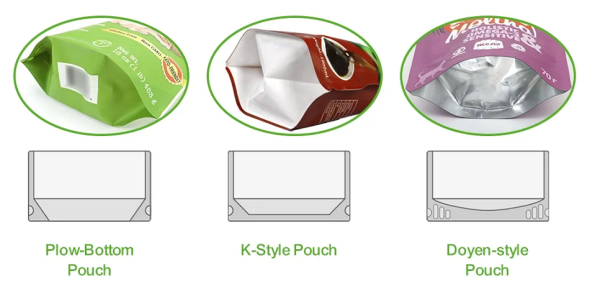
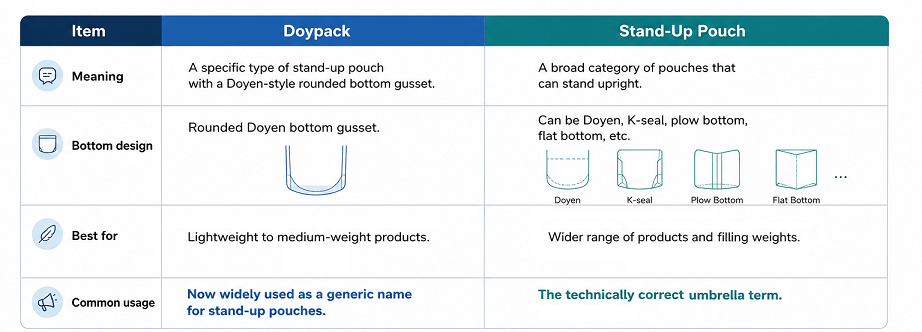
Although the terms doypack and stand-up pouch are often used interchangeably, they are not technically the same. A stand-up pouch is a broad category. It refers to the pouches that can stand upright on store shelves. It includes several bottom-gusset designs, such as Doyen, K-seal, plow bottom, and flat bottom pouches. You can see the picture to see their differences.
A doypack, on the other hand, refers specifically to a stand-up pouch with a Doyen-style rounded bottom gusset. This curved bottom insert expands when the pouch is filled to create a stable base. The unique Doyen bottom is what originally defined the Doy Pack design. Simply, every doypack is a stand-up pouch, but not every stand-up pouch is a doypack. But at present, doypack is widely used in the packaging industry as a generic name for stand-up pouches. Therefore, you may see suppliers use doypack and stand-up pouch at the same time.
What products use doypacks?
Doypacks have many advantages. They feature lightweight, durability and efficient space use. This makes them popular in many industries.
| Industry | Common products | Why doypacks are used |
|---|---|---|
| Food | Coffee, nuts, snacks, candy, dried fruit, pet food | Lightweight, easy printing |
| Beverage | Juice, smoothies, yogurt drinks, energy gels | Spout option, easy dispensing, lower weight than bottles |
| Supplements | Protein powder, powdered drinks, gummies, tablets | Barrier protection, resealable design, flexible sizes |
| Pharmaceutical/healthcare | ORS powder, diagnostic kits, medical powders | Only when the pouch material, cleanliness, barrier performance, stability and local regulatory requirements are validated for the specific product. |
| Cosmetics | Shampoo, lotion, cream, facial mask | Flexible format, spout option, refill packaging |
| Household products | Detergent, fertilizer, cleaning powder | Durable structure, less storage space than rigid containers |
In summary, doy packs can package powders, granules, solids, liquids, and semi-liquids. They have a versatile design and optional features for different product packaging. The applications range from food and beverages to pharmaceuticals, cosmetics, and household products.
What is Doypack made of?
There is no single best material for all doypacks. Doypacks are usually made from laminated materials that combine multiple layers to provide protection. The right structure depends on many factors, such as product sensitivity, shelf-life, filling temperature, sealing method, etc. The common materials are as follows.
Plastic film
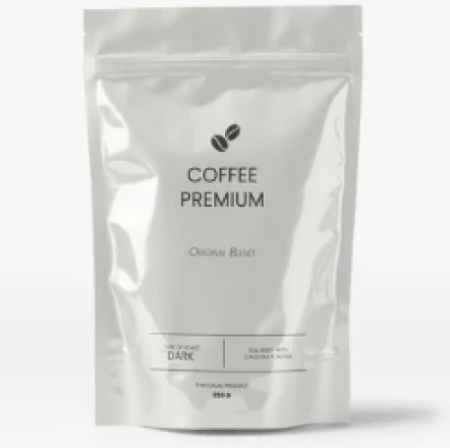
Plastic films are the most commonly used materials for doypacks. They offer good flexibility, durability, and sealing performance. Common plastics are
- PET. Good strength, stiffness, and print quality.
- PE. Excellent heat-sealing ability and flexibility. It is commonly used as the inner contact layer.
- PP. Good moisture resistance and heat resistance.
- PA. It is used to improve puncture resistance and mechanical strength.
They support the combination of different plastics to get required functions. The plastic doypacks can be suitable to pack snacks, frozen food, pet food, household products, etc.
Paper laminates
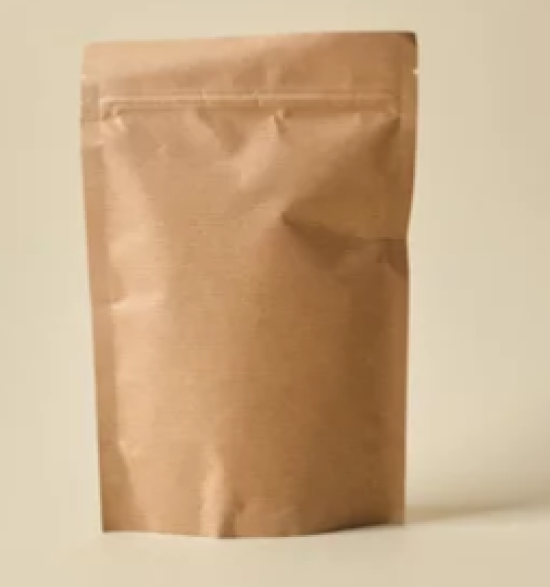
This type combines the properties of paper with the plastic films for protection and sealing. Typical layer structures include Paper / PE or Paper / PET / PE. They improve the printing quality and shelf appeal of the packaging. This material can be used to pack coffee, tea, dry food, and organic products with different material combinations.
Aluminum foil laminates
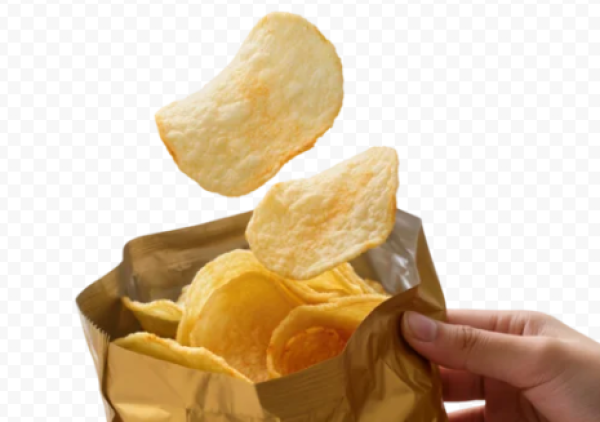
When products have a high requirement against the environment, aluminum foil laminates are often used. They offer excellent barrier performance and protect sensitive products from environmental factors. Common combinations include PET/aluminum foil/PE. They are used to pack powdered supplements or drinks, nutritional supplements, coffee powders, etc.
Recyclable and mono-material packaging
With increasing sustainability requirements, many manufacturers are developing recyclable materials to make doypacks. They can be made from a single type of plastic. Common mono-material structures contain PE-based and PP-based mono-material pouches. But this material may have lower barrier performance compared with aluminum foil laminates.
Six common types of doypacks
There are many standards to classify different doypacks. Packaging manufacturers usually categorize them based on structures, functions, or packaging materials. Moreover, the same pouch may belong to more than one category. For example, a kraft paper doypack may also include other functions like a zipper. The most common classification methods are listed below.
This classification is based on different functions to meet specific needs of doypacks.
Zipper doypack
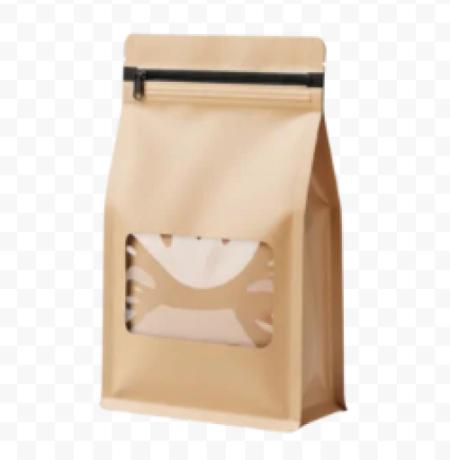
This type features a press-to-close zipper below the top heat seal. It makes the pouch to be opened and resealed multiple times after first use. The zipper consists of interlocking plastic profiles that could preserve freshness, and reduce moisture and contaminants. There are many zipper styles available, including single-track, double-track, and powder-proof zippers. Double-track and powder-proof designs provide a tighter seal for fine powders such as protein powder, coffee and spices.
Spouted doypack
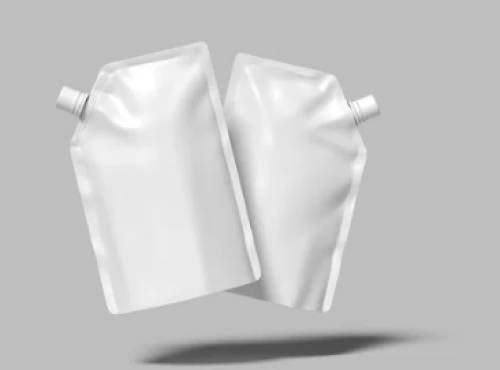
A spouted doypack has a plastic spout and screw cap for resealing. The liquids or semi-liquids can be dispensed easily and still with a tight seal. This design also reduces the risk of leaking. The spout may be positioned at the center or corner of the pouch. It mainly depends on the product and filling process. Compared to glass bottles or jars, spouted doy packaging is lighter and it provides a more convenient way for shipping and storage.
Doypack with valve
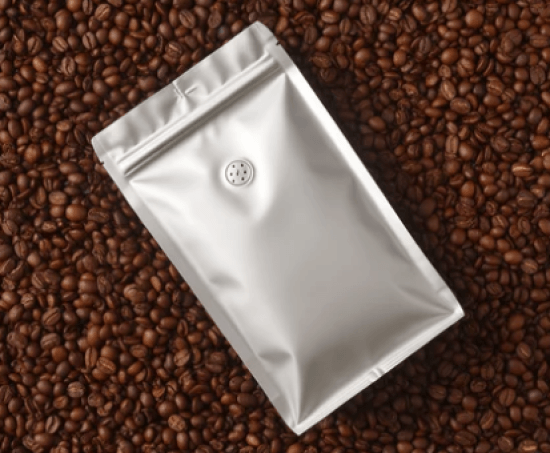
A valve doypack is equipped with a one-way degassing valve. It allows gases inside the pouch to escape and limits outside air from entering. This pouch is mainly used for coffee beans. Freshly roasted coffee beans naturally release carbon dioxide for days or even weeks after roasting. Without a valve, pressure can build up inside the pouch. Then, it may swell or even burst. The one-way valve safely vents extra gas. It can preserve the coffee’s aroma, flavor, and freshness. The valve is often combined with a resealable zipper. So, consumers can repeatedly open and close the pouch while maintaining product quality.
Some doy packs are classified according to their visual design or display features. So you can find that there are various appearances of doy packs.
Window doy pack
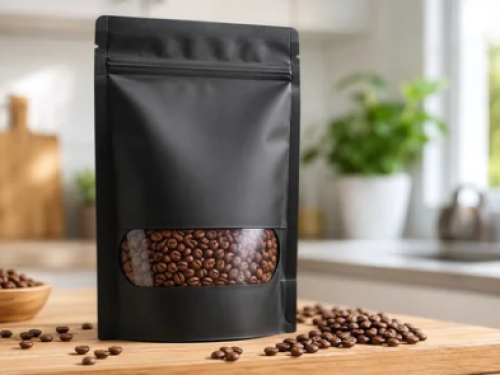
This type has a transparent panel to let consumers directly see the product inside. They can see the color, texture, or size of the product. The window can be clear or frosted. It is also available in various shapes, including rectangular, oval, or custom die-cut designs. Window doypacks are commonly combined with kraft paper or plastic films. They are widely used for coffee beans, tea, nuts or colorful candies that require visual attraction.
Metallic doypack
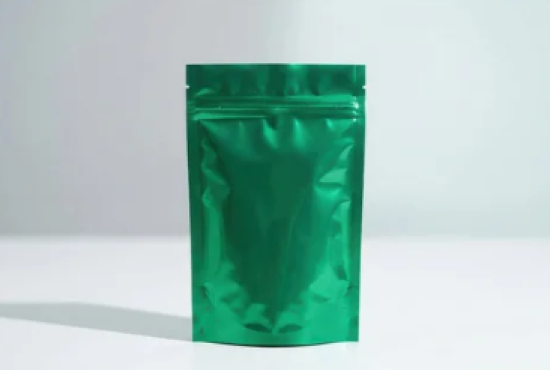
Metallic doypacks have a shiny and reflective surface. They offer the packaging a premium and eye-catching appearance. This type is usually made from metallized films or aluminum foil laminates. Metallic finishes are available in silver, gold, and other custom colors with glossy or matte effects.
Kraft paper doypack
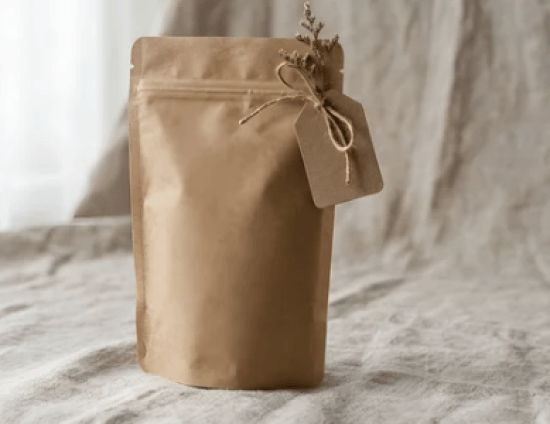
This doypack has an outer kraft paper layer laminated with one or more plastic films. It combines a natural paper appearance with good sealing quality. Kraft paper doypacks are commonly used for tea, bakery products, organic foods, or other products that need a natural brand image. Based on the laminate structure, they may also include zippers, windows, or valves.
How are doypacks made?
Doypacks can be produced in two ways. Most are manufactured as premade pouches by flexible packaging converters and later filled by product manufacturers. On the other hand, an HFFS machine forms, fills, and seals the pouch from rollstock film in a single continuous process. Here introduces you to the manufacturing process of how the doypacks are made in advance.
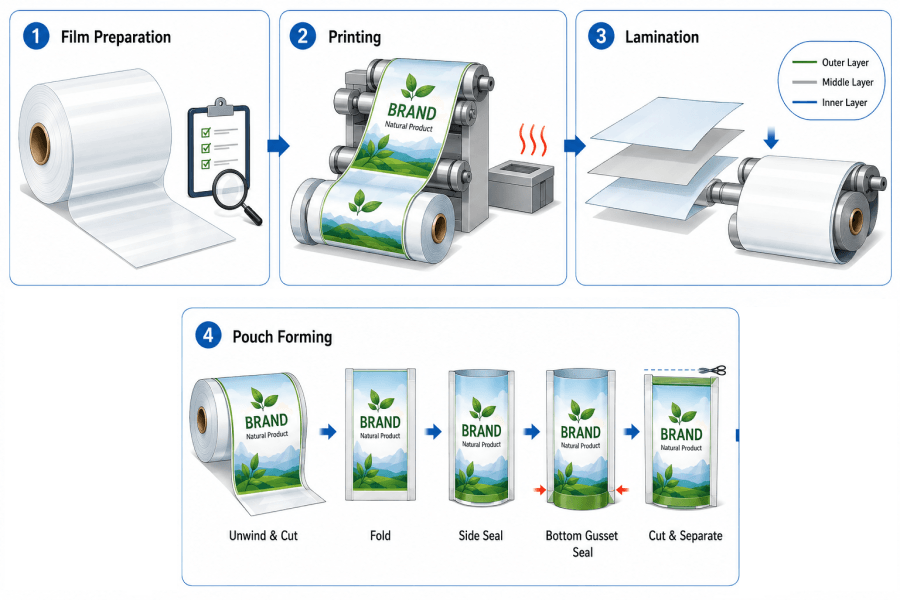
- Film preparation. It starts with the selection and preparation of flexible packaging films. The choice is selected according to the required barrier properties and product requirements. For example, PET/PE are chosen for general food and consumer products. The film rolls should be inspected for thickness, surface quality, and printing suitability before production.
- Printing. The outer layer of the film is often printed with product information, branding, and patterns. Many doypacks adopt rotogravure printing because it provides high-quality images and consistent color. After printing, the ink must be properly dried before the next process.
- Lamination. Then, multiple film layers are bonded together to create the final packaging structure. A typical doypack structure may include an outer layer for printing and protection, a middle layer for barrier properties, and an inner layer for heat sealing. Common lamination methods include adhesive lamination and extrusion lamination.
- Pouch forming. After lamination and curing, the laminated film rolls are converted into individual doypacks. During the pouch-making process, laminated film rolls are unwinded and cut into required sizes. They are then folded and formed into the pouch body. Next, the side seals and bottom gusset are created. Finally, individual pouches are from the film web.
- Function added. Additional functions are added during pouch production according to the pouch design, such as a zipper or valve. These components are usually inserted and sealed during the pouch-making process.
What machines are needed to make doypacks?
Doy packs can be filled by different types of packaging machines. It is decided by whether the pouches are premade or formed from a roll of film. The choice of machine also depends on the product type, production capacity, and packaging format. Also, it is necessary to check whether the pouch needs special features such as a zipper, spout, or valve.
Premade pouch packing machine
This equipment is designed to fill and seal preformed doypacks. During operation, the machine automatically picks up each pouch, opens it, fills the product, and seals the top. If the pouch includes a zipper, the machine seals the area above the zipper to provide a tamper-evident package. Premade pouch machine can handle a wide range of doypack styles. They are widely used because they offer high flexibility. Manufacturers can switch between pouch sizes and formats more flexibly.
You can check the video to see how the premade pouch packing machine works.
Horizontal form-fill-seal (HFFS) packaging Machine
Unlike premade pouch machines, an HFFS machine produces the doypack directly from a roll of packaging film. The machine forms the pouch, seals the bottom and side edges, fills the product, and seals the top in one continuous process. Because of the integrated pouch making and filling process, form-fill-seal systems may have lower packaging material costs and improve automation in high-volume. But the pouch design may be more limited. For doypack-style pouches, the machine needs a suitable forming and sealing system for the bottom gusset.
Here is a video to show you the working process of an HFFS packaging machine.
How to choose the right doypack?
There is no single doypack suitable for every product. The best choice depends on many factors. You need to consider product characteristics, required barrier performance, filling equipment, closure type, and sometimes sustainability. These factors help you have a clear understanding of both technical and commercial requirements. You can ask yourself the following questions to narrow the scope.
| If you’re asking | Factors | Example |
|---|---|---|
| What am I packaging? | Product type | Powders, granules, solids, liquids, and semi-liquids may require different pouch structures and filling systems. |
| What material performance do I need? | Barrier, sealing, filling compatibility, and shelf-life target | Products sensitive to oxygen, moisture, light, aroma loss, oil, or leakage may need different laminate structures. The final material should be confirmed through sample testing with the actual product and filling process. |
| Will consumers use the product multiple times? | Opening and resealing method | Zippers are suitable for snacks, coffee, pet food, and powders. Spouts are suitable for liquids or semi-liquids. |
| Do I need premade doypacks or make them directly? | Making machines | Premade pouch machine or HFFS machine |
| How will customers open it? | Sealing options | Tear notch, zipper, spout, or valve |
| Do I change pouch sizes often? | Production flexibility | Premade pouch machines are usually more flexible for different pouch sizes and styles. |
| Do I want eco-friendly packaging? | Sustainability | Mono-material or recyclable pouch |
After these details are confirmed, it is much easier to choose a suitable doypack machine. Your supplier would also offer more practical suggestions to make your production smooth.


