Gummy manufacturing quality control (QC) is a series of checks throughout production. In this guide, we will follow the gummy manufacturing process to see what to check along the way.
Let’s Start With Raw Materials
Before an ingredient goes into the gummy batch, QC should confirm that it is right for your formulation.
For example, gelatin should match the grade used for the formula. 200–250 Bloom is a common practical reference for conventional gelatin gummies. Lower Bloom usually gives a softer gel, while higher Bloom can make the gummy firmer. Viscosity may also be specified because it affects how the gelatin solution flows during processing. The GME edible gelatine monograph measures viscosity on a 6.67% solution at 60°C.
Different types of pectin form gels in different ways, so you should look at its type and setting grade. HM pectin has a degree of esterification above 50% and gels under high-solids, acidic conditions. LM pectin is below 50% and depends more on calcium.
Unlike gummy candies, supplement gummies usually contain active nutrients, so they need an identity check. FDA dietary supplement CGMP rules require an identity specification for each dietary ingredient used in supplements. Even a qualified supplier’s COA cannot replace the required identity testing.
Control the Gummy Mass During Mixing and Cooking
QC at these stages confirms that ingredients are prepared properly and that the mass reaches the required cook endpoint.
| QC point | How to check | What QC needs to confirm |
|---|---|---|
| Ingredient addition | Review the batch record to see when each ingredient is added | Ingredients are added in the right order |
| Mixing or hydration conditions | Record the temperature and time used to mix the gelatin, pectin, carrageenan, or other gelling system | The gelling agent is prepared under the right conditions |
| Cooking conditions | Record the actual cooking temperature, residence time, and vacuum where used | The gummy mass matches the cooking conditions set for the formula |
| Cook endpoint | Measure the hot mass with a refractometer and record °Brix or soluble solids | The mass reaches the concentration for moving on |
| Acid addition and pH | Record when the acid is added and measure pH after it is fully mixed | The gummy mass is in the right pH range before depositing |
| Heat-sensitive ingredient addition | Record the mass temperature and amount when the ingredient is added | The ingredient is added at the required temperature and dose |
°Brix is one of the main QC numbers during cooking. For conventional gelatin gummies, published literature commonly places soluble solids around 74–80 °Brix. One gelatin gummy study reported 70.99–78.31 °Brix across nine formulations.
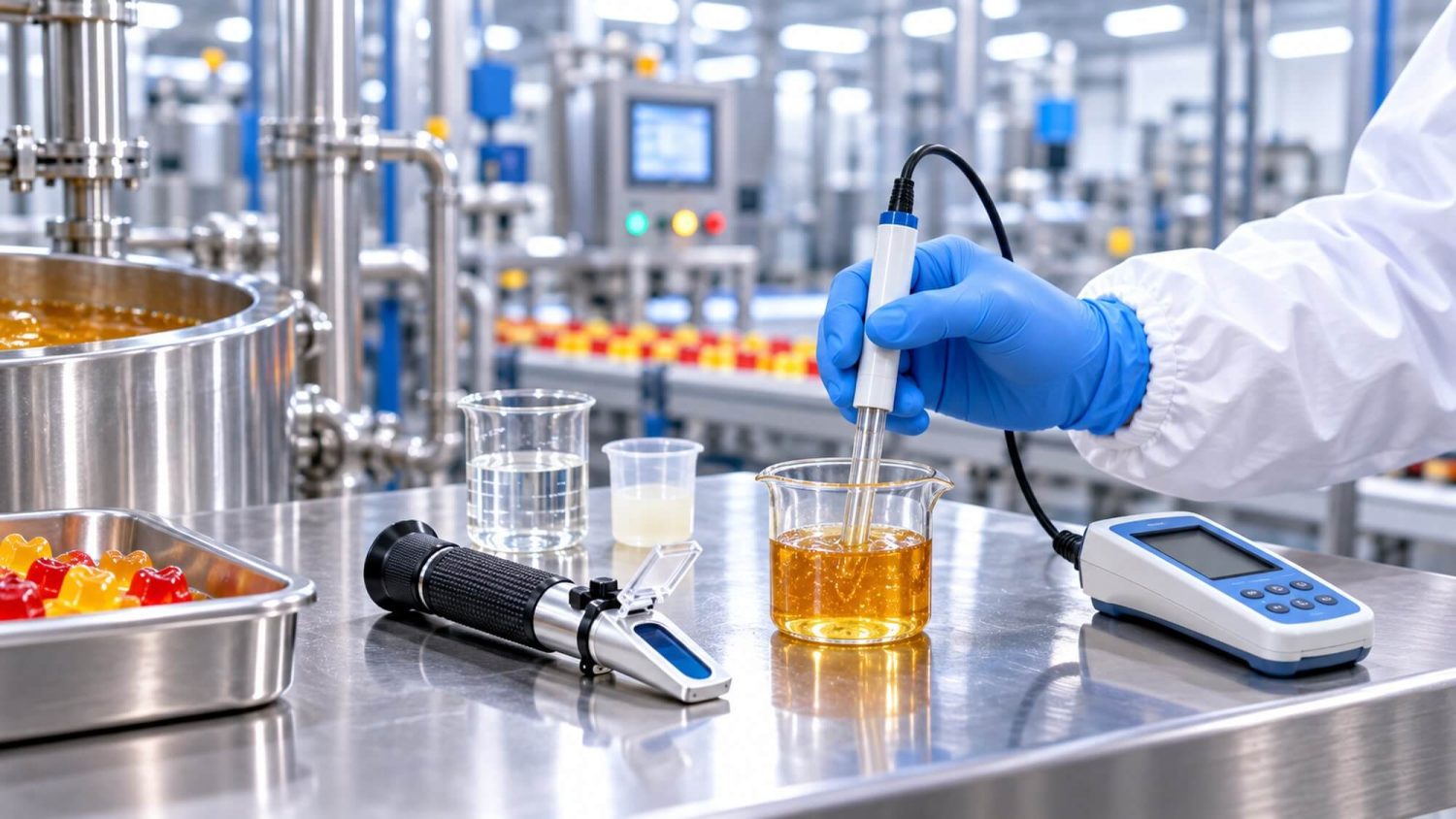
If you’re making HM-pectin gummies, the mass needs high soluble solids and enough acidity to set properly. That makes pH an important control at this stage. Acid is usually added after the cook endpoint and shortly before depositing. Once the acid is fully mixed, about pH 3.0–3.3 and 76–82 °Brix can be used as a published reference.
For gelatin gummies, acid is also often added after high-temperature cooking. But the pH range is usually wider than it is for HM-pectin gummies. Published formulations often fall around pH 3–5. The actual production limit should still be set for the specific gelatin formula.
Make Sure Depositing Stays Consistent
Depositing QC focuses on whether each mold cavity gets the right amount of gummy mass. Regular piece-weight checks and visual inspection can help catch problems early.
| QC point | How to check | What the result tells you |
|---|---|---|
| Gummy mass in the hopper | Record temperature or viscosity | Whether the mass is still fluid enough to deposit evenly |
| Nozzle alignment | Check where each nozzle sits over the mold cavity and where the mass lands | Whether deposits are landing off-center |
| Nozzle or lane output | Compare samples from different nozzle or lane positions | A nozzle or lane keeps running high or low |
| Mold fill | Observe the cavities during depositing | Underfill or overflow |
| Deposit weight | Weigh sample gummies regularly | Whether each piece has the same amount of mass |
When running a multi-nozzle depositor, you should take samples from different nozzles or lanes at different times. Then record the deposit weight and mold fill result at each position. This helps you see whether the machine deposits consistently.
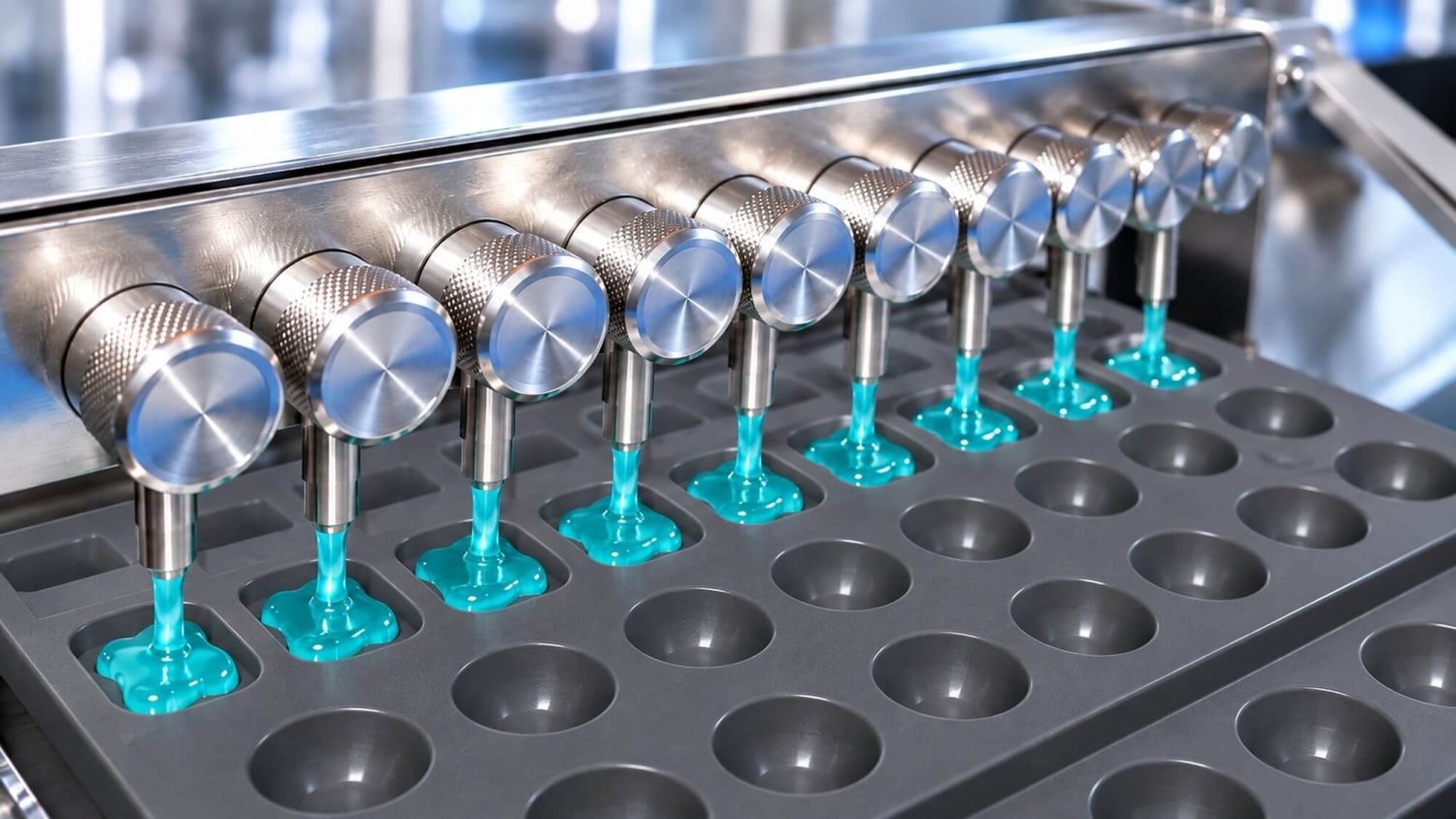
You should also record the hopper temperature or gummy mass viscosity. Compare these readings with the depositing results. It will tell you whether the mass changed when you get a different deposit weight or mold fill.
What QC Should Check During Cooling and Conditioning
During this stage, what you need to confirm is whether the gummies reach the right texture and shape for demolding.
| QC point | How to check | What the result tells you |
|---|---|---|
| Room or tunnel conditions | Record time, temperature, relative humidity, and air flow in the room or tunnel | Confirms that the gummy batch is cooled or conditioned under the right conditions |
| Gummy structure | Use a texture analyzer and perform a defined penetration test to measure firmness | Shows if the gummies are firm enough to demold |
| Moisture content | Weigh a sample before and after drying or use a moisture analyzer | Helps track whether conditioning has reached the target moisture level |
| Water activity | Use a water activity meter | Shows whether gummies have reached the aw for this stage |
A published study of starch-molded gelatin gummies shows that these checks may reach their endpoints at different times.
At 21°C and 35% RH, average hardness rose from 0.79 N after 12 hours to 0.88 N at 16 hours, then became stable. Moisture content continued to drop, from 21.7% at 12 hours to 21.0% at 20 hours. Water activity also changed from 0.72 to 0.71.
In this process, the gummies were firm enough to handle after about 16 hours, but they kept losing moisture until around 20 hours. That means firmness may help decide when the gummies are ready to demold. But moisture content and aw are more useful for checking when conditioning is complete.
Gummy Demolding and Finishing Quality Control
Now it’s time to remove the gummies from the molds. At this stage, QC looks at whether they come out cleanly and have the intended finish.
| QC point | What to check |
|---|---|
| Demolding result | Tearing, misshapen gummies, pieces sticking to the mold |
| Surface residue | Leftover starch or excess release agent |
| Finish coverage | Whether gummies are evenly covered with oil, wax, sugar, or sour |
| Coating amount | Undercoating or overcoating |
| Surface after finishing | Sticking or coating loss |
Demolding QC depends on the gummy production line setup. On starch mogul lines, the main checks are whether the gummies release smoothly and if there is starch left on the surface. Starchless demolding may focus more on ejector force and the amount of release agent used. These may cause gummy sticking or surface damage.
Finishing controls should confirm that gummies are evenly coated. Whether the gummy is oil-covered or sugar-sanded, the surface must also stay intact during the next processing steps. You can perform a simple tumble test to help check this.
Product Checks Before Release Testing
Before the gummies leave the production line, you still need to carry out a few final checks.
Appearance and piece condition. Take some samples and check for color, shape, dimensions, surface finish, broken pieces, and deformation. You can also count how many pieces have defects to get a rough defect rate. That may be more useful than a simple pass/fail visual check.
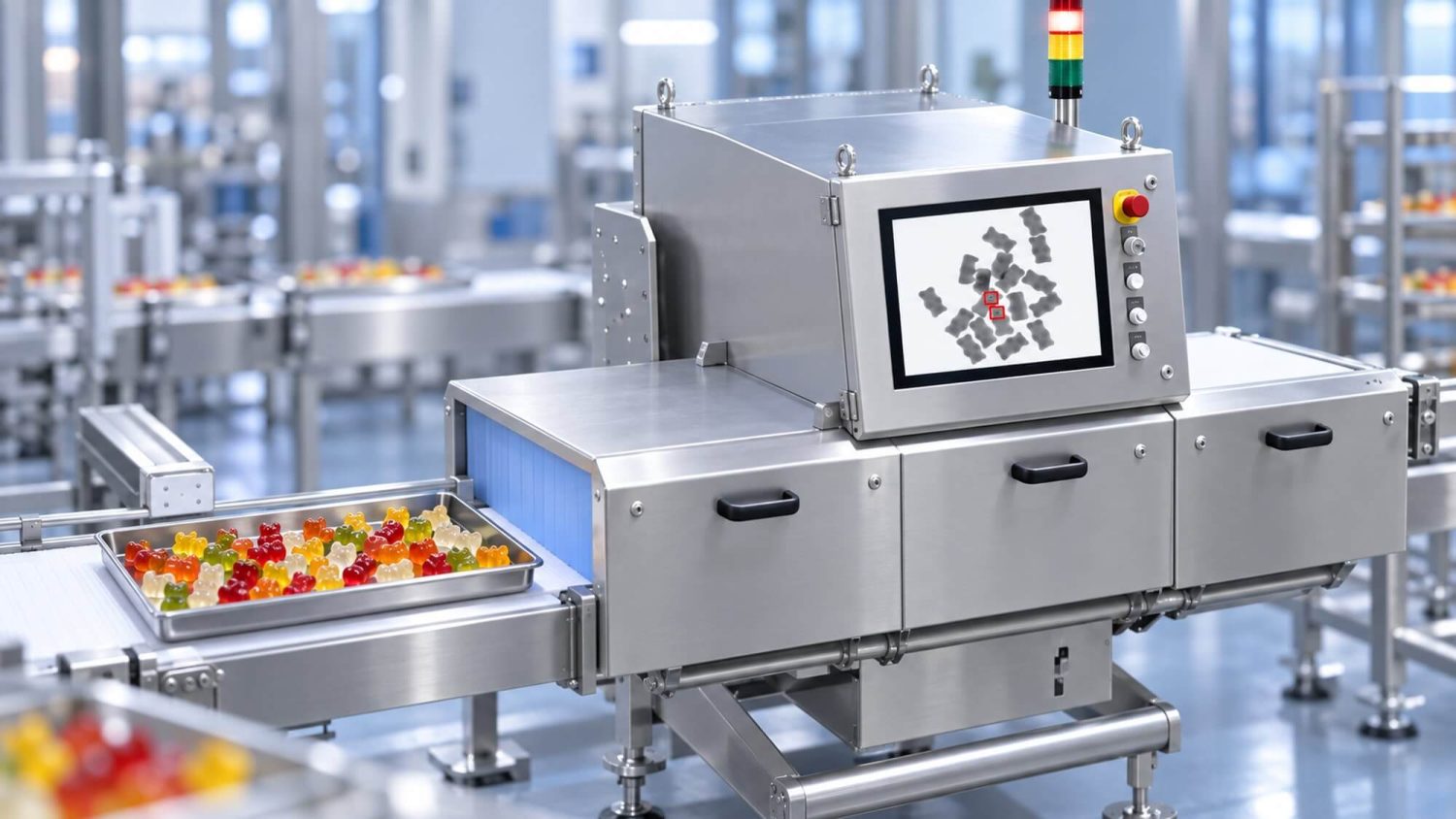
Foreign material. Confirm that finished gummies contain no foreign matter. Check under good lighting for visible foreign bodies. Or use metal detection or X-ray inspection to find contaminants inside the gummies.
Finished piece weight. If the final piece weight is part of the product specification, you should weigh the gummies again. Do not directly record the number from the earlier deposit weight. The two weights might be different. Your gummies have gone through conditioning, where moisture is removed, and oiling or sanding, which adds some weight back.
Verify the Finished Gummies With Laboratory Testing
Laboratory testing covers what you can’t confirm by appearance or in-process measurements.
For confectionery gummies, this may include microbiological testing and final moisture or water activity. Dietary supplement gummies need extra lab testing. Appropriate analytical methods may be used to verify identity, purity, strength, and composition.

This is separate from checks like piece weight or water activity. In a 2025 FDA warning letter about Ashwagandha Gummies, the FDA stated that appearance, color, odor, and aw were not enough to verify that the finished supplement gummies meet the product specification.
QC Review Before Batch Release
Before releasing your gummy batch, QC reviews the batch record and finished product test results. Any recorded deviation must be investigated and resolved. For dietary supplement gummies, 21 CFR 111.123 requires quality control personnel to determine whether in-process and finished product specifications are met before approving or rejecting the batch.
This closes the QC chain. The batch record connects what happened during production with the results used to release the finished gummies.
References
- ScienceDirect Topics. Gelatin.
- Gelatine Manufacturers of Europe (GME). (2024). Standardised Methods for the Testing of Edible Gelatine: Gelatine Monograph, Version 19.
- Chandel, V., Biswas, D., Roy, S., et al. (2022). Current advancements in pectin: Extraction, properties and multifunctional applications. Foods, 11(17), 2683. https://doi.org/10.3390/foods11172683
- U.S. Food and Drug Administration (FDA). (2010). Small Entity Compliance Guide: Current Good Manufacturing Practice in Manufacturing, Packaging, Labeling, or Holding Operations for Dietary Supplements.
- Moreira, A. de O. E., Azevedo Neta, L. M. S., Pietroluongo, M., et al. (2025). Three-dimensional-printed isoniazid chewable gels for on-demand latent tuberculosis treatment in children. Pharmaceutics, 17(5), 658. https://doi.org/10.3390/pharmaceutics17050658
- Kumkong, N., Banjongsinsiri, P., Laohakunjit, N., et al. (2020). Influence of natural colour blends of freeze-dried Gac aril and pulp on the quality of whey protein-mixed gelatin-based chewables. Heliyon, 6(12), e05817. https://doi.org/10.1016/j.heliyon.2020.e05817
- Lei, S., Li, J.-Q., Yang, X.-Q., & Guo, J. (2026). High-methoxyl Citrus Pectin-based gel with fortified plant-protein and less sugar. Food Hydrocolloids, 181, 113001. https://doi.org/10.1016/j.foodhyd.2026.113001
- Wang, R., & Hartel, R. W. (2022). Citric acid and heating on gelatin hydrolysis and gelation in confectionery gels. Food Hydrocolloids, 129, 107642. https://doi.org/10.1016/j.foodhyd.2022.107642
- Delgado, P., & Bañón, S. (2015). Determining the minimum drying time of gummy confections based on their mechanical properties. CyTA – Journal of Food, 13(3), 329–335. https://doi.org/10.1080/19476337.2014.974676
- U.S. Food and Drug Administration (FDA). (2025). Eniva USA, Inc. – Warning Letter 706565.
- Electronic Code of Federal Regulations (eCFR). 21 CFR § 111.123: What quality control operations are required for the master manufacturing record, the batch production record, and manufacturing operations?