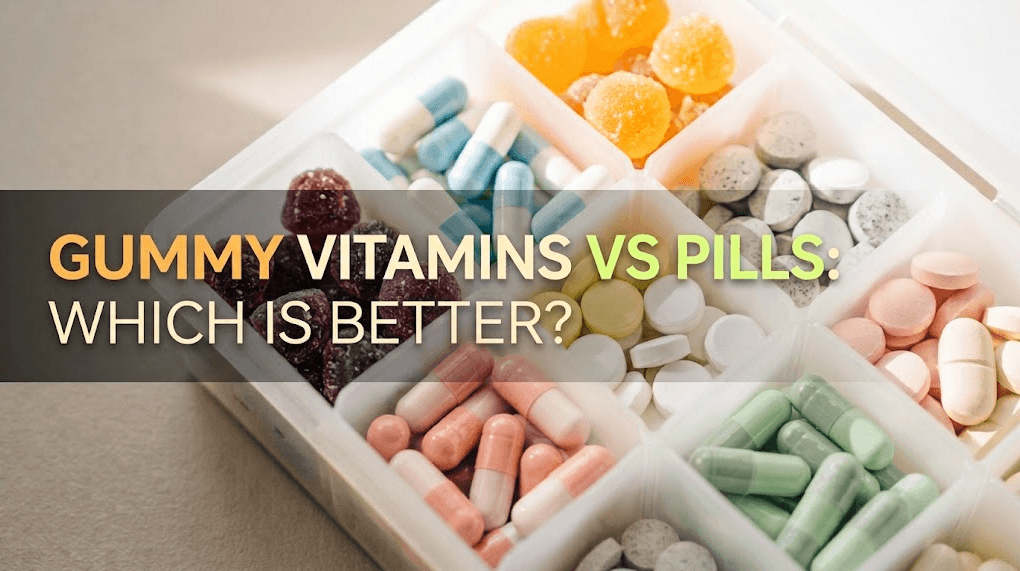
In recent years, vitamin gummies have become a strong competitor to traditional vitamin pills because of their candy-like taste. According to the “Multivitamin Gummies Market Size, Share & Trends Analysis Report 2023 – 2030” published by Grand View Research, the global multivitamin gummies market size was valued at USD 5.15 billion in 2022 and is expected to reach USD 12.03 billion by 2030. However, traditional pills still maintain a strong position in the market. Compared with gummies, vitamin pills provide more precise doses of active ingredients and are easier to store.
So how should vitamin supplement manufacturers choose the right dosage form when developing a product? The first step is to understand the differences between the available options. This article examines the key differences between vitamin gummies and vitamin pills, including capsules and tablets.
A Guide to Vitamin Gummies, Capsules, and Tablets
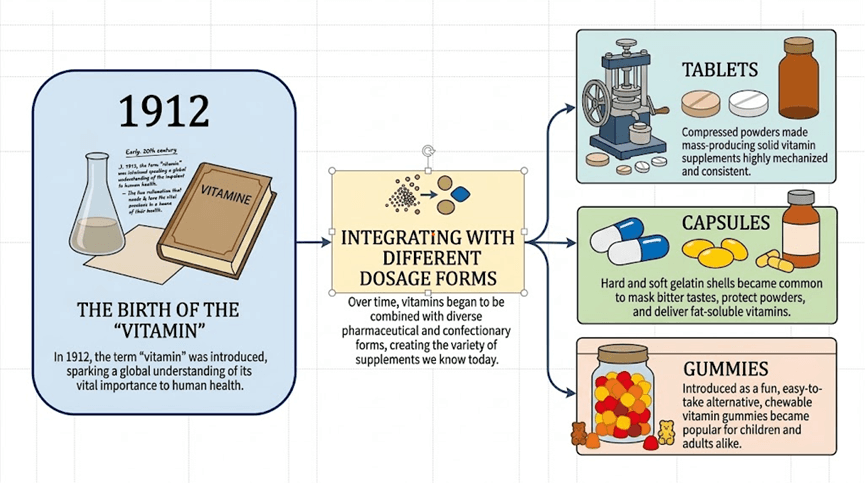
The term “vitamin” was first introduced in 1912. Over time, people began to understand how important vitamins are to human health. Tablets, capsules, and gummies later became common ways to take vitamin supplements.
Vitamin Capsules
Around 1833, soft gelatin capsules were introduced. They could be used to contain cod liver oil and other strong-smelling medicines, making them easier to take. In 1846, two-piece hard capsules were developed. Made up of a body and a cap, they were designed to hold powdered medicines while helping mask their bitter taste and unpleasant odor.
As vitamin began to be mass-produced, hard capsules became a common way to package powdered vitamins. Later, vitamins A, D, E, and K were recognized as fat-soluble vitamins. Since dietary fat helps the body absorb them, softgels also became a common way to package these vitamins.
Note: Unless otherwise noted, the term “capsules” in this article refers to hard capsules.

Vitamin Tablets
Long before vitamin came on the market, tablets were already widely used in medicine. In 1843, British inventor William Brockedon patented a tablet press that compressed powders into solid tablets, helping make tablet manufacturing more mechanized and consistent.
In 1912, Casimir Funk introduced the term “vitamin.” As vitamin supplements emerged, tablets became a natural way to deliver them. Around 1916, Mastin’s Yeast Vitamon Tablets came to market and are considered one of the earliest vitamin tablets.
Vitamin Gummies
In 1922, German confectioner Hans Riegel introduced the gummy bear. Its fun shape and chewy texture quickly made it a popular candy. By the late 20th century, tablets and capsules were well established. However, they were not always easy for children or adults with swallowing difficulties to take.
In 1997, U.S. brand L’il Critters introduced one of the first commercially available gummy vitamins. Since then, gummy vitamins have become a more appealing alternative to traditional supplements.
Gummy Vitamins vs. Pills: Key Differences Explained
1. Composition of Vitamin Capsules, Tablets, and Gummies
Understanding the active ingredients and excipients in vitamin gummies, tablets, and capsules helps explain how these three dosage forms differ.
| Dosage Form | Active Ingredients | Common Excipients |
|---|---|---|
| Capsules | Vitamins, minerals, and other nutrients | Capsule shell materials, diluents, lubricants, glidants, disintegrants, wetting agents, etc. |
| Tablets | Vitamins, minerals, and other nutrients | Diluents, binders, lubricants, glidants, anti-adherents, disintegrants, coloring agents, coating materials, etc. |
| Gummies | Vitamins, minerals, and other nutrients | Gelling agents, sweeteners, acidulants, colorants, flavors, vegetable oils, etc. |
Note: The table lists common categories of excipients, not all of which are used in every product. The specific excipients and their amounts depend on the formulation, manufacturing process, and product requirements.
2. Active-Ingredient Loading Capacity
The physical structure and formulation requirements of different dosage forms affect how much active ingredient they can contain. In general, tablets and capsules can accommodate higher amounts of active ingredients than gummies. As Dr. Vyas has noted, gummy vitamins actually have fewer vitamins and minerals than regular vitamins.
To further examine this trend, we referred to the Dietary Supplement Label Database (DSLD) maintained by the U.S. National Institutes of Health (NIH). We selected five vitamin gummies, five vitamin capsules, and five vitamin tablets. We then recorded and calculated the total amounts of vitamins, other non-mineral nutrients, and minerals listed on each product label. The results are shown in the table below.
Note: This is a small-sample observation for reference only, not a rigorous scientific study. The product information used here can be found in the DSLD. The values in the table were calculated from the information on the product labels and rounded to two decimal places.
Table: Vitamin Gummies
| Brand and DSLD ID | Genepro Protein: 311521 |
up&up: 19920 |
Nutrition Now: 20576 | Musclegen Performance Nutrition: 213543 | Nutrition Now: 20580 |
|---|---|---|---|---|---|
| Vitamins and Other Non-Mineral Nutrients Total | 53.81 mg/gummy | 32.63 mg/gummy | 30.97 mg/gummy | 38.544 mg/gummy | 120 mg/gummy |
| Mineral Ingredients Total | 2 mg/gummy | 0.15 mg/gummy | 0.15 mg/gummy | 75.154 mg/gummy | 5 mg/gummy |
| Sugar | 1.5 g/gummy | 1.5 g/gummy | 1.5 g/gummy | 1 g/gummy | 1.5 g/gummy |
Table: Vitamin Tablets
| Brand and DSLD ID | DermetRx Pharmaceuticals: 37170 | Abbott: 69996 | Women’s Choice Pharmaceuticals: 241396 | Enfamil: 43216 |
Eckson Labs: 278702 |
|---|---|---|---|---|---|
| Vitamins and Other Non-Mineral Nutrients Total | 272.12 mg/tablet | 158.16 mg/tablet | 272.12125 mg/tablet | 167.02 mg/tablet | 265.368 mg/tablet |
| Mineral Ingredients Total | 242.10 mg/tablet | 546.98 mg/tablet | 242.10 mg/tablet | 395.15 mg/tablet | 292.075 mg/tablet |
| Sugar | None | None | None | None | None |
Table: Vitamin Capsules
| Brand and DSLD ID | Cutler Nutrition: 44931 | Doctor’s Best: 82293 |
Nature’s Way: 66380 | SNAC Nutrition: 211837 |
Axe & Sledge Supplements: 255196 |
|---|---|---|---|---|---|
| Vitamins and Other Non-Mineral Nutrients Total | 75.3525 mg/capsule | 87.285 mg/capsule | 268.02 mg/capsule | 464.26 mg/capsule | 290.03 mg/capsule |
| Mineral Ingredients Total | 148.21 mg/capsule | 280.673 mg/capsule | 107.78 mg/capsule | 0 mg/capsule | 134.92 mg/capsule |
| Sugar | None | None | None | None | None |
Across the 15 products sampled, the results broadly supported the trend described above: tablets and capsules showed higher active-ingredient content than gummies.
Why does this difference occur? It may be related to the physical properties and formulation constraints of each dosage form.
- Tablets: Tablets are made by compressing powdered ingredients into a compact solid, so they can usually hold more active ingredients. However, larger tablets can be harder to swallow, which limits how much they can hold.
- Capsules: A capsule’s capacity is mainly limited by its size and fill volume. When a higher amount of active ingredients is needed, manufacturers can choose a larger capsule or increase the number of capsules taken per day. However, larger capsules are also harder to swallow.
- Gummies: Gummies need a gel base, sweeteners, and other ingredients to create their structure and texture. These ingredients take up part of the formulation, leaving less room for high levels of active ingredients. What’s more, as the table above shows, gummies usually contain lower amounts of minerals. This may be because higher mineral levels can affect the gummy’s gel structure and texture.
3. Taste, Convenience, and Consumer Adherence
Even people without swallowing difficulties may struggle to swallow solid dosage forms that are too large or have rough surfaces. Unpleasant odors and tastes can also reduce consumer acceptance.
For vitamin supplements, sensory experience and ease of use influence whether consumers accept and continue taking a product. These factors can also affect its market competitiveness.
The following are the main factors that may affect adherence to vitamin gummies, capsules, and tablets.
Vitamin Capsules:
- Capsule size: Capsule size is an important factor in swallowing comfort. For a comparison of common capsule sizes, see our capsule size chart. Larger capsules are generally harder to swallow. In contrast, very small capsules may be more difficult to pick up and handle, especially for older adults with limited fine motor skills.
- Pill sticking sensation:Capsule shells may soften or change their surface properties when exposed to moisture. Insufficient water intake or improper swallowing technique may increase the risk of a capsule becoming stuck in the throat or esophagus.
- Other factors: A capsule’s smell and color may also influence consumers’ willingness to take it. One survey found that brown capsules were the least preferred.
Vitamin Tablets:
- Tablet size: Like capsules, tablets that are too large can be difficult to swallow. Very small tablets may also be harder to swallow because users may have difficulty sensing them in their mouths. In addition, smaller tablets may need to be taken several at a time to reach the intended dose, increasing the pill burden.
- Coating: A coating can make a tablet’s surface smoother and help mask unpleasant tastes and odors, improving the overall experience.
- Shape: Common tablet shapes include round and oval.
- Color: The same survey found that white tablets were the most preferred, while purple tablets were the least preferred.
Vitamin Gummies:
- Taste and Flavor: How well the gummies’ sweetness balances out bitter, metallic, or other unpleasant flavors from the added nutrients.
- Texture and Chewability: How firm or chewy the gummies are, whether they stick to the teeth, and how easy they are to chew.
- Serving Size: How many gummies need to be eaten per serving and whether taking several at once feels inconvenient.

Figure: The picture shows an Anxine NJP Series fully automatic capsule filling machine in operation at a production facility. Most capsule filling machines can accommodate different capsule sizes by changing the tooling or adjusting the machine settings. This allows manufacturers to tailor their products to their target consumers.
4. Nutrient Absorption and Bioavailability
Tablets, capsules, and gummies release their ingredients in different ways. Gummies usually release nutrients as chewing gradually breaks down their gel structure. Capsules need the shell to dissolve or break apart in gastrointestinal fluids before the fill material can be released. Conventional immediate-release tablets absorb fluid after they enter the gastrointestinal tract, then gradually disintegrate and dissolve, releasing the active ingredients or nutrients inside.
Once released, the ingredients may dissolve further before being absorbed in the gastrointestinal tract. Many nutrients are absorbed mainly in the small intestine. The exact release rate and extent of absorption depend on the ingredient itself, the product formulation, the dosage form, and other factors. Therefore, it is not possible to make a broad claim that one dosage form has higher bioavailability than another.
But are gummy vitamins as effective as pills?
Are Gummy Vitamins Really Effective?
For these questions, we did find some supporting evidence.
【The paper reported two crossover studies comparing the absorption of vitamin D₃ from gummies and tablets. In the second, confirmatory study, 31 healthy adults received a single 20,000 IU dose of vitamin D₃ in each formulation in separate study periods.
The mean AUC in the gummy group was approximately 1.9 times that in the tablet group (1,474 vs. 774 ng·h/mL). The mean peak blood concentration (Cmax) was also about twice as high in the gummy group (47.3 vs. 23.4 ng/mL). Both differences were statistically significant (p < 0.0001).
These findings suggest that, under the conditions of this study, vitamin D₃ gummies may have higher bioavailability than tablets.】
Study 2: Bioequivalence Pilot Study of Two Multivitamin Formulations in Healthy Adults
【A crossover study in six healthy adults found no significant differences in the absorption of vitamins E and B12 between gummy and tablet multivitamins. Folate reached peak levels sooner with gummies than with tablets (1.59 vs. 4.08 hours), although total folate absorption did not differ significantly.】
【A crossover study in 30 healthy adults compared vitamin C absorption from gummies and caplets after a single 1,000 mg dose. The two formulations showed similar total plasma exposure, although peak plasma levels were slightly but significantly higher with caplets. Overall, the study found comparable vitamin C bioavailability between the two formulations.】
Overall, these studies suggest that gummy vitamins may be absorbed about as well as tablets or capsules for some nutrients. However, absorption can vary depending on the nutrient and the product’s formulation. More well-designed studies that directly compare these forms are needed before firmer conclusions can be drawn.
5. Shelf Life and Stability
In terms of shelf life and stability, gummies differ from tablets and capsules. Tablets and capsules are generally more stable, while gummies tend to degrade faster. However, these differences are not absolute and ultimately depend on the specific formulation and packaging used.
First, from a structural perspective:
- Gummies are gel-based foods with relatively high moisture content. Researchers note that higher water activity can increase the risk of spoilage and promote the breakdown of certain nutrients through hydrolysis and oxidation. Gummies also often contain citric acid or malic acid to improve flavor and mask the unpleasant taste of some minerals. As a result, gummies are generally acidic, which may reduce the stability of certain vitamins.
- Hard capsules usually contain dry powders, granules, or small tablets. These contents generally have low moisture levels. The capsule shell adds a protective barrier and helps reduce exposure to the outside environment. Still, hard capsules need to be stored under proper conditions.
- Tablets are made by compressing dry powders, so they usually have low moisture levels and a denser structure. Some tablets also have a thin film coating, which further reduces their contact with oxygen and moisture in the air.
From a packaging perspective:
Most gummies on the market are sold in bottles, while tablets and capsules are more often packed in blister packs. Compared with bottles, blister packs work better for products taken in separate doses over time. They greatly reduce repeated exposure to air.
Gummies, however, can melt at high temperatures and are relatively bulky. These traits make them less suitable for blister packs. To address this, the market has also developed individual sachet packs for gummies. This format also makes it convenient for consumers to take single doses on multiple occasions.
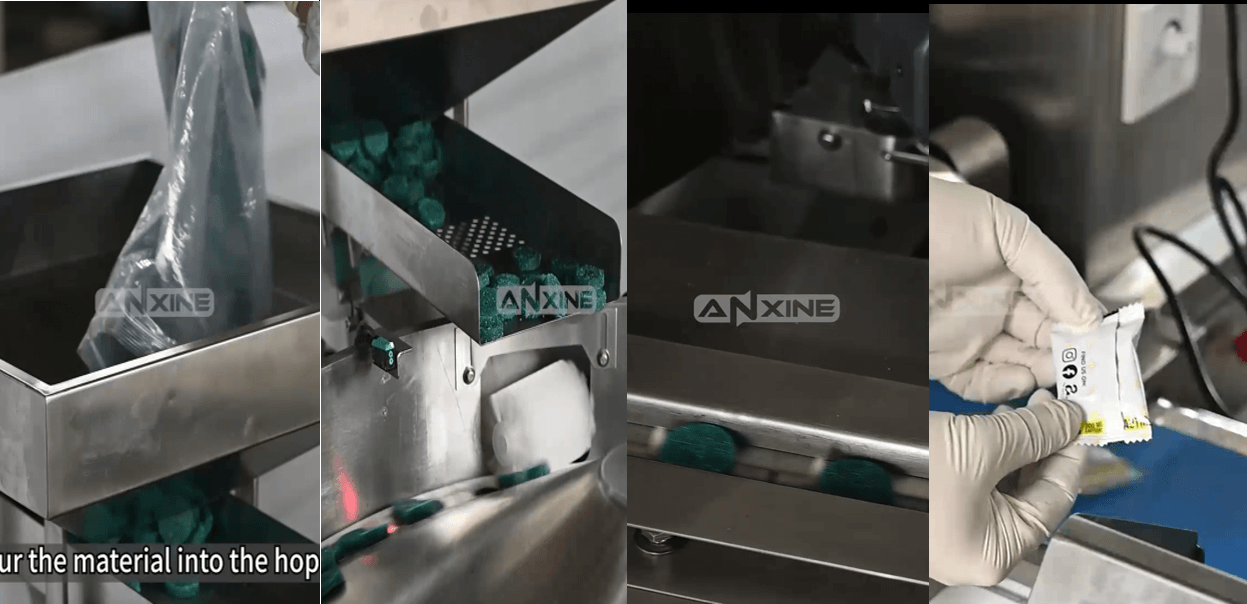
Figure: The image shows an Anxine Pillow Packaging Machine packaging gummies in individual sachets. This format meets the market’s demand for single-serving products. It helps reduce repeated exposure to air and moisture, which may extend shelf life. It also makes the gummies easier to carry and consume as needed.
Who Are Vitamin Gummies Best For?
Vitamin gummies can be a good option for people who have trouble swallowing or dislike swallowing pills. This includes children, older adults, and adults who are not comfortable taking tablets or capsules.
Gummies are also easy to take. They only need to be chewed and do not require water. Their pleasant taste and convenient format may help improve adherence to a supplement routine. After all, the expected nutritional benefits depend on taking the product consistently at the recommended dose and as directed.
Still, consumers should avoid taking more than the recommended amount and pay attention to the sugar content of gummies. They should also check the formula to make sure it meets their nutritional needs.
Who Are Vitamin Pills Best For?
Vitamin tablets and capsules may be a better choice for people who need higher doses, want more precise control over their intake, or need to limit their sugar intake. Compared with vitamin gummies, tablets and capsules are usually less expensive and often have a longer shelf life, making them more suitable for long-term use.
That said, high-dose supplementation should be done under the guidance of a qualified professional. Taking too much over a long period may cause harm that is not easy to notice.
How Manufacturing Processes Influence Dosage Form Selection
Are the Ingredients Suitable for the Manufacturing Process?
Each dosage form uses a different manufacturing process, so the ingredients must be suitable for that process. For example, gummy production involves heat. If an ingredient is heat-sensitive, you need to assess whether high temperatures could reduce its stability. Tablets are made by compression, so the powder’s flowability and compressibility can affect how well the tablets are produced.
Does the Formula Meet Manufacturing Requirements?
The entire formula must meet the requirements of the selected dosage form, not just the individual ingredients. For example, nutrients in gummies can affect the gel structure and texture. A tablet formula must be suitable for compression, while capsule fill material must work well with the filling process. Otherwise, even compatible ingredients may affect the quality of the finished product.
Can the Existing Equipment Meet Production Needs?
You should also assess whether the facility’s existing equipment can support the selected manufacturing process. If the dosage form requires additional equipment or processing steps, production costs may increase. For this reason, dosage form selection should be based not only on the formula but also on the facility’s actual capabilities.
If you want to learn more about how capsules, tablets, and gummies are made, see our articles on vitamin capsule manufacturing, tablet production process, and gummy production lines. These will help you better understand the key factors to consider when manufacturing different dosage forms.
Conclusion
Overall, vitamin gummies, capsules, and tablets each have their own strengths. There is no single “best dosage form” for every product or every consumer. Manufacturers should weigh the factors discussed above and choose the dosage form that best fits their product.
FAQs
Sources
- Grand View Research – Multivitamin Gummies Market (2023–2030)
- PubMed – The Discovery of the Vitamins
- NIH Dietary Supplement Label Database (DSLD) – Dietary Supplement Label Database
- Pharmacy World and Science – Patients’ Evaluation of Shape, Size and Colour of Solid Dosage Forms
- Vitamin D Bioequivalence Study – Bioequivalence Studies of Vitamin D Gummies and Tablets in Healthy Adults: Results of a Cross-Over Study
- Multivitamin Bioequivalence Study – Bioequivalence Pilot Study of Two Multivitamin Formulations in Healthy Adults
- Vitamin C Bioequivalence Study – Vitamin C Bioequivalence from Gummy and Caplet Sources in Healthy Adults: A Randomized-Controlled Trial
- ContractLaboratory.com – Vitamin Gummies: Solving the “Shelf-Life Stability” Headache