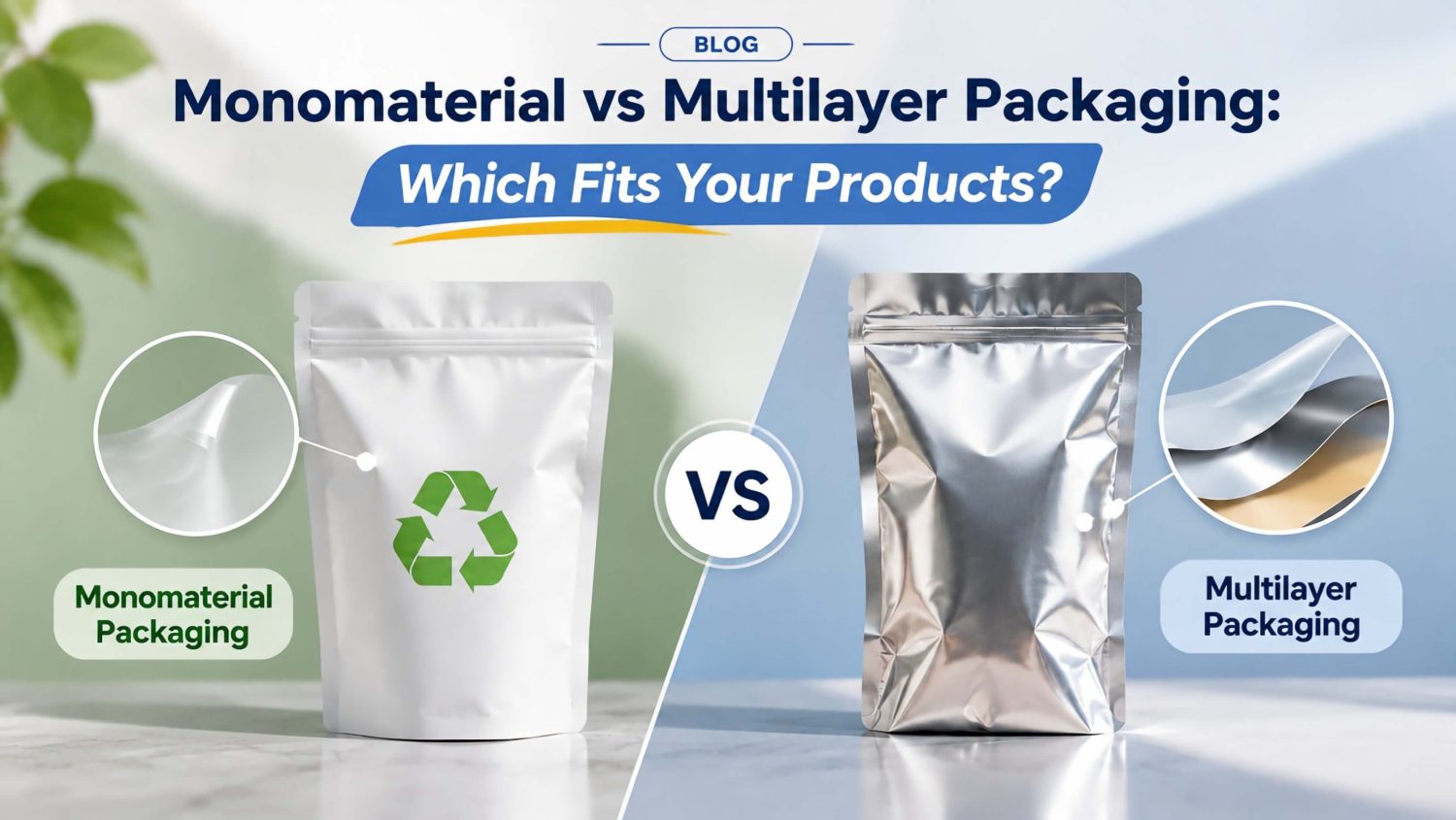
When choosing a packaging type, many people are considering monomaterial or multilayer types. Monomaterial packaging offers a simpler material structure, and it can support recycling-focused goals. Multilayer packaging can combine many properties, such as barrier protection and mechanical strength, in one package. Actually, there is no best choice between them. The selection depends on many factors, such as the product and the packaging requirements. Thus, a comprehensive understanding of these two structures is important.
What is monomaterial packaging?
Monomaterial packaging is mainly made from a single base material, such as paper, plastic, glass, or metal. It may still contain small amounts of auxiliary components, like inks, adhesives, or coatings. These components may not change the main material family of the package, but they can affect recyclability. It should be checked against the relevant recycling design guidelines and test results.
The key idea is that the main packaging materials belong to the same material family. For example, a PE-based package may be made of different types or grades of polyethylene for different layers. One layer may provide strength or easy printing, while another provides heat sealing. Although these layers have different functions, the main structure remains PE-based. Simply put, monomaterial can still have multiple layers or parts, as long as the main packaging structure uses the same type of material.
What does multilayer packaging mean?
Multilayer packaging combines two or more layers of different materials or material types. Each layer can provide a unique function. For example, an outer layer may provide strength and printability; a barrier layer may protect the product from oxygen and moisture. An inner layer may offer a good seal. For flexible packaging, a common structure of multilayer packaging includes PET/aluminum/PE. For aseptic packaging, it may be made of paperboard, PE, and aluminum foil.
What protection do you need for your products?
Monomaterial packaging can meet moderate barrier requirements and make a much simpler material structure. It may use some techniques like coating to achieve a higher protection level. But it may increase material or processing costs. In comparison, multilayer packaging may achieve the same performance through a more flexible combination of materials. For example, PE/EVOH/PE is a commonly used structure. EVOH is used as the oxygen-barrier layer, while the PE layers provide sealing and other properties. However, for products that are highly sensitive to oxygen and moisture or require a long shelf life, multilayer packaging is still the better choice.
What strength do your products require?
Mechanical performance is related to how products are handled during transportation and storage. Neither structure is automatically stronger or easier to process. It mainly depends on the materials, film design, and packaging process.
Puncture and tear resistance
Monomaterial films can provide good mechanical strength. But some applications may need extra film design. For example, BOPE can improve mechanical strength and barrier performance compared with conventional PE films. It is suitable for monomaterial packaging that needs better puncture and tear resistance. In multilayer packaging, different materials can be combined to provide stiffness, toughness, or puncture resistance. Thus, a monomaterial film may need to be thicker or require more complex processing to reach the required strength. You need to evaluate if the extra cost is worth it to complete it.
Heat and low-temperature performance
Temperature requirements depend largely on the material itself. PP generally offers better heat resistance than PE, while PE is often preferred when flexibility is important. A suitable PP-based structure can be used for applications that require high-temperature processing. But the actual temperature limit depends on the grade and package design. In real production, a monomaterial can be enough when one material can meet the performance requirements, like a PP-based material for high temperature. Multilayer offers more options when the package needs many properties for strength and safety.
Processing and printing
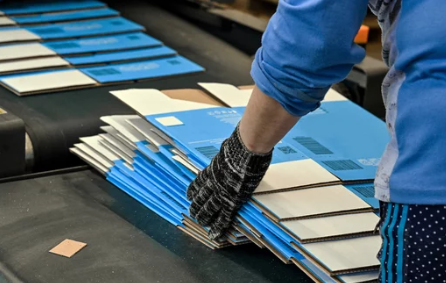
A material change can also affect how the package is processed on the production line. Different films may require adjustment to sealing temperature, web tension, line speed, and friction control. Moreover, some materials, like PE and PP, may have difficulties in printing and coating without surface treatment. In this case, corona treatment is commonly used to improve surface properties and ink adhesion. This does not mean that monomaterial packaging is difficult to produce. Many monomaterial films are designed for existing packaging processes. The important point is that a material adjustment should be tested on the actual packaging line.
Overall, monomaterial packaging can meet demanding mechanical and production requirements when the material and film are properly designed. Multilayer packaging offers more flexibility when different materials are needed. The selection should be based on the performance target, available film technology, and production conditions.
How about seal and tamper evidence?
Both monomaterial and multilayer packaging offer good sealing and tamper-evident features. The main difference is in the material design and sealing structure.
Seal integrity
A monomaterial package can achieve consistent seals when the material and sealing process are properly designed. Multilayer materials can also offer high-quality sealing with a dedicated seal layer. For each structure, seal strength, seal width, temperature, pressure, and dwell time need to be tested under real production conditions. A higher seal strength does not mean better package safety. Because the package also needs to balance sealing performance with opening requirements.
Tamper evidence
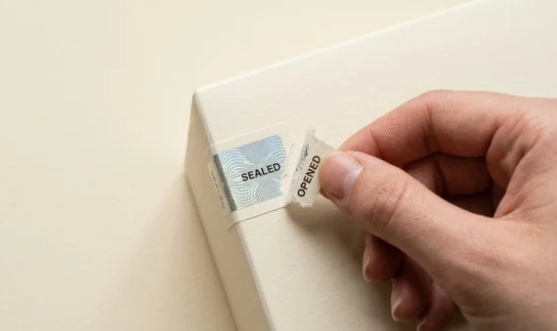
Tamper evidence mainly depends on how the package is made to show that it has been opened. Features such as tear strips, peel-open areas, or breakable seals can be broken after opening. Monomaterial packaging can adopt specially designed seal areas, easy-open features, or tamper-evident seals to achieve the result. Its advantage is that these functions can be built into a simpler material structure.
Multilayer packaging may offer different functions when made with different layers. For example, an outer layer can be used for strength and printing, while a seal layer controls seal strength and opening. A barrier layer can protect the product well. This offers multilayer structures more flexibility when a package needs barrier protection, strong sealing, and controlled opening at the same time.
Does monomaterial packaging always mean better recyclability?

Monomaterial packaging is often easier for recycling because its main structure belongs to one material family. A PE-based package, for example, can be made around the requirements of the PE recycling stream. RecyClass in the EU also identifies mono-material structures as an important starting point for recyclable flexible packaging. But monomaterial does not mean recyclable. The package still needs to be collected and processed through a suitable recycling system. In addition, a package that fits one recycling stream may not be suitable in another region. The package design is also important. Inks, adhesives, coatings, and additives can influence recycling. RecyClass has specific guidance for these features. But you should pay attention to the updates in time.
Multilayer packaging may still be recyclable if its materials and structure can be processed. RecyClass notes that some laminated PE structures can still be compatible with recycling when the adhesive and other parts are designed well.
Which material costs more?
The material price is only one part of the cost. A monomaterial structure may have fewer material types. But a new film may need different production methods or more material to achieve the required performance. A multilayer structure may have a higher material cost per unit. However, an established structure may already run efficiently, with stable line speed, low scrap, and fewer process changes. A better comparison is the cost of the whole finished package. The following factors need to be considered.
- Material cost. The material structure affects how many material types are needed and how much each one costs. A monomaterial package may need fewer materials and production methods. But if it uses a higher-performance resin, thicker film, coating, or special treatment, the cost could be higher.
- Production cost. A new monomaterial film may need adjustment to machine speed, sealing settings, and web tension. It can also increase scrap or downtime. A multilayer structure may already run well on the existing line, making production costs easier to control. On the other hand, a monomaterial structure can reduce some material processing time. The cost depends on how well the film runs on the existing equipment.
- Quality testing cost. A material adjustment can also create extra development and quality-control costs. New packaging may need material testing, sealing tests, and shelf-life testing.
Note: Do not compare monomaterial and multilayer packaging only by material price. Look at material use, production efficiency, waste, testing, and the cost of finished packages.
Which material fits your packaging requirement better?
There is no single structure that works best for every product. The right choice depends on the level of protection, the packaging process, and what happens to the package after use.
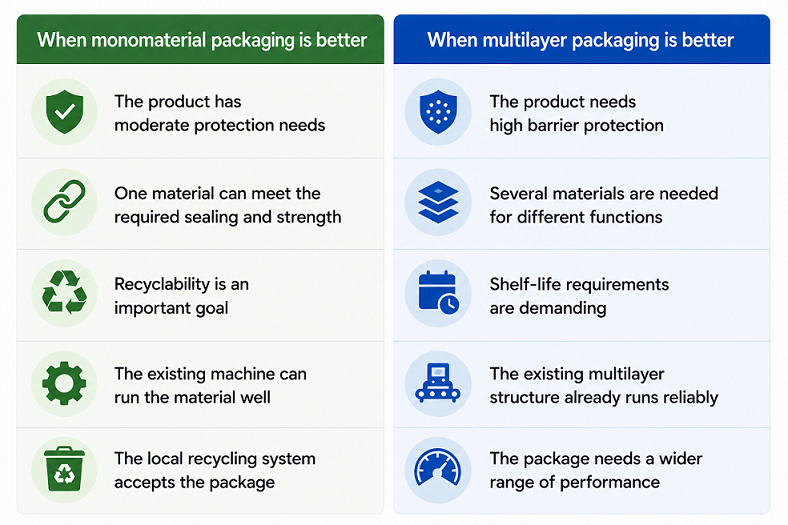
Monomaterial is more attractive when one material can meet the product and production requirements while supporting recycling goals. Multilayer is still useful when the package needs a combination of properties that is harder to achieve within one material system.
A practical checklist
Before you choose a packaging material or packaging format, check the following factors to make a better selection.
- Product sensitivity
- Required shelf life
- Moisture and oxygen barrier
- Required mechanical strength
- Sealing requirements
- Existing packaging equipment
- Expected material waste
- Recycling requirements
- Budget
- Required testing and validation
If the product is highly sensitive, the first priority should be protection and shelf life. If production volume is high, machine compatibility, speed, and material waste become more important. If sustainability is a key requirement, you’d better check recyclability and the available recycling infrastructure before making the final choice.
The end
There is no one packaging structure that is ideal for every product. Multilayer packaging can provide strong barrier protection and mechanical performance. Monomaterial packaging can simplify material recovery and support recyclability goals. But they also have some disadvantages. The best choice should be based on the product requirements and production conditions. A comprehensive comparison is necessary. Besides, a high-quality packaging machine is important for making good packaging. If you don’t know how to choose one, contact us freely. We offer different types of packaging equipment to meet your requirements.