Gummies are no longer traditional candy-style products. They are now widely used for vitamins, minerals, herbal supplements, and other functional products. As gummy production methods continue to develop, starchless gummies are getting more attention from manufacturers. Compared to the traditional starch mogul process, starchless gummies provide many advantages. This article helps you have a thorough understanding of starchless gummies.
What are starchless gummies?
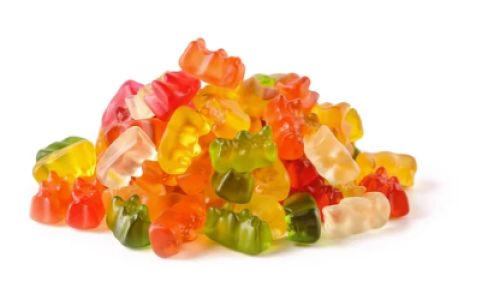
Starchless gummies mean gummy products are made without starch in the molding process. In traditional gummy making, it adopts starch mogul technique for production. The starch itself acts like a one-time mold that shapes the gummies. For starchless gummies, the mixture is deposited directly into reusable silicone or metal molds. The gummies are then cooled to set and removed from the molds.
Starchless does not mean that the gummies contain no sugar or carbohydrates. Starchless gummies can still contain active ingredients, sugar, glucose syrup, gelatin, pectin, etc. They can also have the same soft and chewy texture. This mainly depends mainly on the gummy formula and the ingredients used, such as gelatin or pectin.
The biggest difference between starchless gummies and starch-based gummies is how the gummy mixture is shaped during production. You may check the following table to see their differences.
| Feature | Starchless gummies | Starch-Based gummies |
|---|---|---|
| Molding method | The gummy mixture is deposited directly into molds made of metal or silicone. | The gummy mixture is deposited into cavities made of starch. |
| Role of starch | Starch is not used to form or support the gummy shape. | Starch holds the gummy shape while the product sets. |
| Product removal | Finished gummies are removed from the molds. | Finished gummies must be separated from the surrounding starch. |
| Starch handling | No molding starch needs to be handled. | Used starch may need to be cleaned, conditioned, and reused. |
| Cleaning | The production area has less starch residue and dust from the molding step. | Starch residue needs to be cleaned around the molding and handling areas. |
| Shape changes | Suitable for products that need different shapes and frequent product changes, depending on the mold design. | New shapes usually require different starch mold patterns and related setup changes. |
| Production setup | A starch-free depositing and molding system is required. | A starch-based molding system is needed, often called a starch mogul system. |
Why do manufacturers choose starchless gummies?
Starchless gummy production offers many benefits. It is cleaner, easier to manage, and more flexible than the starch mogul process.
Cleaner production
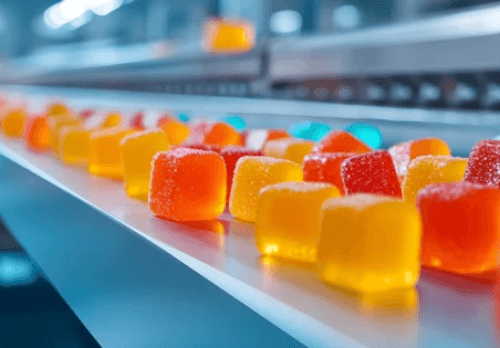
Starch-based gummy production needs a large amount of starch during the molding stage. Some starch can remain on the gummies, molds, equipment, and surrounding surfaces. Starch dust can also build up in the production area. In comparison, a starchless system does not use molding starch. So, there is less starch powder and residue around the production line. It can make the production area easier to manage and clean. However, the production line still needs regular cleaning because gummy ingredients can also leave product residue on molds and equipment.
Flexible gummy shape design

Gummy manufacturers often want products that stand out from standard candy shapes to get more attraction. Custom shapes are then increasingly popular. Starchless molding can support different mold designs for various gummy shapes. These may include animals, fruits, logos, letters, etc. This offers manufacturers more freedom when developing new products.
But very complex shapes may require special mold designs and suitable depositing conditions. In this case, a new mold may need to be designed and manufactured before production. The new mold may also require testing and parameter adjustment to create gummies that meet your requirements. However, it costs much more when you need to make a new mold.
Easier product changeovers
Gummy manufacturers may produce products with different formulas, colors, flavors, sizes, and shapes. For starch-based production, if you need to change products, it also requires handling the starch, such as cleaning, replenishing, recovering, or adjusting. This requires more human effort and handling time. A starchless system can offer more flexibility. For a product that already has a suitable mold, the manufacturer may only need to change the mold and adjust the relevant depositing and processing settings. The actual steps depend on the machine and product formula.
Efficient and stable-quality production
Modern gummy manufacturers often need to produce more products with consistent quality and less manual work. Automation and easier management are becoming important when manufacturers plan a new production line or upgrade an existing one. During starchless gummy making, the mixture can be deposited directly into molds and cooled to get a firm shape. It is a good choice for manufacturers that want
- Automatic gummy depositing and molding.
- Frequent product changes.
- Different gummy shapes.
- A cleaner production environment.
The actual benefits depend on the gummy formula, product design, production volume, and machine configuration.
What are the limitations of starchless gummies?
Starchless gummy production has many advantages, but it is not the right choice for every manufacturer. It is necessary to know some main considerations. Then, you can decide whether a starchless method fits your products and production plans.
The materials should match the depositing system.
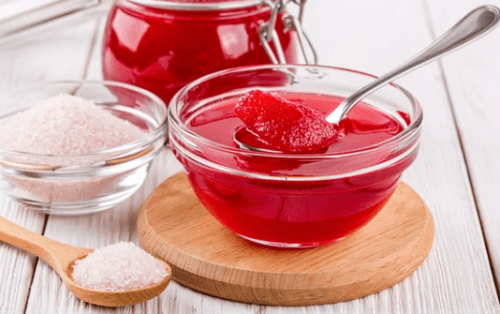
A gummy formula needs to flow properly through the depositing system. Its viscosity affects how easily the mixture moves through the depositor and fills each mold cavity. A formula that is too thick may not fill the cavities properly. A formula that is too thin may not hold the required shape well after depositing. Other factors, like temperature, can also affect depositing. If the formula changes, some adjustment like parameter setting is also required. Therefore, manufacturers should evaluate the formula and depositing machine together to get gummies with consistent shapes and quality.
New product shapes may require new molds.
The starchless method needs physical molds to form the gummies. This offers manufacturers more freedom to create custom shapes to attract customers. But it also means that a new product may require a new mold. It usually needs to be designed and manufactured before the new mold can be used. It may also require testing to make sure the gummy fills the cavity correctly and can be removed without damage. Therefore, customization is possible, but every new shape requires a mold cost and development time. Each extra mold increases the cost of mold manufacturing and adds to storage and maintenance requirements.
Higher equipment investment may be required.
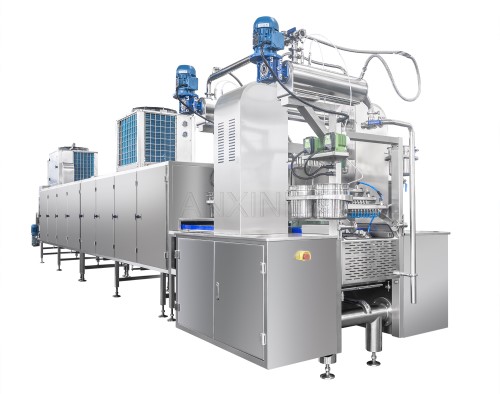
A starchless gummy line should be equipped with a dedicated depositing and molding system. This may require a larger initial investment. The total investment usually includes the gummy depositor, molds, and other supporting equipment. The actual cost mainly depends on production capacity, automation level, gummy size and mold design.
Less practical for manufacturers built around existing starch.
Starchless production can be attractive for a new gummy production line. However, it may not be suitable for a manufacturer that already has a mature starch-based system. An existing starch-based line may already have the equipment, starch handling system, molds, operators, and production procedures in place. If you replace this system with a starchless line, it may require new investment. Moreover, this may not provide enough benefit for a manufacturer with a stable product range.
What should you consider before choosing starchless gummy production?
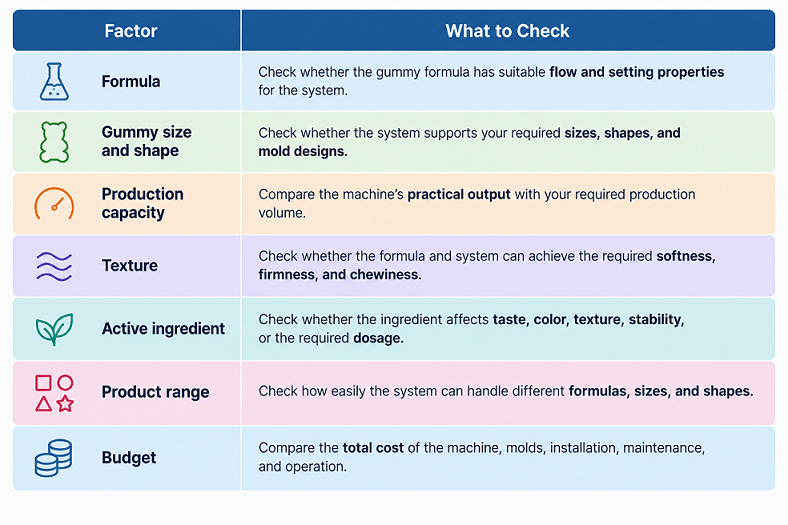
The decision should not be based only on the starchless feature. Before choosing starchless gummy production, manufacturers should check the product, production needs, and total cost. The following factors can help narrow down the right option.
- Formula. Different formulas may require different production settings. You’d better choose a gummy making machine that can handle the formula well.
- Gummy size and shape. Simple shapes are easier to produce, while larger or more complex gummies may need more careful setup and mould design.
- Production capacity. If you plan to make large volumes, the machine should support stable and efficient output over long runs.
- Texture. It is one of the most important parts of a gummy. The production should keep the final product soft and chewy.
- Active ingredient. If your gummies contain active ingredients like vitamins, the manufacturing process should be suitable for these ingredients and helps maintain their quality.
- Product range. Some manufacturers use a machine for one product only, while others want more flexibility. It is worth checking whether the line can support different product types in the future.
- Budget. The right choice is not always the most expensive one. It is better to find a solution that fits both your production needs and your budget.
You can check the table below to have a better understanding.