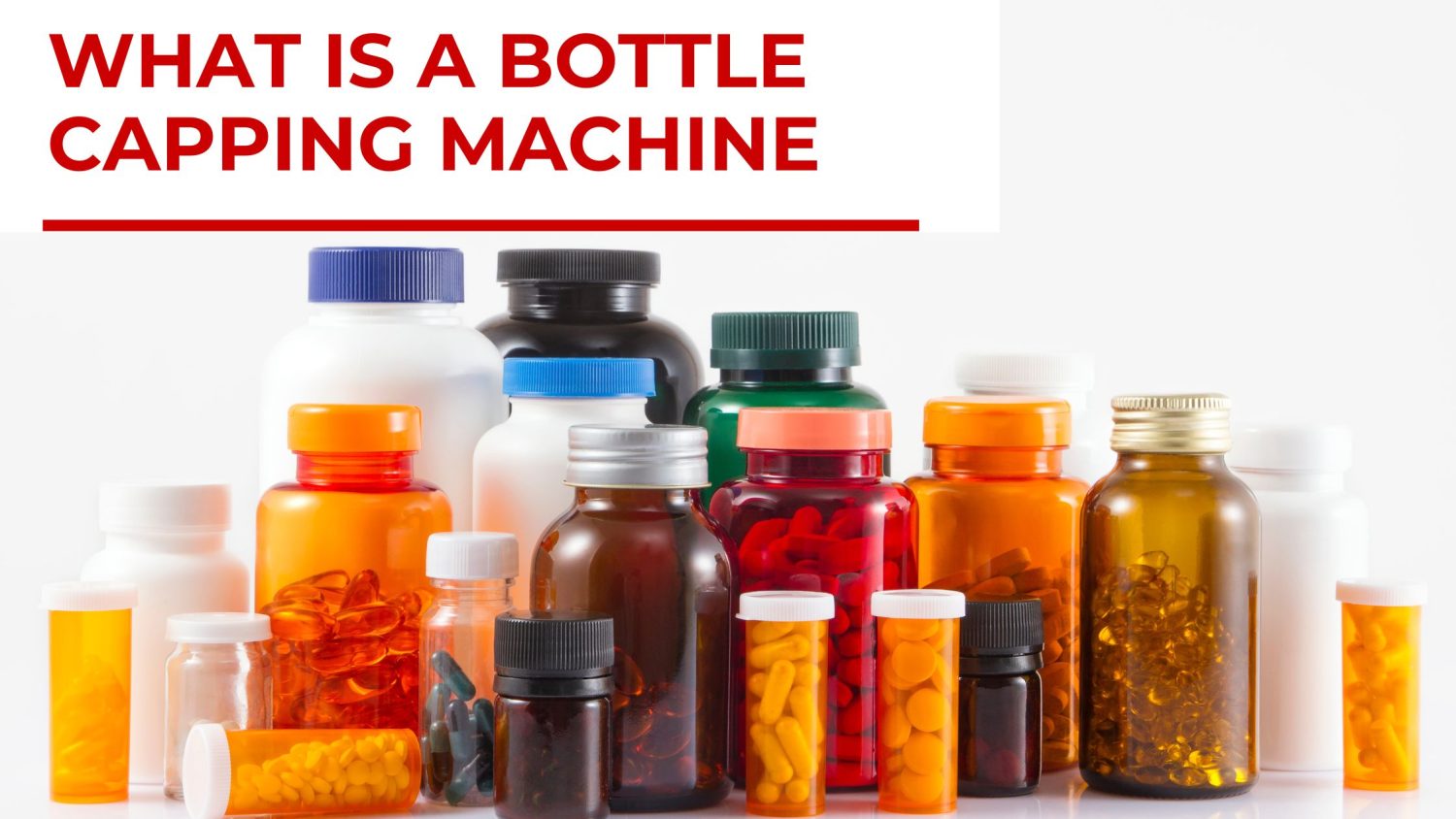
Whether you manufacture vitamins, medicines, or other products sold in bottles, secure capping is an essential part of the packaging process. As the demand grows, bottle capping machines are becoming popular. Compared to manual capping, they are more reliable and efficient. In this guide, you’ll learn what a bottle capping machine is, how it works, the common types available, and the key factors to consider before purchasing one.
What Is a Bottle Capping Machine?
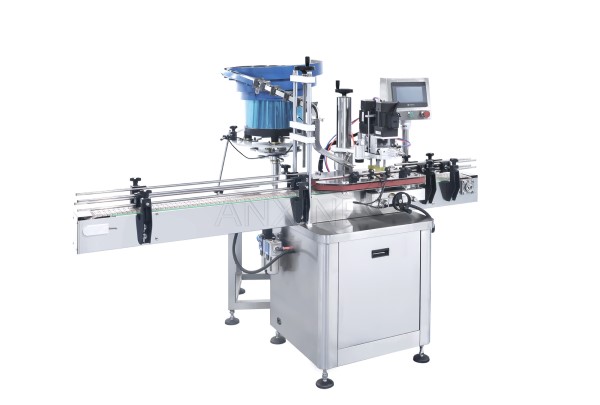
A bottle capping machine is used to place and tightens caps onto filled bottles. Each cap is applied with consistent force and then creates a secure closure. It prevents leaks, contamination, and product damage during storage and transportation.
Depending on the application, bottle capping machines can handle different bottle materials, such as plastic, glass, and metal containers. Moreover, various cap types are supported, such as screw caps, press-on caps and pump caps. Because of the easy using and importance, Bottle capping machines are widely used in areas, such as
- Food and beverages.
- Pharmaceutical products.
- Cosmetics area.
- Chemicals products.
- Nutritional supplements.
- Household products.
Bottle capping machines are available in manual, semi-automatic, and fully automatic models. Fully automatic capping machines feature the highest efficiency and price, suitable for large factories. The other two types are more ideal for small businesses or manufacturers who have a limited budget.
Advantages of Bottle Capping Machines
Bottle cappers offer many benefits during production. They support
- Higher production efficiency. A bottle capping machine can handle hundreds or even thousands of bottles per hour. You can choose one based on your production needs.
- Consistent capping quality. The machine applies each cap with consistent torque. It reduces the risk of loose, over-tightened, or crooked caps.
- Different bottles and caps. Many bottle capping machines can handle a wide range of bottle sizes, shapes, and cap types. With flexible adjustments, the same machine can be used for multiple products.
How Does a Bottle Capping Machine Work?
For semi-automatic bottle capping machines, they automate only the cap tightening process. Bottle loading, cap placement, and bottle removal are finished by operators. They also require manual check whether the caps are sealed tightly. Compared to automatic types, semi-automatic bottle cappers need more human effort. You may check the video to see how they work.
Fully automatic models have a higher automation level. They complete the whole process from bottle feeding, cap tightening to product discharge. They could be integrated into a production line. These machines are always installed after the bottle filling machines. As filled bottles move along a conveyor, the machine feeds caps automatically, places them onto the bottle openings, and tightens or seals them with the appropriate capping method. Here are the detailed steps.
Step 1: Bottle enters the machine.
Filled bottles arrive from the filling machine on a conveyor. Guide rails keep the bottles aligned and orderly before they enter the capping station.
Step 2: Caps are fed automatically.
The operator puts the caps into the hopper. They are separated and oriented in the correct direction. The machine supports vibratory sorting and centrifugal sorting. The former is suitable for caps with complex designs. Centrifugal sorters are widely used for high-speed beverage production. In some models, a cap elevator is used for fast and continuous production.
Then, caps are delivered one by one to the capping head.
Step 3: Caps are placed on the bottles.
The machine puts one cap directly above each bottle. Depending on the machine type, the cap may
- Drop onto the bottle by gravity.
- Be picked up by the capping head and placed on the bottle.
- Be held in position while the bottle moves underneath.
At this stage, the cap is only loosely resting on the bottle and it has not been tightened.
Step 4: Caps are tightened.
Next, the capping head applies force to secure the cap. There are many capping methods.
- Screw capping machines rotate the cap until it reaches the preset torque.
- Press-on capping models press the cap firmly onto the bottle.
- ROPP capping equipment rolls metal threads around the bottle neck to form a tamper-evident seal.
- Snap capping machines push snap-fit caps into place until they lock.
Many modern capping machines are equipped with a torque control system. It ensures every cap is tightened consistently without being too loose or too tight.
Step 5: The capped bottles leave the machine.
After capping, the capped bottles move to the next process, such as induction sealing, labeling, coding, or cartoning. If a cap is missing or incorrectly applied, some models automatically reject the bottle before it reaches the next process.
Here is a video to show you how an automatic capping machine works.
Six Main Types of Bottle Capping Machines
Bottle capping equipment could be divided based on different classifications, such as closure methods, cap styles and sealing process.
Spindle Capping Machines
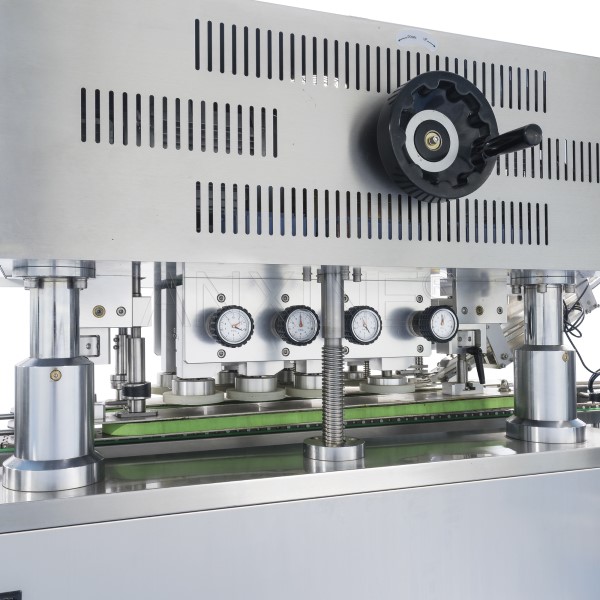
A spindle capping machine is designed to seal screw-on caps. It uses several pairs of rotating rubber spindle wheels to tighten screw caps. After the cap is placed on the bottle, side gripping belts hold the bottle securely as it moves through the machine. Several pairs of rotating spindle wheels then grip the sides of the cap and gradually tighten it until the desired torque is reached.
Spindle capping machines are suitable for closures that can be gripped from the sides. The spindle wheels contact only the lower portion of the cap. So, they can easily handle pump dispensers, trigger sprayers, flip-top caps, and other closures with irregular upper shapes. However, very small, lightweight, or unstable containers may require additional bottle stabilization during capping.
Most spindle cappers are designed as continuous inline machines. This design makes them ideal for medium and high-speed production lines. Another advantage is flexibility. By adjusting the spindle wheels and guide rails, the same machine can often handle different bottle sizes and cap styles.
Chuck Capping Machines
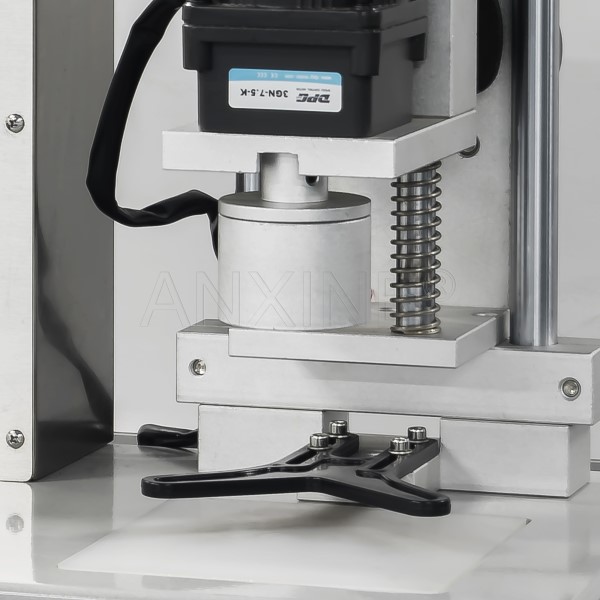
A chuck capping machine is equipped with a capping head. The head moves down onto the cap, grips it securely, and rotates it until the preset torque is reached. They are also designed for screw-up caps. Because the chuck applies force evenly around the cap, it provides more accurate torque control than spindle capping systems.
Chuck cappers are available in both inline and rotary configurations. Inline machines typically use one or two capping heads for low to medium-speed production. Rotary machines feature multiple capping heads mounted on a rotating turret for high-speed operation. Different chuck designs can also be replaced to fit various cap sizes and closure types.
Chuck capping machines are commonly used for bottles that require precise positioning during capping. The bottle is usually indexed by a star wheel before the chuck lowers onto the cap. It makes this type ideal for small, lightweight, or unstable containers. Because the chuck grips the entire circumference of the cap, it delivers highly consistent torque. They can handle screw caps, child-resistant closures, and other flat caps. But chuck cappers require a higher initial cost.
Snap-on Capping Machines
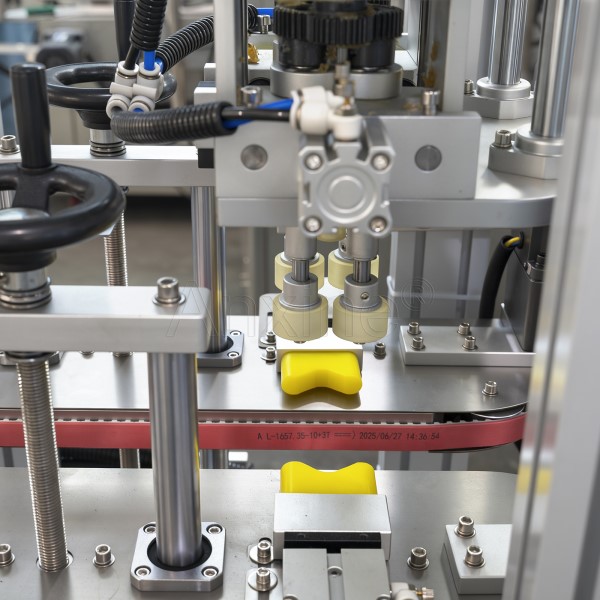
This type applies caps by pressing them vertically onto the container. The capping head aligns the closure with the bottle opening and applies downward force until the locking mechanism engages. This process could be driven by a pneumatic or servo system. Since it doesn’t twist, the capping process is fast and simple. The key performance factor is how accurately the machine can apply a vertical pressing force and how consistent that force is each time. For common plastic snap-on caps or metal crown caps, the pressing force may be within the 500-1,500 N in some machine configurations. The exact force should be confirmed through cap samples, bottle material, closure design, and supplier testing. Excessive force may deform the container, while insufficient force may cause poor locking.
Most snap-on cappers are built as inline machines. They can be equipped with one or multiple pressing heads, depending on the required production speed. They are designed for press-fit and snap-on closures. Common types include flip-top caps, overcaps, measuring caps, and dispensing closures.
The three types above are divided according to how caps are applied on the bottles. You can check the chart to see their differences.
| Feature | Spindle capper | Chuck capper | Snap-on capper |
|---|---|---|---|
| Working principle | Rotating rubber wheels tighten the cap from the sides. | The chuck head lowers and grips the top of the cap, then rotates. | Vertical pressure pushes the cap until it locks. |
| Application | Screw caps, pump, trigger sprayers, flip-top | Screw caps, flat caps, vials | Snap-on, press-fit, overcaps |
| Torque control | Medium accuracy | High accuracy | No torque control |
| Changeover | Fast | Slower | Fast |
| Bottle types | Medium to large bottles | Small, lightweight, or high-precision bottles | Cosmetic jars, and non-threaded containers |
ROPP Capping Machines
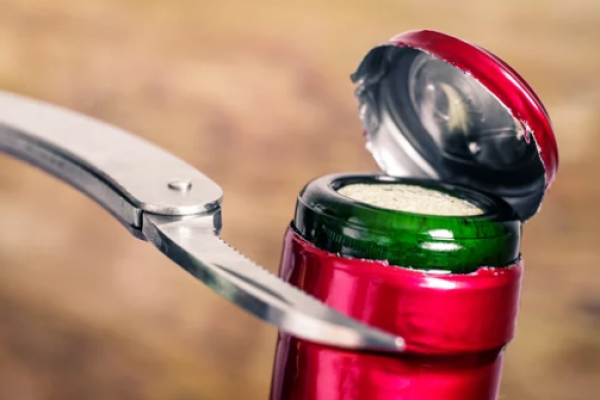
ROPP capping machines stand for Roll-On Pilfer-Proof cappers. They are designed to seal aluminum ROPP closures, a type of screw caps. Unlike standard screw caps, ROPP caps have a smooth inner surface with no pre-formed threads. Most industrial ROPP cappers use a four-roller capping head. During the capping process, the machine first presses the cap onto the bottle neck, and then several hardened rollers shape the aluminum around the bottle finish. The rollers simultaneously form the cap threads and the tamper-evident band.
Many ROPP capping machines support adjusting the forming pressure and roller position. Then they can handle different cap sizes, aluminum thickness, bottle finish, and container material. ROPP cappers are commonly used for wine, liquor, olive oil, pharmaceutical syrups, and specialty chemicals packaged in glass bottles. They offer an attractive tamper-evident closure with excellent sealing quality.
Lug Capping Machines
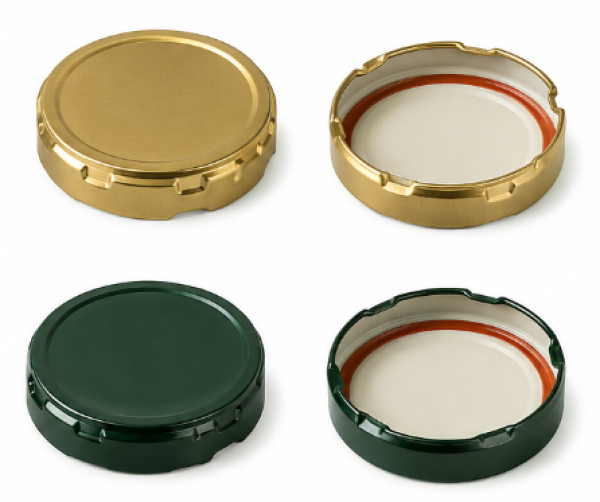
Lug capping machines are designed for twist-off lug caps. These caps feature several short locking lugs instead of continuous threads. During operation, the machine places the cap onto the jar and rotates it only a small angle. Then, the lugs engage with the matching glass finish. Accurate torque control is essential for a proper seal without damaging the closure.
Most lug cappers are integrated into hot-filling or vacuum packaging lines. They are commonly used for jams, pasta sauces, salsa, pickled vegetables, baby food,etc. They could provide a good tamper-evident seal and operate well with vacuum packaging.
Lug capper and ROPP cappers are classified based on the closure types. They have many differences you need to notice.
| Feature | Lug capper | ROPP capper |
|---|---|---|
| Closure type | Pre-threaded lug (twist-off) caps | Smooth aluminum ROPP caps |
| Working principle | Chuck capping | roller-forming head |
| Cap material | Usually tinplate or steel | Aluminum |
| Application | Jams, sauces, pickles, baby food | Wine, spirits, olive oil, pharmaceutical syrups |
Vacuum Capping Machines

Vacuum sealing is a common technology used in capping equipment. It keeps product fresh and prevents bacteria from growing. Vacuum capping machines are then widely used. They remove air from the container during the cap tightening process. So, negative pressure could be created inside the package. Based on the design, the bottle can enter a sealed vacuum chamber. Or vacuum may be generated directly around the bottle neck during capping. The cap is tightened while the vacuum is maintained. It makes a high-quality vacuum seal after the bottle leaves the machine.
Vacuum cappers have semi-automatic and fully automatic systems. They are often integrated with hot-filling lines for glass jars. Many models also combine vacuum generation, capping, and torque control into a single operation. This type is mainly used for jams, honey, sauces, and pickles to keep flavor and quality.
How to Choose the Right Capping Machine?
A suitable capping machine is important for packaging quality, compliance, and production efficiency. You may need to consider the following factors when purchasing.
Compatibility
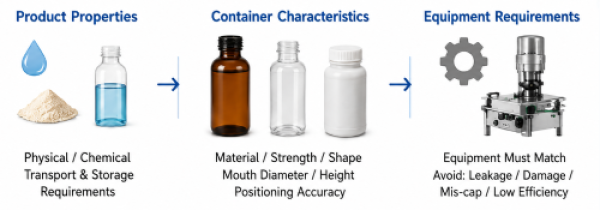
Products have different transportation and storage requirements. They directly affect the choice of packaging and closure types. Key parameters you should notice include bottle mouth diameter range, height, and positioning accuracy. In most cases, a practical reference target is to keep bottle positioning deviation within about ±0.5 mm. However, this is only a reference value, not a universal industry standard. The actual positioning tolerance depends on factors such as the bottle shape, cap type, the accuracy of the star wheel and guide rails, and the capping method used.
Meanwhile, the operating mode of the equipment must fully match these characteristics. Otherwise, it will lead to packaging defects or reduced production efficiency.
Capacity
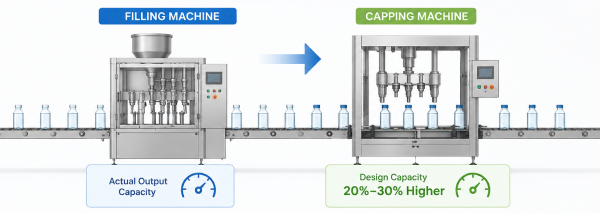
It must match your required output. A proper match is helpful for efficient production. If the capping machine is integrated into a production line, its design capacity should be 20%–30% higher than the actual output capacity of the upstream filling machine. This is used to reduce efficiency losses in the capping stage caused by various issues, such as abnormal cap feeding. However, the final capacity margin should be confirmed based on line layout, product changeover frequency, and supplier recommendations.
Purchase and Operation Cost
Before ordering, you need to consider the total cost of ownership (TCO). It includes machine price, operation and maintenance cost, downtime cost and technical support. Then you compare it with your budget and know which machine suits you better. Here is a chart about machine type, price and application for your reference.
| Type | Estimated price range | Typical capacity | Common applications |
|---|---|---|---|
| Tabletop semi-automatic cap screwing machine | $300 – $2500 | 600-1800 bottles/h | Small to medium factories |
| Fully automatic standalone cap machine | $3,900- $8,200 | 2400-6000 bottles/h | Medium to large factories |
| Fully automatic cap machine for pump heads | $8900 – $13600 | 1800-4500 bottles/h | Mid-to-high-end cosmetics factories |
| Automatic integrated bottle filling and capping machine | $19000 – $31000 | 3000-8000 bottles/h | Fully automatic production lines |
The price of a bottle capping machine can vary greatly depending on the level of automation, production capacity, machine materials, electrical components, and customization requirements. For example, machines made with higher-grade stainless steel, vision inspection or automatic cap elevators usually cost more. The table above just offers a rough reference range for common capping machine types. The actual quotation should be confirmed with your supplier.
Industry Compliance

Industries such as food and pharmaceuticals have mandatory requirements for packaging safety. The design and manufacturing of capping machines must meet the certification standards of the target market. These include GMP standards, FDA regulation in the US, and CE requirements in the EU. They are necessary conditions for the equipment to be manufacturered and enter the intended market.
The End
As the capping machines are becoming more important, a good selection is important. It helps you improve sealing quality, reduce downtime, and lower maintenance costs. If you’re unsure which capping machine best fits your application, our team can help. Feel free to contact us.


