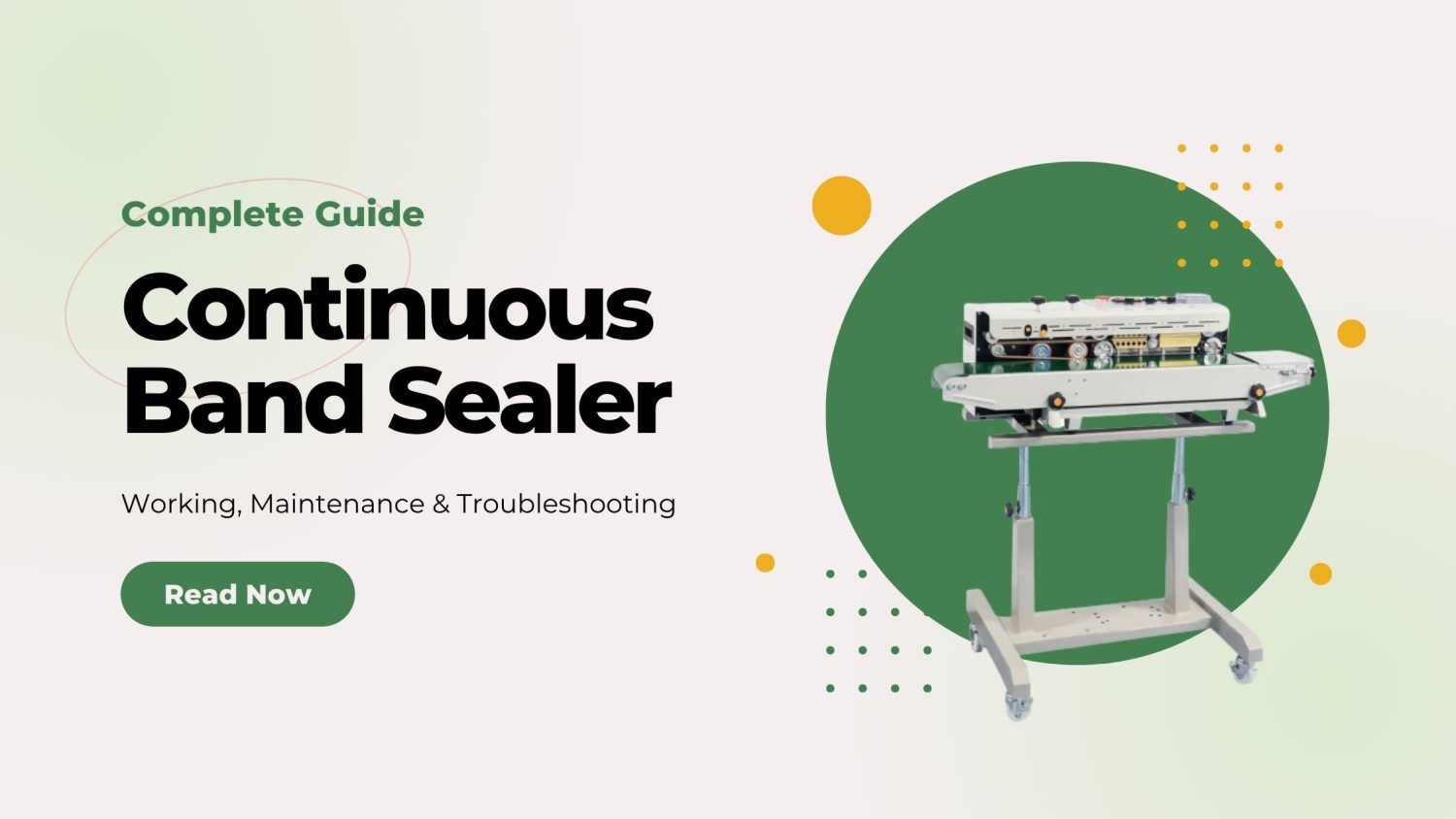
Heat sealing plays a key role in different packaging production. It creates a clean and strong seal for packaging. Continuous band sealers are common machines used in heat sealing. They are popular because of many advantages like good price and easy use. This article helps you have a comprehensive understanding of continuous band sealers.
What Is A Continuous Band Sealer?
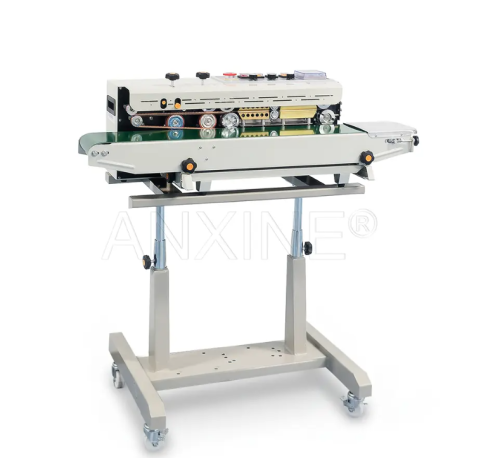
A continuous band sealer is a machine used to seal bags or pouches in a continuous process. It uses heat and pressure to seal thermoplastic packaging materials together. Most continuous band sealers use constant heat sealing. The heating system could keep a set temperature as required during operation. It is suitable for many common packaging materials such as PE, PP, and laminated films. For pouch types, the machine could be used for plastic bags, laminated pouches, aluminum foil bags, sachets, etc.
Advantages of Continuous Band Sealers
A continuous band sealer greatly improves packaging efficiency and seal quality. Compared with manual sealing, it can work faster and produce more consistent seals. It also reduces labor costs and supports continuous production lines.
Meanwhile, a continuous band sealer could protect products from moisture, dust, air, and other contamination. A proper seal can also extend product shelf life and improve transportation safety. Some machines include extra functions such as date coding, embossing, air evacuation to meet different production needs.
Application of Continuous Band Sealers
Continuous band sealers are used in many industries. Here are some examples.
- Food industry. Food needs to maintain freshness and be kept from moisture or air. So the machine is widely used in packing snacks, coffee, spices, tea, sauce, etc.
- Pharma production. Continuous band sealers are used for medicine pouches, medical supplies, health supplements, and powder packaging.
- Chemical industry. Chemical manufacturers use the machines to pack powders, granules, detergents, fertilizers, and industrial materials.
- Cosmetic area. Products include facial mask, cream, lotion, oil, etc.
How Do the Continuous Band Sealers Work?
The sealer is operated easily. You can check the video to see how it works.
Bag Feeding
The filled bag is placed into the machine entrance. When the machine starts, the bag would be transferred automatically. So you need to make sure the bag opening is clamped correctly with the entrance.
Bag Transferred
The belts grip the bag and move it through the machine automatically. This continuous movement allows the machine to seal many bags without stopping.
Heating Stage
The bag opening passes through heated sealing blocks or heating bars. The heat softens the packaging material. Different materials require different sealing temperatures.
Pressure Application
While the material is heated, the sealing belts apply pressure to press the materials together. Heat and pressure are used together to form the seal.
Cooling
After heating and pressing, the sealed area moves through cooling blocks. Cooling makes the seal firmer and more stable.
Discharge
The sealed bag exits the machine automatically. Some continuous band sealers also include optional functions such as date printing, embossing, air evacuation, or gas flushing for special packaging needs.
How to Clean and Maintain the Band Sealing Machines?
During use, regular cleaning and maintenance are necessary. It makes the machine run smoothly and reduces downtime. Regular maintenance can also improve sealing quality and extend machine service life.
Daily Cleaning
After production, the machine surface should be cleaned to remove dust and residue. The sealing belts, heating blocks, and conveyor area should be checked carefully. Because melted film or dirt may stick to these parts during operation. You can use a soft cloth to wipe the belts. Sharp tools should not be used. They may scratch or damage the belt surface. Please note that the machine should be turned off and cooled down before cleaning. If not, the safety risks are increased.
Key Part Inspection
The key parts require regular checks for stable filling. They include sealing belts, heating blocks, cooling fan, cooling blocks, etc. Some of them directly influence sealing quality and strength. Different parts need to be checked for different aspects and inspection frequency. You can check the chart to get more information.
| Parts | What to Check | Inspection Frequency |
|---|---|---|
| Sealing belts | Belt surface, tension, and tracking condition. | Visual check: every day.
Tension/tracking: every week. |
| Heating blocks | Surface cleanliness, heating stability, and gap adjustment. | Temperature/surface: every day.
Gap check: every week. |
| Cooling blocks | Cooling condition and surface cleanliness. | Every month |
| Cooling fan | Fan operation and dust buildup. | Every week |
| Conveyor belt | Belt alignment, tension, and smooth movement. | Tension/tracking: every week.
Wear check: every month. |
| Rollers and moving parts | Rotation condition, looseness, and abnormal noise. | Loose screw check: every day.
Wear inspection: every month. |
| Springs and adjustment screws | Tightness and adjustment condition. | Every month |
| Electrical components | Wires, switches, temperature controller | Visual inspection: every week
Professional inspection: every 3–6 months |
How to Troubleshoot the Band Sealer?
In production, you may find some problems with parts or sealing quality. Some of these issues could be solved by yourself. Take the Anxine model CFR-900V for example.
| Faults | Causes | Solutions |
|---|---|---|
| Off tracking of
sealing |
The driving wheel and driven wheels are unparalleled. | Adjust the two screws of the driven wheel until they are not off tracking. |
| Sealing belts break
Easily. |
Sealing belts are too tight. | Adjust the longitudinal adjusting screw of the driven wheel seat. The sealing belt should not be too tight or too loose. |
| Sealing belts are
adhered to film or other Dirt. |
Clear away the adhesive materials and dirt on the surface of sealing belts in time. | |
| Sealing belts have folding
Mark. |
Adjust or change, the sealing belts cannot have a folding mark. | |
| Embossing is not
Clear. |
Embossing wheel seat
pressure spring is not Impacted. |
Adjust the embossing wheel seat
pressure spring. |
| Sealing belts have
resistance during Transporting. |
The distance between heating blocks or cooling blocks is too small, and the friction is too high. | Adjust the gap between cooling blocks or heating blocks to a suitable space. |
| Conveyor belt and
sealing belt out of Sync. |
The conveyor is not tensioning. | Properly tension the driving roller shaft and intermediate shaft conveyor belt to make it entirely touch with idler wheel. |
How to Choose a Suitable Band Sealer for Your Business?
There are many factors you should consider when selecting a continuous band sealer. A suitable machine can improve sealing quality and benefit from long-term operation.
Packaging Material

Different bag materials require different sealing temperatures and pressure conditions. Before choosing a machine, it is important to confirm whether it can seal your packaging material properly. For example, if you only seal thin PE snack bags, a small tabletop band sealer is usually enough. If you seal thick coffee bags with aluminum foil layers, a machine with stronger heating power and better cooling performance is more suitable.
Bag Size
Bag dimensions affect machine selection. The sealing width, conveyor size, and machine structure should match your package size. Each model always has a production range. The Anxine CFR-900 model could handle sealing widths from 6 mm to 14 mm, and the single-layer film thickness is from 0.03 to 0.8 mm. For the LF1080 model, the sealing width is from 6 to 12 mm, and the max thickness of a single-layer film is ≤ 0.08 mm. So you need to have a clear understanding of the bag size that the band sealer can process. Otherwise, it may delay your production. Therefore, we strongly recommend providing sample bags for testing during the inquiry stage to ensure perfect compatibility.
Sealing Speed
Sealing speed should match your actual production capacity. A machine that is too slow may reduce production efficiency. In addition, machine speed should also match bag material thickness, sealing temperature, conveyor stability and upstream filling speed.
Please note that higher speed is not always better. If the speed is too high, the seal may become weak, wrinkled, or incomplete. So a suitable sealing speed is important. Take the CFR-900 model, for example. The max sealing speed is 12 m/min, ideal for small to medium businesses. If you need higher efficiency for a large factory, other types may be better.
The End
You must have a clear understanding of continuous band sealers and know how to choose a good one. If you find it difficult to contact a reliable supplier, Anxine is a good partner. We offer different types of band sealers to meet diverse production needs. If you have any questions, feel free to contact us.


