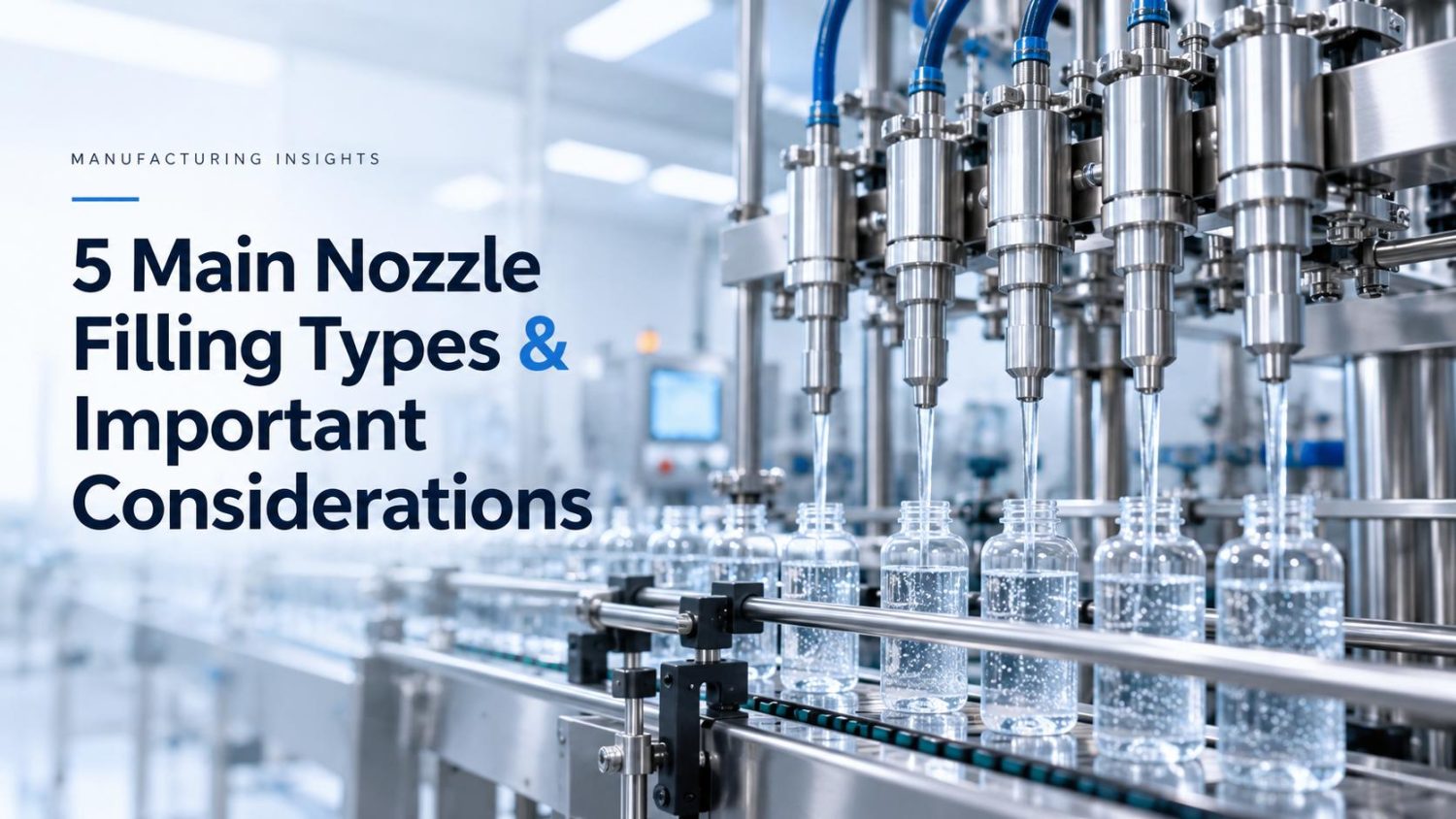
In any liquid filling process, the nozzle is a must-have part. It directly controls how product flows into each container and influences the filling accuracy. Different liquids behave in different ways. Some flow like water, while others are thick, sticky or foamy. A single nozzle design cannot handle all these liquid types efficiently. That is why filling machines are equipped with different nozzle types. Each is designed for a specific purpose and production batch. If you use liquid filling machines, it is necessary to understand the different types of filling nozzles.
What is a filling nozzle designed for?
A filling machine nozzle is a precision-engineered outlet in the liquid filling machine. It controls the discharge of liquid or semi-liquid products into a container during the filling process. It is designed for controlled flow, accurate dosing, and clean production without unnecessary waste or contamination.
In most filling systems, the nozzle is connected to a dosing unit, such as a piston pump or pressure tank. Once the filling cycle starts, the nozzle opens and controls how the product is released into the container. Because different liquids have different physical properties, like viscosity, the nozzle should be designed to handle these variations while maintaining consistent performance.
Main functions
In the liquid or cream filling machines, nozzles are used to
- Dispense product accurately. Every bottle or package receives the correct volume or weight according to the preset filling parameters.
- Control flow rate. The nozzles determine how fast or slow the product enters the container. Proper flow control is especially important for high-speed production lines. Otherwise, it may lead to overflow, underfill, or product loss.
- Reduce dripping. It prevents product waste, contamination on the container exterior, and unstable packaging quality.
- Prevent foaming and splashing. The nozzles guide the liquid gently into the container for both good appearance and accuracy.
Five common types of filling nozzles by structure and function
Different structures and functions are important classification types for nozzles. Here are common examples for your reference.
Straight through nozzles
Straight nozzles are also called open nozzles. They are the simplest and most widely used type of filling machine nozzle. This type has a straight passage from the product inlet to the outlet. It does not contain any internal valve or shut-off mechanism. During the filling process, the product flows directly through the nozzle into the container. Once the filling system stops liquid from flowing, the flow ends naturally. The Anxine automatic vial filler CGZ-20 adopts this nozzle type. You can check the video to see how it works.
Features: open nozzles feature a simple structure and low manufacturing cost. Since there are no internal valves, there are fewer components that require replacement. This also reduces maintenance costs and minimizes machine downtime. However, after the filling ends, a small amount of liquid may continue to flow from the nozzle. This can cause dripping. It leads to product waste and leaves residue on the outside of containers.
Applications: open nozzles are mainly used for thin and free-flowing liquids that do not require special filling techniques. Typical applications include water, alcohol, cleaning solvents, liquid chemicals, etc. They are not suitable for foamy, sticky, or highly viscous products. These materials are more likely to splash, string, or drip during filling.
Positive shut-off nozzle
This type is designed to provide an anti-drip function. It uses an internal sealing mechanism to completely stop product flow when the filling cycle ends. Unlike an open nozzle, a positive shut-off nozzle actively closes the product outlet with a valve. This creates a tight seal that prevents liquid from continuing to flow after filling. Because the outlet is sealed, these nozzles provide much better control over the filling process. They also greatly reduce dripping, stringing, and product waste. Here is a video about how the liquid filler with positive shut-off nozzles works.
Features: depending on how the outlet is sealed, positive shut-off nozzles can use different valve designs and actuation methods. The most common types include needle valve nozzles, poppet valve nozzles, pneumatic shut-off nozzles, and spring-loaded shut-off nozzles. They could close the nozzle outlet completely before the next filling cycle begins.
Applications: positive shut-off nozzles are widely used for products that require clean filling or high accuracy. They are especially suitable for medium- and high-viscosity liquids, sticky products and high-speed production. In these cases, even a small amount of dripping can affect product quality.
Rotary valve nozzle
A rotary valve nozzle uses a rotating valve mechanism to control liquid flow. Inside the nozzle, a rotary valve core turns to open or block the liquid passage. When the valve passage is aligned, the liquid flows through the nozzle for filling. When the valve rotates to the closed position, the flow path is blocked and the liquid stops.
Features: a rotary nozzle controls flow through rotary movement instead of linear movement. It can provide accurate flow control and reduce dripping. Therefore, some rotary valve nozzles can be considered a type of positive shut-off nozzle. But the classification depends on the specific valve design and application.
Applications: Depending on the valve design, sealing structure and sanitary requirements, it can be used for some medium- to high-viscosity products that require clean and stable filling, such as syrups, creams, lotions and sauces. that require clean and stable filling. Examples include syrups, creams, lotions, sauces, etc.
Diving nozzle
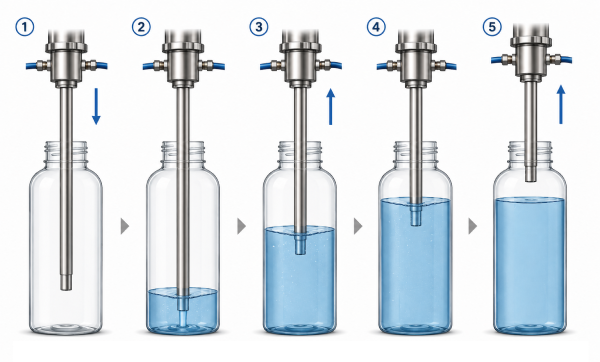
Diving nozzles have different filling methods from other types. They perform bottom-up filling to reduce foam. It is designed to enter the container during the filling process. At the start of each cycle, the nozzle moves downward into the empty or partially filled container, positioning its outlet close to the bottom. As liquid is dispensed, the nozzle gradually rises simultaneously with the filling level. This keeps the nozzle outlet below the liquid surface throughout most of the process. It greatly reduces foam generation, splashing, and air entrapment.
Features: The liquid is delivered directly into the lower portion of the container instead of dropping. So, the flow could remain smoother and more controlled. This can reduce foam, splashing and air entrapment to maintain more consistent fills. The final volumetric accuracy still depends on the dosing system and machine settings.
Applications: This type of nozzle is commonly used for viscous or foaming liquids such as shampoo, liquid detergent, hand soap, etc.
Overflow nozzle
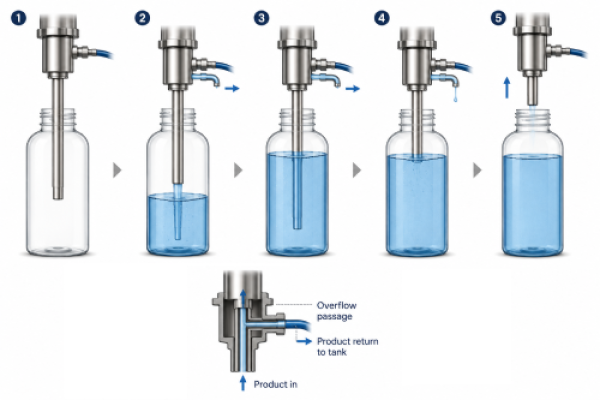
An overflow nozzle is designed for filling level control. It fills containers to a consistent liquid level rather than a precise volume. During the filling process, the nozzle is inserted into the container and begins dispensing the product. Once the preset level is reached, any excess product is returned to the supply tank through the overflow passage. After the liquid level stabilizes, the product flow stops and the nozzle moves to the next container.
Features: overflow nozzles produce a uniform fill level across all containers rather than a precise volume. They are suitable for handling free-flowing and low-viscosity liquids.
Applications: Typical products include bottled water, fruit juice, shampoo, mouthwash, glass cleaners, and other thin liquids packaged in transparent containers. Higher-viscosity products like shampoo require testing before working with an overflow nozzle.
You can check the table to see their main differences.
| Nozzle type | Working principle | Advantages | Limitations | Applications |
|---|---|---|---|---|
| Straight through (open) nozzle | Liquid flows directly through an open passage without a shut-off valve. | Simple structure, low cost, easy maintenance. | It may cause dripping, not suitable for foaming or viscous liquids. | Water, alcohol, solvents, thin chemicals. |
| Positive shut-off nozzle | The internal valve closes the outlet to stop liquid flow after filling. | It prevents dripping, and improves accuracy. | Higher cost and more complex maintenance. | Pharmaceutical liquids, cosmetics, viscous and sticky products. |
| Rotary valve nozzle | A rotating valve core opens or blocks the liquid passage. | Accurate flow control | Performance depends on valve design. | Syrups, oral solutions, creams, lotions, sauces. |
| Diving nozzle | The nozzle moves into the container and fills from bottom to top. | It reduces foam, splashing, and air entrapment. | Additional movement control is needed. | Shampoo, detergent, hand soap, foaming liquids. |
| Overflow nozzle | Fills to a set liquid level, with excess liquid returned to the tank. | Consistent fill levels. | Not designed for exact volume filling. | Water, juice, oil, mouthwash, cleaning liquids. |
How to choose a suitable filling nozzle for your production?
A suitable nozzle can improve filling performance and make stable production. There are many factors you need to consider when selecting nozzles for liquid or cream filling.
Product characteristics
The properties of the liquid are the first factor to consider. They require different nozzle designs to achieve smooth and accurate filling. The viscosity of liquids is highly related to the choice.
| Liquid type | Key properties | Recommended nozzle types |
|---|---|---|
| Low-viscosity liquids | roughly 1–100 cP as a reference range, generally free-flowing | Straight through and overflow nozzles |
| Medium-viscosity liquids | roughly 100–10,000 cP as a reference range, with slower flow than water-like liquids. | Positive shut-off or diving nozzles |
| High-viscosity liquids | often above 10,000 cP in many applications, but the exact limit depends on the product and filling process. | Positive shut-off, valve-in-tip or diving nozzles |
Filling accuracy
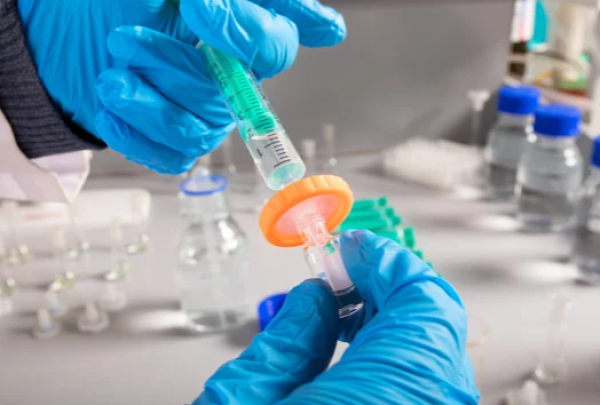
The required filling accuracy directly affects nozzle selection. There is no need to choose the highest-precision nozzle if your application does not require it. Because more precise systems usually cost more and require additional maintenance. Consider the following questions before you choose a nozzle.
- What filling tolerance do you need? Products in the pharmaceutical industry usually require much higher accuracy than household chemicals.
- Will small filling errors increase production costs? Even a small overfill can lead to great product loss over large production volumes.
- Do you need to meet regulatory or quality standards? For example, pharmaceutical filling must follow validated procedures, defined acceptance criteria, batch records and traceability requirements. Variations beyond the approved limits may require further investigation, extra quality checks, or even rejection of the entire batch.
- Does the product continue to drip after filling? If so, a positive shut-off nozzle may be needed to improve filling consistency.
Production speed
Your required output affects both the nozzle type and the number of nozzles on the filling machine. A nozzle that performs well at low speed may not deliver the same results on a high-speed production line. For small batches, single or a few nozzles are enough. For medium or large production, a multi-nozzle filling system is needed.
Container design
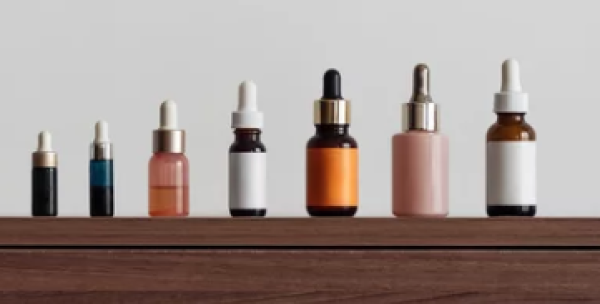
The container shape and opening size should match the nozzle design. A nozzle that works efficiently for a wide-mouth jar may not fit a narrow-neck bottle. Therefore, you should check
- Bottle opening diameter.
- Container height.
- Bottle shape.
- Required fill level.
Then, confirm these parameters with your supplier to see if the nozzle can handle them well. If not suitable, you may need to customize the nozzle type, like diameter or length, to get smooth filling.
Material compatibility
The nozzle material should be compatible with the product being filled. The wrong material may lead to corrosion, contamination, or shorter equipment life. You should check whether the product is
- Corrosive
- Acidic or alkaline
- High-temperature
- Solvent-based
After identifying the product characteristics, you can select nozzle materials that can withstand the product conditions. For example, 316L stainless steel is commonly used for pharmaceutical and food applications because of its corrosion resistance and easy cleaning. For highly corrosive or solvent-based products, additional materials such as PTFE may be required to improve durability and prevent contamination.
Get an efficient filling solution with Anxine
If you don’t know how to choose an ideal nozzle for filling equipment, Anxine could help. We offer a wide range of liquid or cream filling machines with different types of nozzles. Tell us your production details, such as liquid viscosity and filling volume. We can select the most suitable machine quickly to meet your needs.


