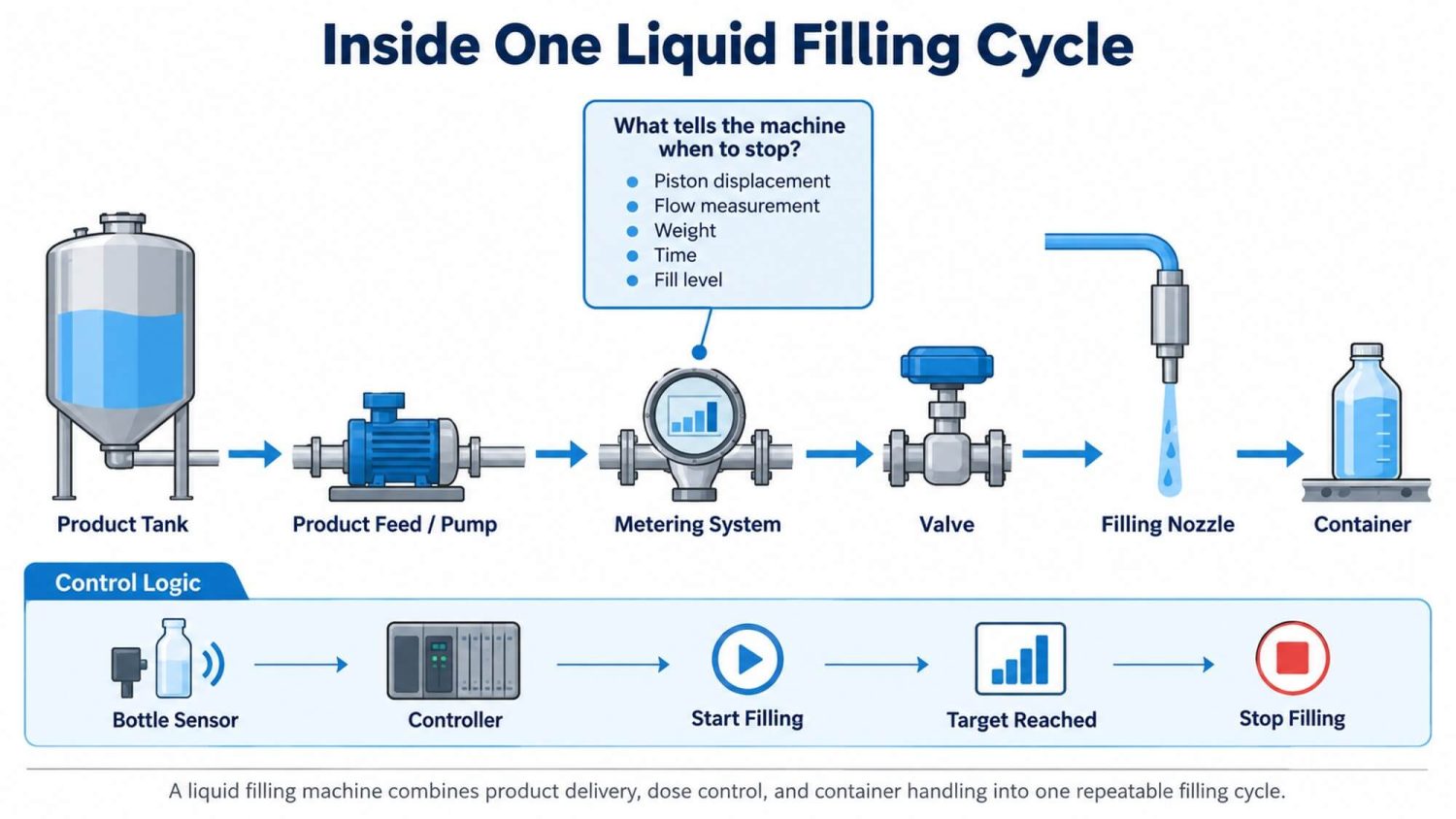
The function of a liquid filling machine is to move the liquid product from a feed tank into containers in controlled doses. In every operating cycle, the machine positions the container, opens the product flow, fills the dose, stops filling, and transfers the filled container to the next station.
The machine’s specific working principle depends upon the method used for dosing the product. A piston system may be used, as well as volume, weight, time, or level-based controls. According to the viscosity of the product being filled and the type of filling system being used, the product can be delivered to the filling nozzle in various ways.
This article describes how a liquid filling machine works from the initial product source to the final filled container and specifies what the machine is precisely controlling at every step of the process.
How a Liquid Filling Machine Controls the Fill Amount
This is the heart of any liquid filling machine working principle. Because various machines control the fill amount in different ways, the fill-end signal is also determined differently for each type.
| Filling principle | What controls the fill amount | When filling stops |
|---|---|---|
| Piston filling | Volume displaced by the piston | The piston finishes its preset stroke |
| Flow-meter filling | Product passing through the flow meter | The measured volume reaches the target |
| Net weight filling | Mass of product as measured by the load cell | The preset net weight is achieved |
| Pump dosing | Movement or pumping cycles of the pump | A pre-programmed volume has been dispensed |
| Timed flow filling | Fill duration | Pre-programmed time has expired |
| Overflow filling | Level of liquid in the container | Liquid reaches the set fill level |
For example, a piston filling machine takes a pre-defined volume of liquid product into a cylinder and displaces the same volume into the container. A flow-meter filling system, on the other hand, uses a meter to monitor the incoming liquid flowing through the filling path. When the required volume has passed through the meter, the filling valve is closed.
In a net-weight filler, the product mass is monitored during the filling process. This means the machine no longer calculates the dosage based on volume or time, but rather relies on weight. The machine’s load cell checks the weight of the product and the flow is stopped when the preset net weight is achieved. In overflow filling, the goal is different. Here, the container is filled up to a reproducible liquid level and any additional product flows back into the product reservoir. In this way, you can maintain a constant fill level, regardless of minor variations in the container itself.
So, two liquid filling machines might appear similar on the outside, but use a completely different signal for completing each fill.
From Product Supply to the Filling Nozzle
When the fill amount is set, the product then needs to travel through the machine in a consistent manner. It usually starts in a storage tank or hopper and goes through the filling system to the nozzle. How the product passes through the system depends primarily on how well it flows.
Moving a Liquid Through the Filling System
Low viscosity liquids can generally flow by gravity or assisted with low pressure. More viscous products typically require a pump or piston to force the product through the filling path.
It’s not necessarily about whether there is a pump. The product supply needs to flow consistently for the filling system to dose properly. If product reaches the system intermittently, the machine will have difficulty repeating the same fill volume every cycle.
Also, product temperature can play a role. A sauce or gel could become significantly easier to pump as the temperature rises and harder to pump as it cools. Even though the fill amount is set, the machine parameters may need to be adjusted if the product becomes significantly more viscous over time.
Regulating Flow at the Nozzle
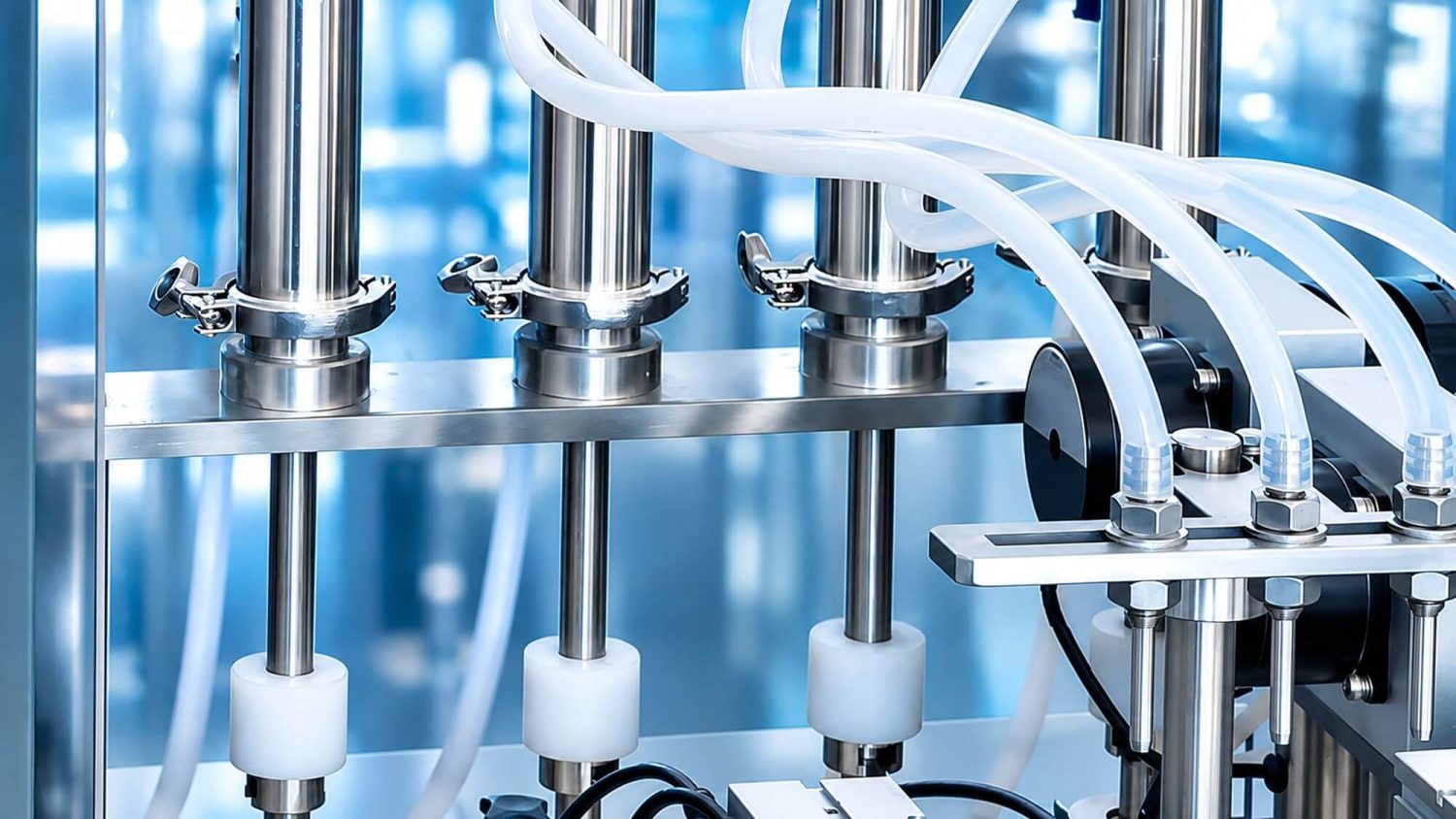
The nozzle controls the last stage of the product pathway, which is the product entering the container.
With free-flowing products, the nozzle typically sits above the container during the filling process. For products prone to foaming, the nozzle may descend into the container and rise as the product level increases, reducing the fall distance of the product.
Lastly, ending the fill process is critical. When the filling system has reached the target fill amount, the flow of product should be terminated. The nozzle may include some type of shutoff or suck-back mechanism that prevents dripping as the product leaves the nozzle to minimize residue left on the container and nozzle for subsequent fills.
How the Machine Coordinates Container Motion and Filling
A liquid filling machine needs to control the sequence of container movement and dosing. The product should not start flowing unless a container is in the filling position, and it should not leave the filling position until the dose is finished.
In most cases, sensors will detect whether a container is present and in the right location. When the appropriate condition is achieved, the control system triggers the filling process. The dosing device then executes the prescribed motion or measurement, whether that’s finishing a piston stroke, achieving a target flow rate, or reaching a set weight.
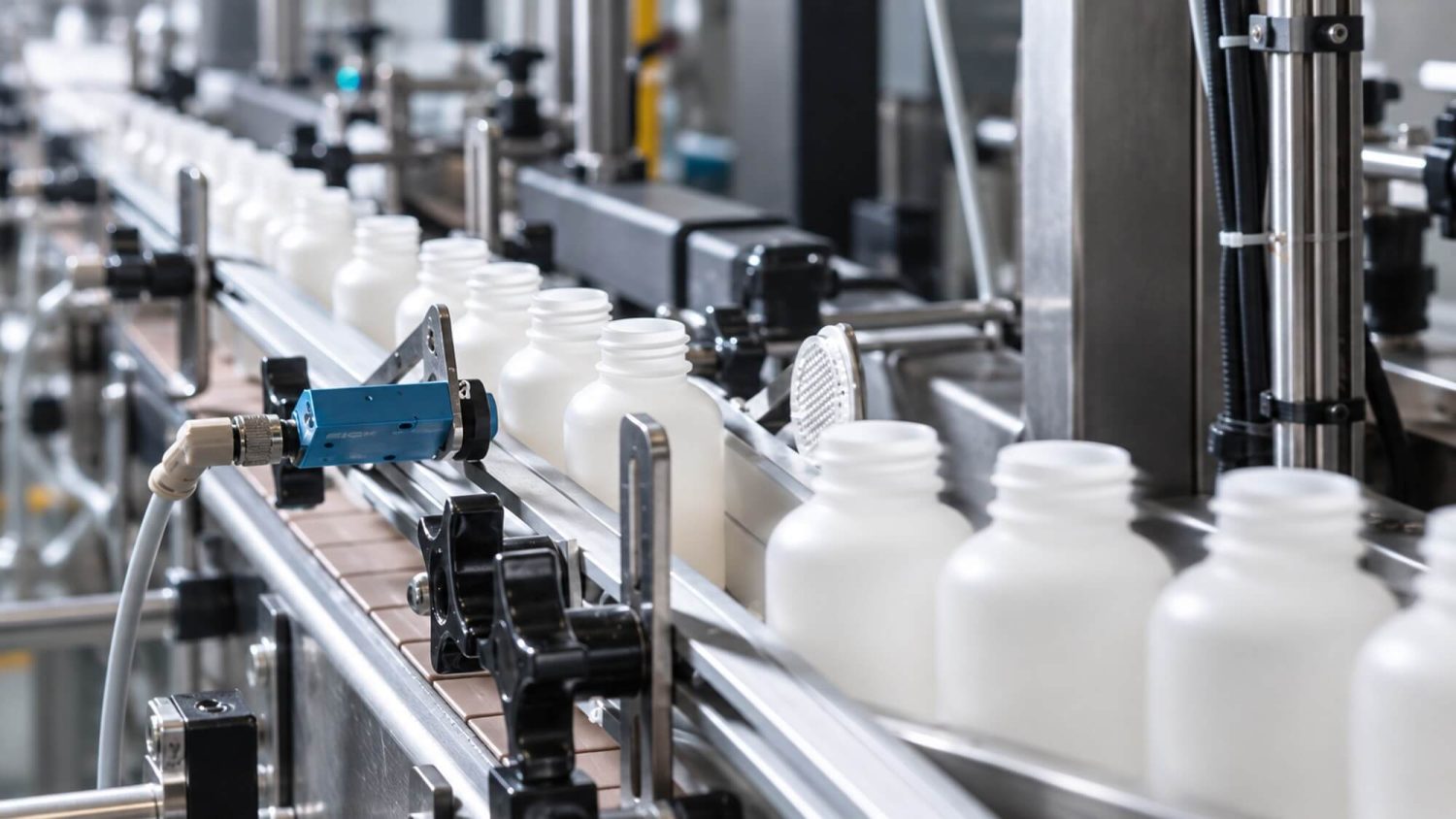
The sequence can also enable basic safeguards such as No Bottle, No Fill. If a container is absent or out of position, the system might prevent that particular filling head from dispensing the product.
On an automatic line, the sequence is continually executed as containers move through the equipment. Consequently, the conveyor, container indexing, and the filling operation must remain synchronized. If containers are present too early, too late, or in the wrong place, the filling process may be deferred or canceled instead of dispensing product into an empty location.
Why Liquid Properties Change the Filling Process
Even though the filling principle remains constant, how the product behaves within the machine might require different parameters to achieve a stable fill. Water-based products move easily through pipes and fill heads, whereas thicker products will flow more slowly and could require more force, a longer cycle time, or a wider product path.
Another major point of variation is foaming. Some liquids trap air easily, and if they are filled too quickly or dispensed from too high of a distance above the vessel, they may foam before reaching the desired volume. This problem could be mitigated by reducing the speed of flow, or by filling from the bottom up.
Temperature can also alter the way a product fills if the viscosity changes due to temperature. A product that flows well when warm might get very thick as it cools over the course of production. Even if the same volume is targeted for filling, the actual flow through the product delivery path will likely change.
Products with pulp or other small suspended particles also present a concern in filling. The product path and fill head opening must have sufficient space to allow passage without impeding flow or getting blocked.
| Product characteristic | What may change during filling |
|---|---|
| Higher viscosity | Slower flow and greater resistance through the filling path |
| Foaming tendency | Lower fill speed or bottom-up filling may be needed |
| Temperature-sensitive viscosity | Flow can change as the product warms or cools |
| Suspended particles | Larger or less restrictive product paths may be required |
What Actually Changes Between Liquid Filling Machines?
Oftentimes, liquid filling machines are referred to by the name of their method of dosing, like piston, gravity, or pump. They may also be described by how the container travels: inline or rotary. Depending on how much of the process requires manual intervention, these machines can also be grouped into manual, semi-auto, or automatic. The nozzle design and how it delivers product into the container is yet another variation.
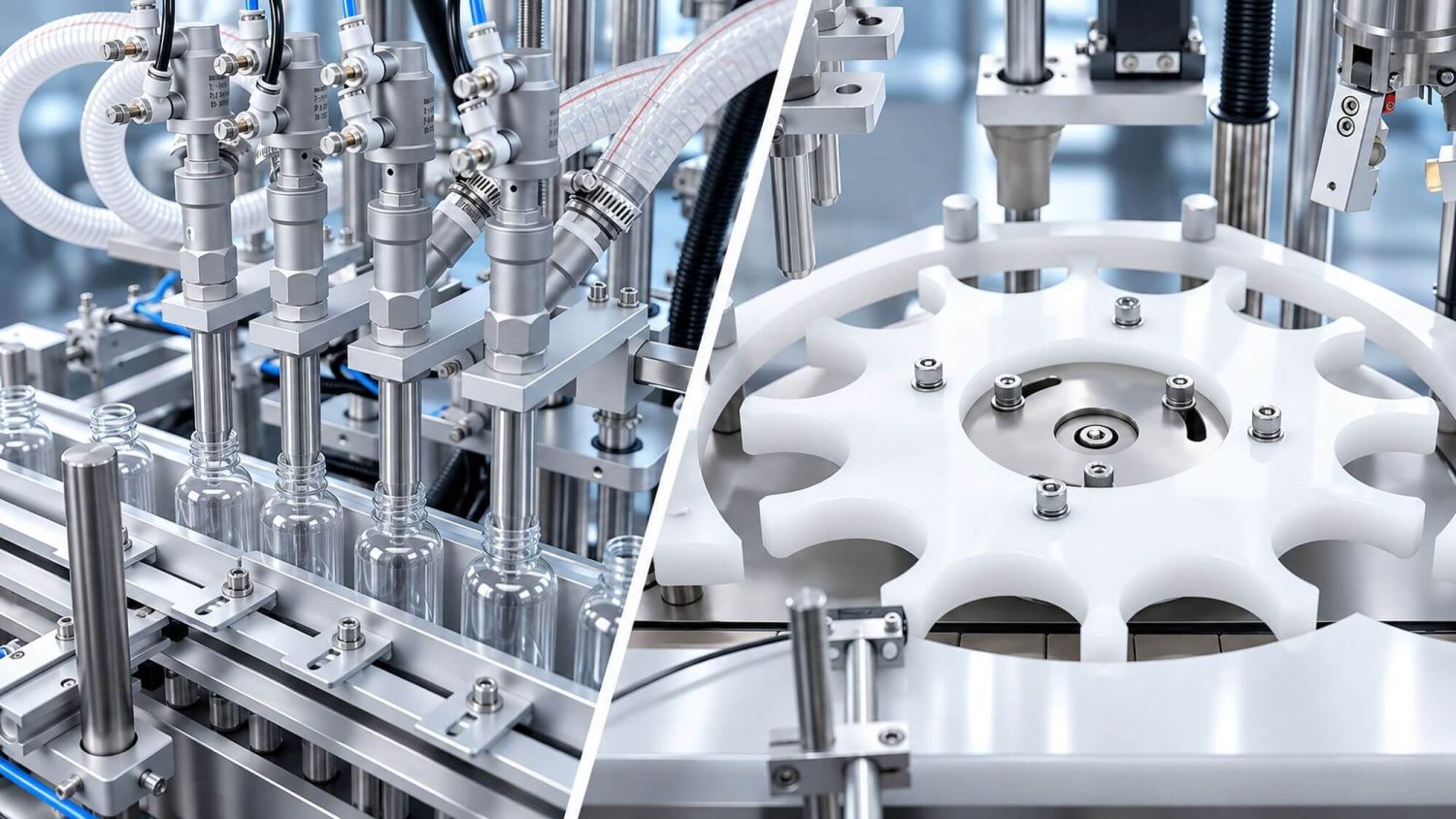
So a machine can be an automatic inline liquid filler using servo-driven pistons and diving nozzles. Another automatic line may be flow meter controlled with fixed nozzles. Both will achieve the same result, but the method for controlling the product and container movement will be completely different.
Liquid Filling Process at a Glance
A liquid filling machine usually combines 3 functions simultaneously:
- Product movement: Liquid flows from the tank to the filling system, then out of the nozzle.
- Dosing control: The quantity is measured and controlled using volume, flow, weight, time, or liquid level.
- Container handling: Mechanical and electrical mechanisms ensure that filling begins when the container is placed in the right position and stops before it leaves.
While there may be many variations in the specific details of the machine, the above-mentioned principles always apply. Once you grasp them, you can better understand the distinctions among piston, flow-meter, gravity, pump, inline, rotary, and automatic filling machines.


