When products are stored in bottles or jars, such as sauces and medicines, a foil seal is often made to prevent leaks and reduce contamination risks. Therefore, an induction sealer is necessary. Different from heat sealing, it can seal the foil layer tightly without contacting the container. As an important machine in the packaging industry, it is necessary to have a comprehensive understanding of this equipment.
What Is an Induction Sealer?
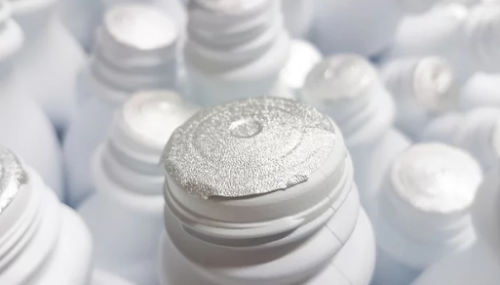
An induction sealer is a packaging machine used to seal a foil liner to the bottle or jar opening with electromagnetic heating. It doesn’t need to contact the product and makes a tight seal. The machine generates an electromagnetic field through an induction head. When a capped container passes beneath the sealing head, the foil liner inside the cap heats up rapidly. The heat melts the sealing layer on the liner and bonds it to the container opening. After cooling, a secure seal is formed.
A typical induction seal liner consists of several layers. They include a backing material, a wax layer, an aluminum foil layer, and a heat-seal layer. The aluminum foil layer is a key part. It can respond to the electromagnetic field generated by the induction sealer. But the liner structure can vary depending on the container material, product characteristics, and sealing requirements.
What Products Can Be Used With Induction Sealing Machines?
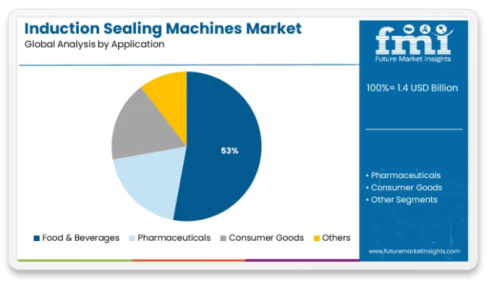
Induction sealers are widely used in many production areas. According to Future Market Insights, the food and beverage industry accounts for the largest revenue share of induction sealing machine demand, with an estimated share of around 52.9% in 2025. They protect products from contamination and provide tamper evidence for consumers. Here are the common uses.
- Pharma production. Medicine bottles, vitamin supplements, and capsule containers.
- Food industry. Peanut butter, sauce, honey, and spice jars.
- Beverage. Wine, sports drinks, and juice.
- Cosmetics. Shampoo, lotion, facial cream, and skincare products.
- Chemicals. Pesticide, detergent, and motor oil bottles.
How Does an Induction Sealer Work?
Induction sealing machines use electromagnetic induction to heat the aluminum foil liner and create a hermetic seal. To improve production efficiency, many manufacturers integrate the automatic induction sealers into the production line. Here is a video to show you the whole working process.
Step 1: Bottle Conveying
At first, the induction liner is pre-inserted and firmly fixed inside the cap. When filled bottles are capped with the capping machine, they are transferred to the sealing station through the conveyor. During this process, guide rails keep the bottles in a straight line and roughly in the right position.
Step 2: Bottle Positioning
When bottles move under the sealing head, side guides or belts help center each bottle. There is an induction coil installed inside the sealing head. When connected to a high-frequency power supply, the coil generates a high-frequency alternating electromagnetic field. This step makes sure the bottle opening is aligned with the induction coil above it. Proper alignment is important for a stable and even seal.
Step 3: Induction Heating and Sealing
This is the main sealing step. When the bottle passes under the induction coil, the machine creates an electromagnetic field. The induced eddy currents flow within the aluminum foil layer and generate heat due to electrical resistance. This heating method is called Joule heating. It quickly heats the heat-seal layer and causes it to melt evenly.
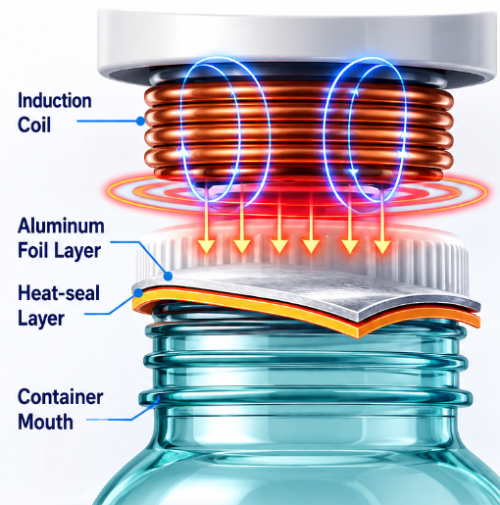
During this process, the pre-tightening pressure from the cap presses the softened sealing layer evenly onto the edge of the container opening. Then it forms a bond between the aluminum foil layer and the container mouth. By adjusting the machine parameters, heating and sealing can be completed within a short dwell time. It ranges from fractions of a second to several seconds depending on the machine and package.
Step 4: Cooling
After sealing, the liner cools, and the heat-seal layer solidifies as the container moves away from the sealing head. The machine’s cooling system mainly helps control the temperature of the induction coil and power components during continuous operation.
Step 5: Discharge
Finally, the sealed bottles would be transferred to the next processing station, such as labeling and coding. For more precise sealing, some manufacturers integrate an inspection system into the machine. It checks whether any sealing defects occur, such as missing seals or wrinkles in the sealing layer. If the bottles do not meet the preset standards, the system will reject the defective products and collect them in a dedicated reject collection area. This prevents them from entering downstream processes.
Five Common Types of Induction Sealing Machines
To match different production scales and packaging lines, there are many types of induction sealers to choose from. The main classification criteria include automation level, cooling method, and production line configuration.
Handheld Induction Sealer
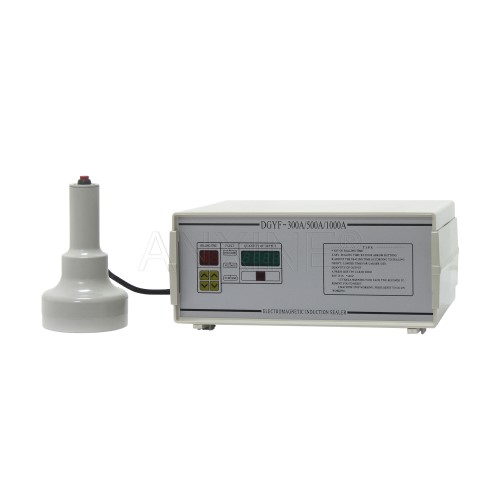
Handheld induction sealers are portable machines with a movable sealing head. They require the operator to position the container correctly under the sealing head before the sealing process. Then start the machine and seal the bottles. Because the sealing process relies on manual operation, production efficiency is low. The actual speed depends on operator experience and container size.
These machines typically have a power range of about 0.5 kW to 1.5 kW. The sealing diameters can be different based on the machine design. For example, Anxine DGYF-300 is rated at 1200 W and supports φ15–50 mm caps. The DGYF-1000 model could handle cap diameters from φ70 mm to φ130 mm with a max power of 1200 W. These specifications need to be confirmed with your supplier before purchase. So it won’t delay your production. The main advantages of the manual sealing device are compact size, low purchase cost, and easy portability. They are commonly used for small-batch production, product testing, and laboratory applications.
Semi-Automatic Induction Sealers
This type is much larger than handheld induction sealers. So it can be fixed on the work table. The operator places the container under the sealing head. Then the machine automatically performs the sealing process after starting. Compared with handheld models, semi-automatic machines provide more consistent sealing quality. Because the sealing distance and sealing time are controlled by the machine. Typical output ranges from 300 to 1,500 bottles per hour. It mainly depends on container size and operating conditions.
These machines are widely used by small and medium-sized manufacturers. They require higher productivity but don’t have enough budget for fully automated models.
Fully Automatic Induction Sealing Machines
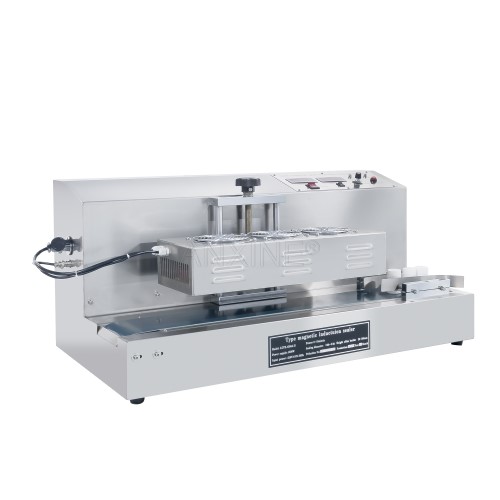
Automatic induction sealers are industrial machines designed for continuous production. They can be connected with upstream filling equipment and downstream packaging equipment to form a complete automated production line. The machine could be installed directly on a conveyor system. Containers pass through the sealing area automatically, and the sealing process is completed without manual intervention.
Depending on the machine design, sealing diameters can range from approximately 20 mm to 200 mm. Some custom models can handle larger container sizes. The sealing speed varies based on machine design. For example, the Anxine LGYF-2000BX could achieve 2~12 m/min. Actual production capacity is decided by container size, product characteristics, and sealing requirements. Automatic sealing machines usually include advanced control systems. They are widely used in large-scale businesses.
The three types above are classified by automation levels. Each has pros and cons. Here is a comparison table for your reference. The specification ranges are based on Anxine product data and publicly available product catalogs from other induction sealer manufacturers. Actual performance may vary by cap diameter, liner material, container material, sealing distance, and production speed.
| Feature | Handheld induction sealer | Semi-automatic induction sealer | Automatic induction sealer |
|---|---|---|---|
| Operator involvement | High | Medium | Low |
| Typical output | Based on the operator skill | 300-1,500 bottles/hour | commonly several thousand bottles/hour |
| Production mode | Batch production | Small to medium production | Continuous production |
| Equipment cost | Lowest | Medium | Highest |
| Sealing consistency | Depends heavily on operator skill | More consistent than handheld models | Highest consistency |
| Typical applications | Product testing, laboratory work, small businesses | Small and medium manufacturers, flexible production | Large-scale industrial manufacturing |
The cooling system plays an important role in maintaining stable operation during continuous production. According to the cooling medium used, induction sealers are always divided into air-cooled and water-cooled models.
Air-Cooled Induction Sealers
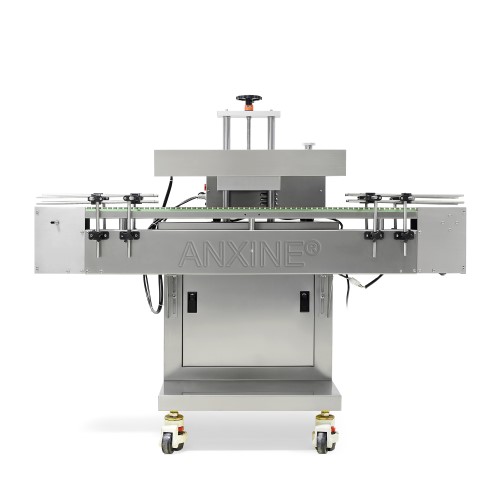
Air-cooled induction sealers use built-in industrial fans to remove heat from the induction coil and power components. Air is forced through the machine to carry heat away from critical parts. It maintains a stable operating temperature. These machines do not require an external water supply system. With simple installation and low maintenance requirements, the overall equipment cost is usually lower than that of water-cooled models. Therefore, air-cooled machines are widely used in small and medium-scale production.
However, cooling capacity is limited compared with water-cooled systems. Performance may be affected in high-temperature environments or applications that require long periods of continuous operation.
Water-Cooled Induction Sealers
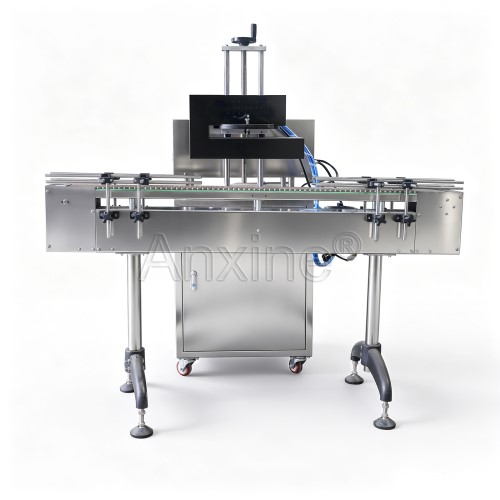
Water-cooled induction sealers use circulating water to transfer heat away from the induction coil and other key components. Heat is removed through a cooling system. It may include a water chiller or a closed-loop cooling unit. Compared with air-cooled machines, water-cooled models provide higher cooling efficiency and more stable temperature control.
These machines require higher installation and maintenance costs because of the extra cooling equipment. They are better suitable for high-speed production lines, heavy-duty operation, and long production runs. They are also frequently used in pharmaceutical and cosmetic production lines.
You can check the chart to see the main differences between air-cooled induction sealers and water-cooled induction sealers.
| Feature | Air-cooled induction sealer | Water-cooled induction sealer |
|---|---|---|
| Cooling method | Built-in fans remove heat. | Circulating water removes heat. |
| Cooling efficiency | Lower | Higher |
| Best production scale | Small to medium production | Medium to large production |
| External cooling equipment | Not required | Required, such as a water chiller |
| Typical applications | Food, cosmetics, and small packaging lines | Pharmaceutical and chemical |
| Price | Lower | Much higher |
What Should You Consider Before Buying an Induction Sealer?
Confirm Your Production Output and Automation Requirements
The first step to selecting an induction sealer is matching the equipment automation level and rated capacity with your current production volume. If you have a high budget, long-term expansion plans could be considered. But for start-ups with a limited budget, manual or handheld induction sealers are better. They are enough to support your daily output. If your required output is above 1,500 bottles per hour, a fully automatic model could be considered. Moreover, many buyers reserve extra capacity, for example, 20–30%, to accommodate demand growth. It avoids premature equipment bottlenecks or unnecessary operation costs from oversized machines.
Match Container Material, Bottle Height, and Mouth Size
You should make sure the induction sealer is compatible with your containers. The main factors include container material, bottle height, mouth diameter, and bottle shape. These factors affect sealing quality and production efficiency.
- For materials, plastic containers such as PE, PP, and PET are commonly compatible with sealing. Glass bottles require suitable settings and foil liners to achieve reliable sealing. For metal containers or metal caps, they can interfere with the electromagnetic field. So they usually require special equipment design or liner structure.

- For automatic and inline machines, bottle height is a key consideration. It should be within the machine’s adjustable range. So the bottle mouth stays at the correct distance from the induction coil. If the bottle is too tall or too short, sealing quality may become inconsistent.
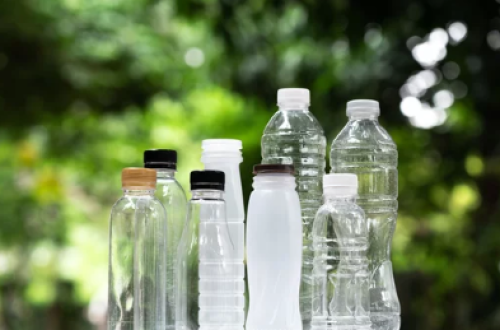
- You should also check whether the machine supports your bottle mouth diameter. Different induction sealers can handle different diameter ranges. You need to confirm it with your supplier.
Supplier Verification
When you contact a supplier, you’d better
- Check the supplier’s background first.
- industry experience
- customer cases
- Compliance documents, such as CE marking or GMP-related documents.
- Run a trial sealing before ordering to see the result.
- sealing tightness
- peeling strength
- edge quality
- no overheating issues
- Confirm contract details when signing the agreement.
- performance standards
- warranty
- delivery time
- after-sales service
This type of testing and qualification review can effectively reduce problems such as poor sealing performance, unstable machine operation, incompatibility, etc.
The End
An induction sealing machine is an essential packaging solution for modern production lines. It uses electromagnetic induction to create a secure and tamper-evident seal. If you are looking for a reliable induction sealing solution, Anxine can help you in every aspect. Contact us to get more details or a customized solution for your production line.
Sources
- Future Market Insights – Induction Sealing Machines Market


