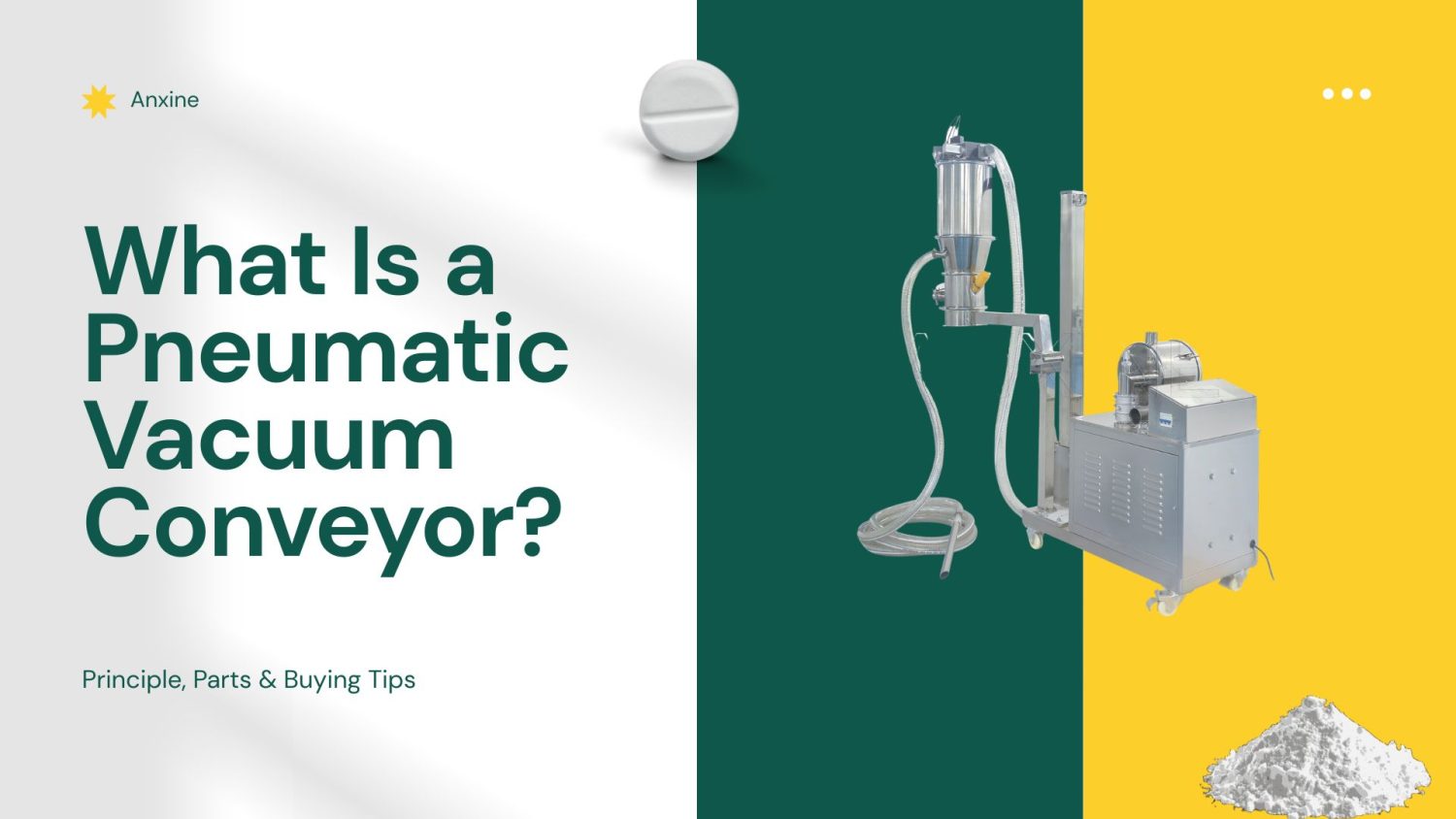
In many manufacturing areas, a pneumatic vacuum conveyor is always used to improve material transfer efficiency. It is an important part of the production line. This article helps you have a better understanding of pneumatic vacuum conveyors and how to use them.
What Is a Pneumatic Vacuum Conveyor?
A pneumatic vacuum conveyor transports bulk materials through closed pipelines by means of vacuum pressure. It can transfer powders, granules, pellets, capsules, etc. In most cases, small pneumatic vacuum conveyors operate at a vacuum gauge pressure of about -0.2 to -0.4 bar. Large vacuum pump systems, especially those used for long-distance powder conveying, can reach -0.5 to -0.6 bar.
A pneumatic vacuum conveyor supports automatic material transfer between different processing machines. The conveyor can feed mixers, tablet presses, capsule filling machines, and packaging machines. Continuous material supply also improves production efficiency and product consistency.
Advantages of Pneumatic Vacuum Conveyors
A pneumatic vacuum conveyor offers many advantages compared to manual handling.
- Dust-free material transfer. An enclosed conveying pipeline keeps materials inside the system throughout the whole transfer process. Dust does not escape into the production area, and the working environment remains clean.
- Less contamination. Product quality depends on a clean production process. The enclosed design minimizes exposure to dust and moisture. It helps manufacturers get higher product purity and quality.
- Higher efficiency. Automatic material transfer shortens production time and maintains a continuous supply. Then operators can focus more on production control.
- Gentle handling. Vacuum conveying applies controlled conveying force throughout the transfer process. It is helpful for fragile materials and limits unnecessary particle degradation.
- Easy cleaning and maintenance. Many pneumatic vacuum conveyors support quick disassembly and simple cleaning procedures.
Applications of Pneumatic Vacuum Conveyors
A pneumatic vacuum conveyor is widely used to handle dry bulk materials. Here are some common uses in different industries.
- Pharmaceutical area. Powders, APIs, granules, tablets, and capsules.

- Food industry. Flour, milk powder, sugar, coffee beans, seasonings, and starch.

- Chemical industry. Chemical powders and detergent powders.

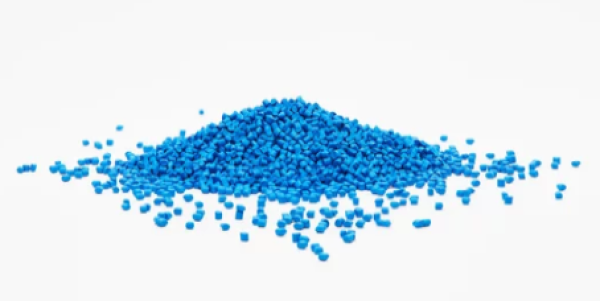
- Plastic manufacturing. Plastic pellets, plastic granules, and resin pellets.
How Does a Pneumatic Vacuum Conveyor Work?
A pneumatic vacuum conveyor uses compressed air to create suction, move material through a pipeline, and discharge it for processing. Here is a video to show you how the equipment works.
Step 1: Vacuum Creation
When compressed air is supplied to a pneumatic vacuum generator, the process begins. This generator converts high-speed compressed air into a low-pressure zone. Then, vacuum forms inside the conveyor’s hopper and connected pipeline.
Step 2: Material Suction
Once the vacuum is created, materials are pulled into the suction nozzle together with the surrounding air. The airflow carries the material through the conveying pipeline.
Step 3: Conveying
The material and air travel through a closed conveying pipeline toward the receiving hopper. A continuous vacuum keeps the airflow to carry the material through the pipeline. It can move the material both horizontally and vertically without belts or screws.
Step 4: Material and Air Separation
When the material reaches the hopper, the airflow slows down. The material falls into the hopper, and the air passes through a filter. The filter prevents fine particles from entering the air exhaust. It also protects the vacuum generator from taking in solid materials.
Step 5: Material Discharge
When the feeding cycle is complete, the compressed air supply stops. The vacuum then disappears. A pneumatic cylinder opens the discharge valve, and the material falls into the receiving equipment by gravity. This equipment may be a tablet press, packaging machine, or storage hopper.
Many pneumatic vacuum conveyors are equipped with an automatic filter cleaning system. After each conveying cycle, compressed air flows backward through the filter to remove residue. This maintains stable vacuum performance and reduces manual cleaning.
What Are Common Components of a Pneumatic Vacuum Conveyor?
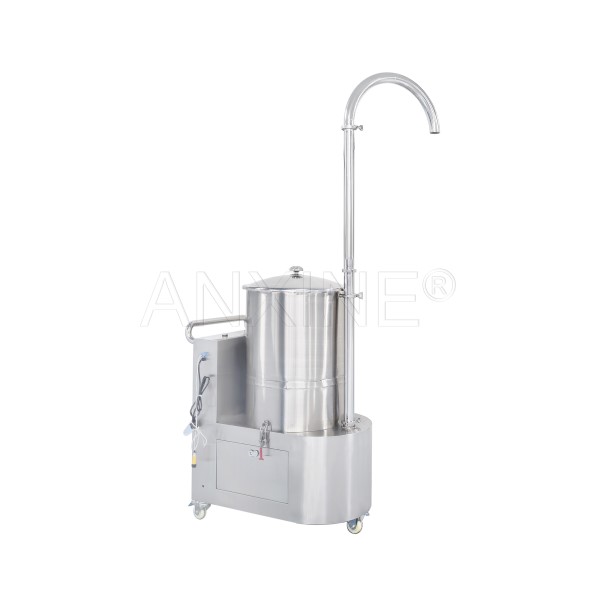
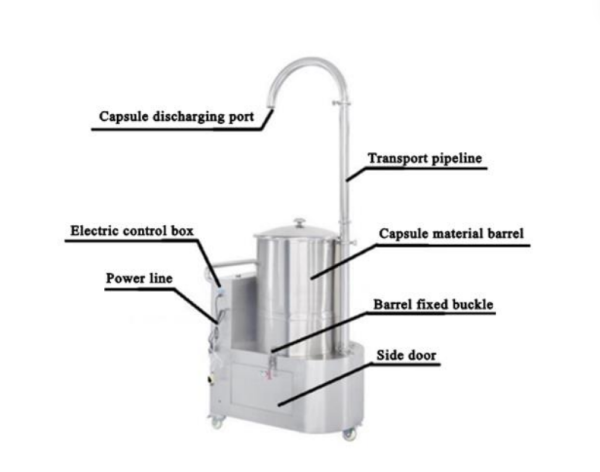
The main structure of pneumatic vacuum conveyors consists of many parts. Each has its unique functions. The basic components may vary by model. The following section uses the SE capsule conveyor as an example to explain the machine structure
Capsule Material Barrel
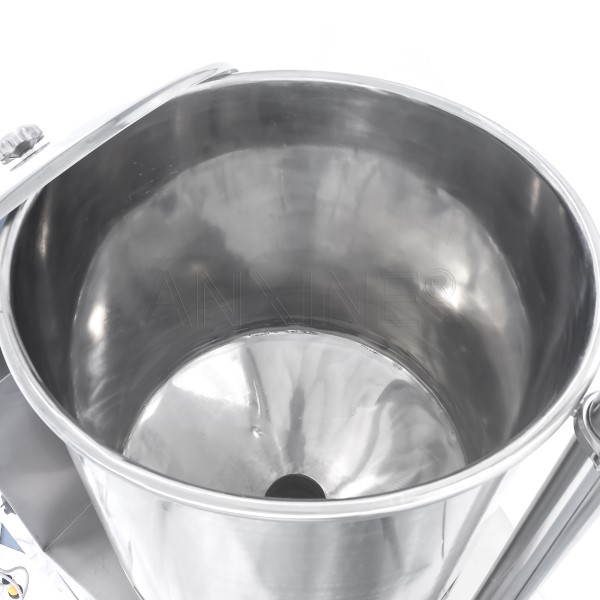
This is the main container located in the center of the machine body. It stores bulk empty capsules before they are transported. It is also used to feed capsules into the pneumatic conveying system when the process starts. The barrel is always made of 304 stainless steel for cleanliness and durability. The size could be customized based on your production needs.
Transport Pipeline
The transport pipeline is a sealed conveying tube. It runs vertically from the material barrel to the discharge port. It is used to carry capsules with airflow. This prevents dust, contamination, and unexpected damage. The pipeline can support horizontal, vertical, and inclined layouts based on plant layout requirements. Most manufacturers need to change the length, height, and routing angle of the part. Then, it can match their factory space and production line design. The control box configuration can usually be customized based on customer requirements.
Power Line
The power line is the external electrical cable connected to the control box. It supplies either 110V or 220V single-phase AC power. The part provides stable electricity to the entire system, including the pump, control circuit, and sensors. The machine requires proper grounding for safe operation. The electrical standards may be different among countries. Many manufacturers offer customization for power supply and voltage to meet safety requirements.
Capsule Discharging Port
It is the outlet at the top end of the machine. Capsules exit after being transported through the pipeline. Its main function is to deliver capsules directly into the next process equipment, such as capsule filling machines. The port is designed to match standard feeding hoppers. It can maintain stable and continuous production flow. In most cases, the discharge port size and connection type can be customized to fit different downstream machines.
Electric Control Box
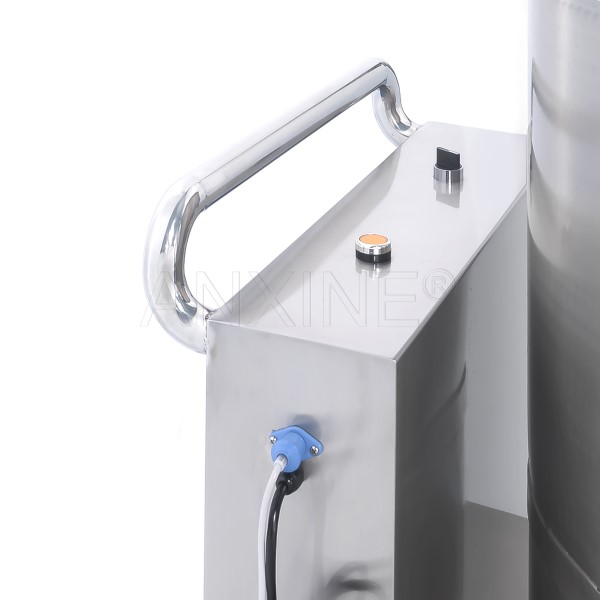
The electric control box is the main control unit. It is located on the side of the machine body. The part contains PLC screens, buttons, and other electrical components. They manage the operation of the feeding pump and system logic. It can be used to
- Start and stop the machine.
- Receive signals from the level sensor.
- Control automatic feeding cycles.
- Ensure safe operation of the system.
The PLC type and interface language could be changed to meet more needs.
Barrel Fixed Buckle
This component is a mechanical locking component. It is located around the lower or side connection of the capsule barrel. The fixed buckle secures the barrel firmly onto the machine base. Therefore, the machine won’t move or vibrate greatly during the operation. The airtight connection is also guaranteed with the conveying system. Moreover, this part allows quick installation and removal for cleaning.
Side Door
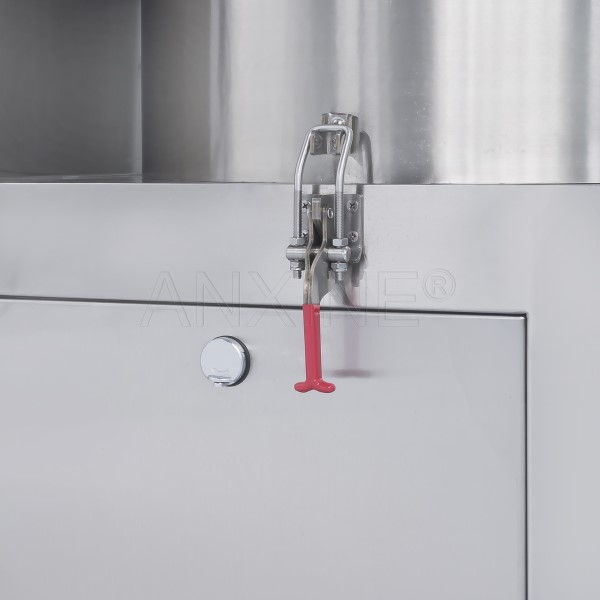
This part is located on the lower side of the machine base. The operator can open it and check the components, such as mechanical parts or wiring, for cleaning and maintenance. The door should be kept closed during use and storage.
Two Main Types of Pneumatic Vacuum Conveying Systems
Pneumatic vacuum conveyors are generally classified into two types. The standard is based on how the material moves through the conveying pipeline. It contains dilute phase vacuum conveyors and dense phase vacuum conveyors. The main difference is the amount of air used and how the material travels inside the pipe.
Dilute Phase Vacuum Conveyor
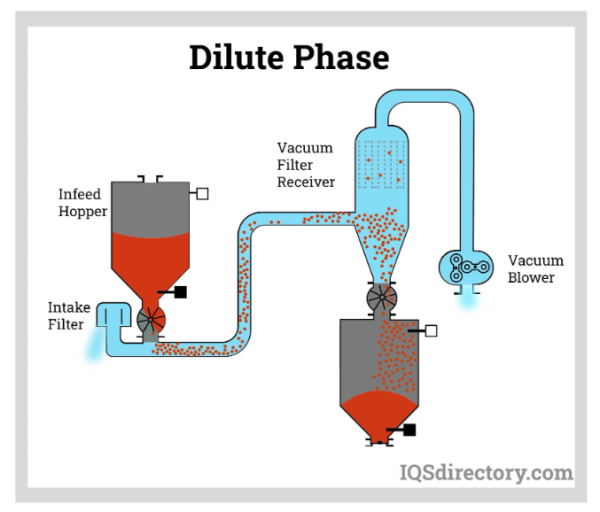
A dilute phase vacuum conveyor transports materials with high-speed airflow. The particles are fully suspended in the air. Then, they are transported rapidly through the conveying line. It is like how leaves are carried away by a strong wind. The air is powerful enough to lift and move every particle continuously. Because of its high conveying speed and simple design, dilute phase conveying is the most widely used type of pneumatic vacuum conveyor. It is always used in pharmaceuticals, food, chemicals, and plastics. Materials include powders, granules, plastic pellets, flour, sugar, etc.
Dense Phase Vacuum Conveyor
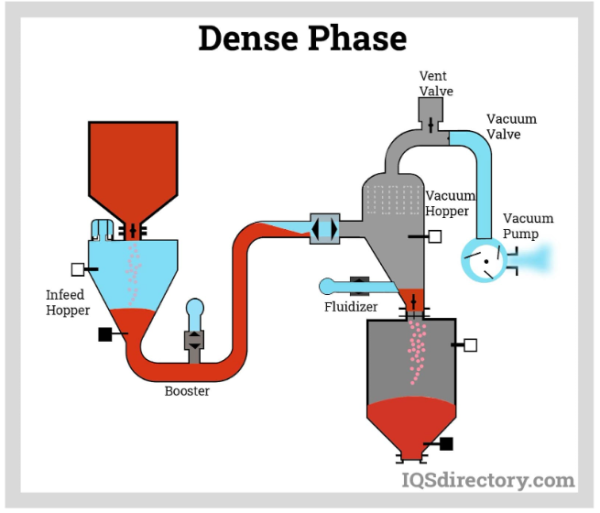
A dense phase vacuum conveyor moves materials with lower air velocity. It keeps a much higher concentration of product inside the pipeline. Instead of being suspended in the air, the material moves in compact plugs slowly. Because the conveying speed is lower, they are ideal for fragile, abrasive, or high-value materials.
What Needs to Be Considered When You Choose a Phase Vacuum Conveyor?
Material Characteristics

The type of material is the first factor to evaluate. This includes the physical form of the material, such as powders, granules, capsules, or other fragile items. Fine powders may require high-efficiency filtration to prevent dust leakage. Fragile materials need a gentle conveying process. Flowability is another key factor. Poor-flowing materials tend to agglomerate. So they require stronger suction capacity or use specialized filter designs.
Conveying Distance and Height
Conveying direction could be operated in a horizontal, vertical, or inclined way. It affects the vacuum capacity you need. Vertical and inclined transportation generally requires more power. In addition, longer distances or higher elevations demand models with greater suction force or higher vacuum levels.
Capacity
The machine should meet your daily production needs. Throughput should be measured in kg/h, the number of capsules per hour, or batches per hour. It is important to understand the relationship between capacity, conveying distance, and material properties. Longer conveying distances or materials with poor flowability reduce actual throughput. Because the vacuum must overcome greater friction, gravity, and resistance in the pipeline. This lowers suction efficiency and increases the chance of blockages. So it slows the overall material transfer rate.
Air Supply Conditions
A stable and adequate compressed air supply is critical for pneumatic vacuum conveyors. Most models require supply pressures in the range of 0.4 to 0.6 MPa. Air consumption varies by model. It is necessary to verify that the compressed air system can meet the demand. For instance, the QVC-1 requires 180 L/min, while the QVC-3 requires 720 L/min. Moreover, the air quality must be clean and dry. It avoids malfunctions and prevents contamination of the conveyed materials.
Power Supply
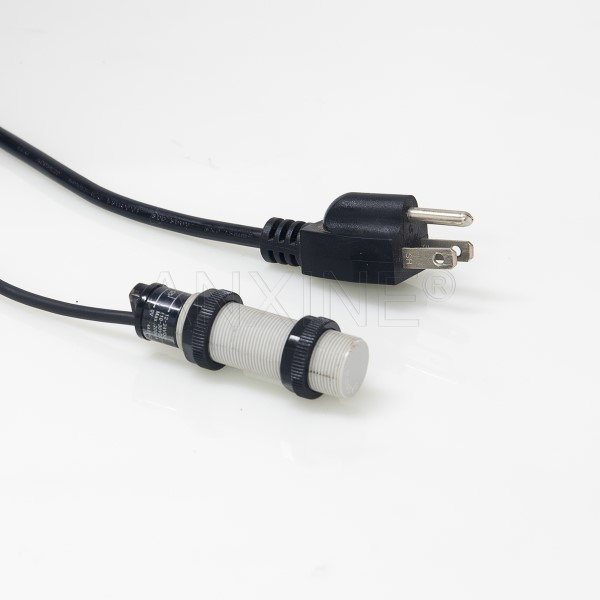
Before purchasing, you need to verify that the machine’s power supply matches your facility’s electrical system. Depending on the model, it may require a single-phase 110V or 220V supply or a three-phase five-wire power source. In addition to electrical compatibility, available control functions are also important. If the conveyor will handle powders, proper grounding is also essential to dissipate static electricity for safe operation. If not compatible, you can ask for customization.
Filter and Cleaning Design
The filter system should be selected based on the material’s particle size and the hygiene standards. Common filter materials include PE, PET laminated membranes, 304 or 316L stainless steel, and titanium. Each offers different levels of filtration performance and durability. To maintain stable conveying efficiency, many pneumatic vacuum conveyors use compressed-air pulse back-blowing to automatically clean the filter surface.
Downstream Equipment Compatibility
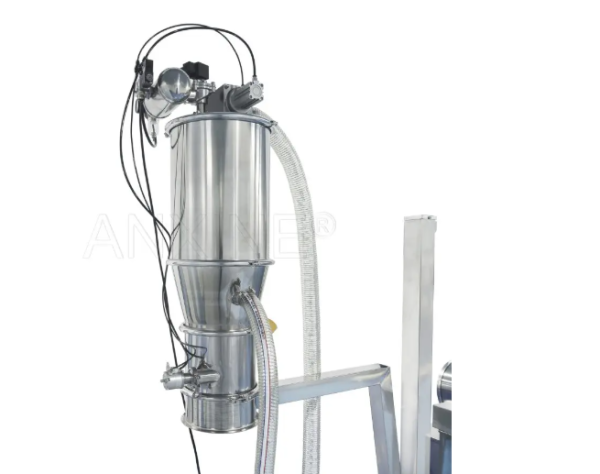
A pneumatic vacuum conveyor should be compatible with the equipment it feeds. Before purchasing, the following factors that need notice are
- the outlet size.
- connection type.
- discharge height.
You should confirm they match the inlet requirements of downstream equipment, such as capsule fillers. If the conveyor will be integrated into an automated production line, check whether it supports material level sensors or other control signals for automatic refilling. Proper compatibility is important for continuous material transfer and less downtime.
Installation Space
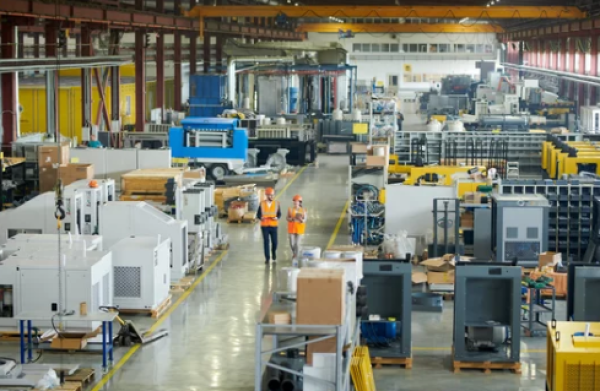
Production may require conveyors to be moved between different stations. The machine’s dimensions should allow sufficient room for operation, maintenance, and connection to other equipment. If the conveyor needs to serve multiple production lines or workstations, models equipped with casters can be moved more easily. It provides greater flexibility, making it easier to adapt to changing production requirements.
Pneumatic Vacuum Conveyor Model Comparison Table
You must have a basic understanding of how to choose a good pneumatic vacuum conveyor for your business. The chart below compares several common conveyor series for different materials, conveying distances, capacities, and installation needs. You can see the basic information and know how to ask your supplier more accurately to meet your needs.
| Factor | QVC Series | ZKS Series | SE Series |
|---|---|---|---|
| Material type | powders, granules, small pellets; not ideal for large particles or fragile items. | powders and granules | empty capsules from sizes 0# to 5# |
| Conveying direction | For short to medium distance conveying. Vertical/inclined conveying is possible. | It supports multiple directions and handles long distances. e.g. ZKS-20-5 conveys 20m | Vertical conveying to capsule filling machines; typically ≤3 m |
| Capacity | QVC-1: 350 kg/h, QVC-3: 1500 kg/h | ZKS-1: 400 kg/h to ZKS-7: 6000 kg/h | SE-30: 100,000 pcs/h; SE-40: 200,000 pcs/h; SE-50: 300,000 pcs/h |
| Air supply requirements | Pressure 0.5–0.6 MPa; air consumption 180–720 L/min | Pressure 0.4–0.6 MPa | It uses pneumatic conveying technology with lower pressure requirements. |
| Power supply | Usually single-phase AC220V/110V | Three-phase five-wire AC380V | Single-phase AC220V/110V |
| Filter & cleaning | PE filter, back-blowing system and air blow cleaning | It includes multiple filter types like PE and supports air blowing, water washing, or ultrasonic cleaning. | Stainless steel conveying pipeline with quick clamps, easy to dismantle and clean. |
| Mobility | Usually fixed installation | Some models can be mounted on mobile frames. | It is equipped with casters for easy relocation to different capsule fillers. |
The End
A pneumatic vacuum conveyor is an efficient machine for transferring materials for processing. Compared with manual handling, it reduces dust generation and improves efficiency. If you are interested but don’t know how to find a reliable supplier, contact us freely. We offer different types of pneumatic vacuum conveying systems to meet your demands.