Modern tablet manufacturing usually starts with one of two routes: direct compression or granulation. Granulation can be done by a dry or wet process. The main difference is the form of the material before it reaches the tablet press.
This guide will compare direct compression with dry and wet granulation to see when one may fit better than another. We’ll also share what to watch for before you choose a process.
Granulation vs. Direct Compression at a Glance
| Factor | Direct compression | Dry granulation | Wet granulation |
|---|---|---|---|
| Material path | Blend → lubricate → compress | Preblend → compact → mill → final blend → compress | Premix → add liquid → granulate → dry → size → final blend → compress |
| Granulation step | None | Powder is compacted and milled into granules. | Liquid is added to help the powder particles stick together. The material is then dried and milled. |
| Liquid | Not used | Not used | Granulating fluid is used. |
| Drying stage | Not required | Not required | Happens in specialized drying equipment |
| Material before tablet compression | Loose dry powder blend | Dense dry granules | Dried and sized granules |
| When it may fit | The final powder blend is already free-flowing and can be compressed directly. | Powder is poorly flowing and sensitive to moisture or heat. | Also needs granulation but is stable against water and heat. |
How the Three Tablet Manufacturing Routes Work and What Equipment They Use
Each route handles the powder differently before final compression, so the required process steps and equipment also change. Let’s follow the powder from dispensing to tableting to see how direct compression and granulation work.
Direct Compression
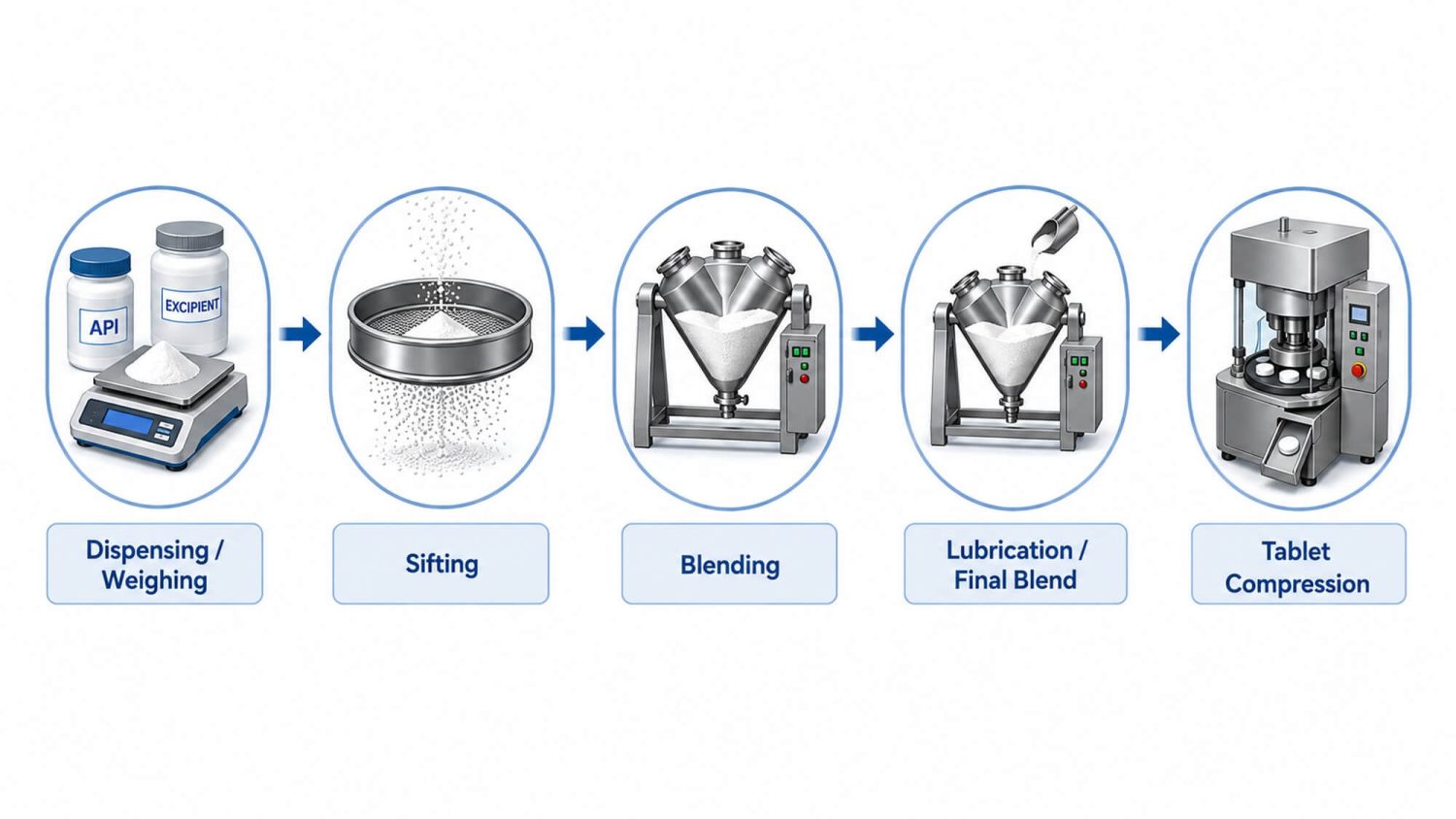
Step 1: The API and excipients are first weighed. If the powder has lumps, it may go through a sifter or mill to break them up. This prepares a consistent material feed for the next step.
Step 2: A tumble blender or continuous blender mixes the API with the excipients until the blend is uniform. Lubricant is usually added near the end. Mixing for too long after lubrication can reduce tablet strength in some formulations.
Step 3: The final blend enters the hopper of the rotary tablet press and moves into the feed frame. The feed frame needs to fill each die with a consistent amount of powder.
Step 4: The upper and lower punches press the powder inside the die to form a solid tablet. Finished tablets are then pushed out of the die and discharged from the press.
A peer-reviewed review also describes feeding, blending, lubricant addition, and rotary compression as key steps of direct compression in continuous tablet manufacturing.
Dry Granulation
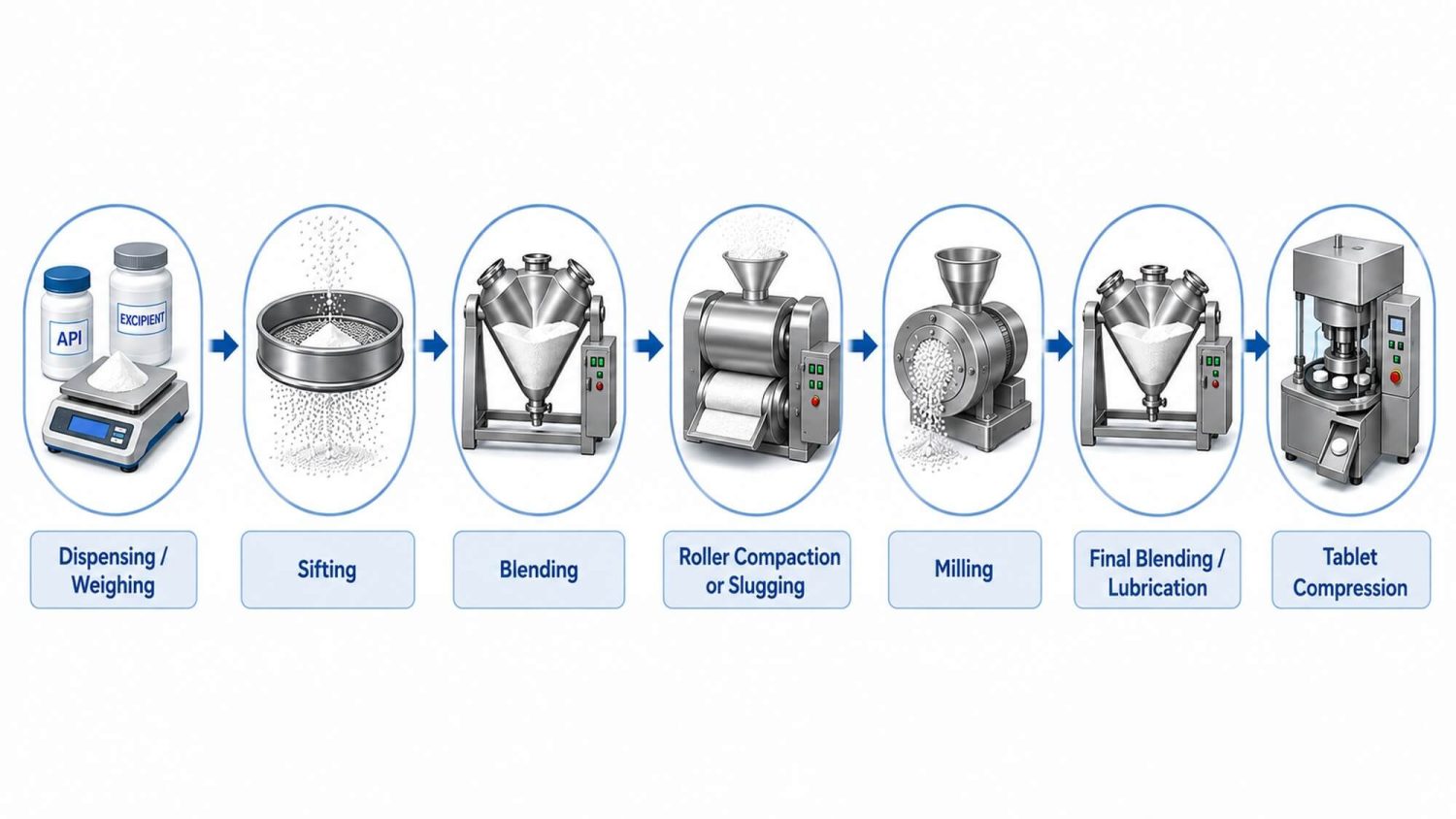
Step 1: Operators first weigh the API and excipients. If needed, use a sifter or sieving machine to break up agglomerates in the raw materials. The equipment can also remove unwanted particles or debris. The ingredients are then mixed in a V blender or bin blender to make the mixture uniform.
Step 2: The powder blend feeds into a roller compactor and is compacted into ribbons. This operation makes the powder denser without using a granulating liquid.
Step 3: The ribbons are then milled into smaller dry granules. Again, the granules pass through a sieve to separate material that is too fine or too large.
Step 4: The milled granules are mixed with lubricant and any remaining disintegrant in a final blender. They then move to the tablet press. We recommend running a trial at this stage. This helps make sure the first compaction step has not made the granules too hard to compress into tablets.
Wet Granulation
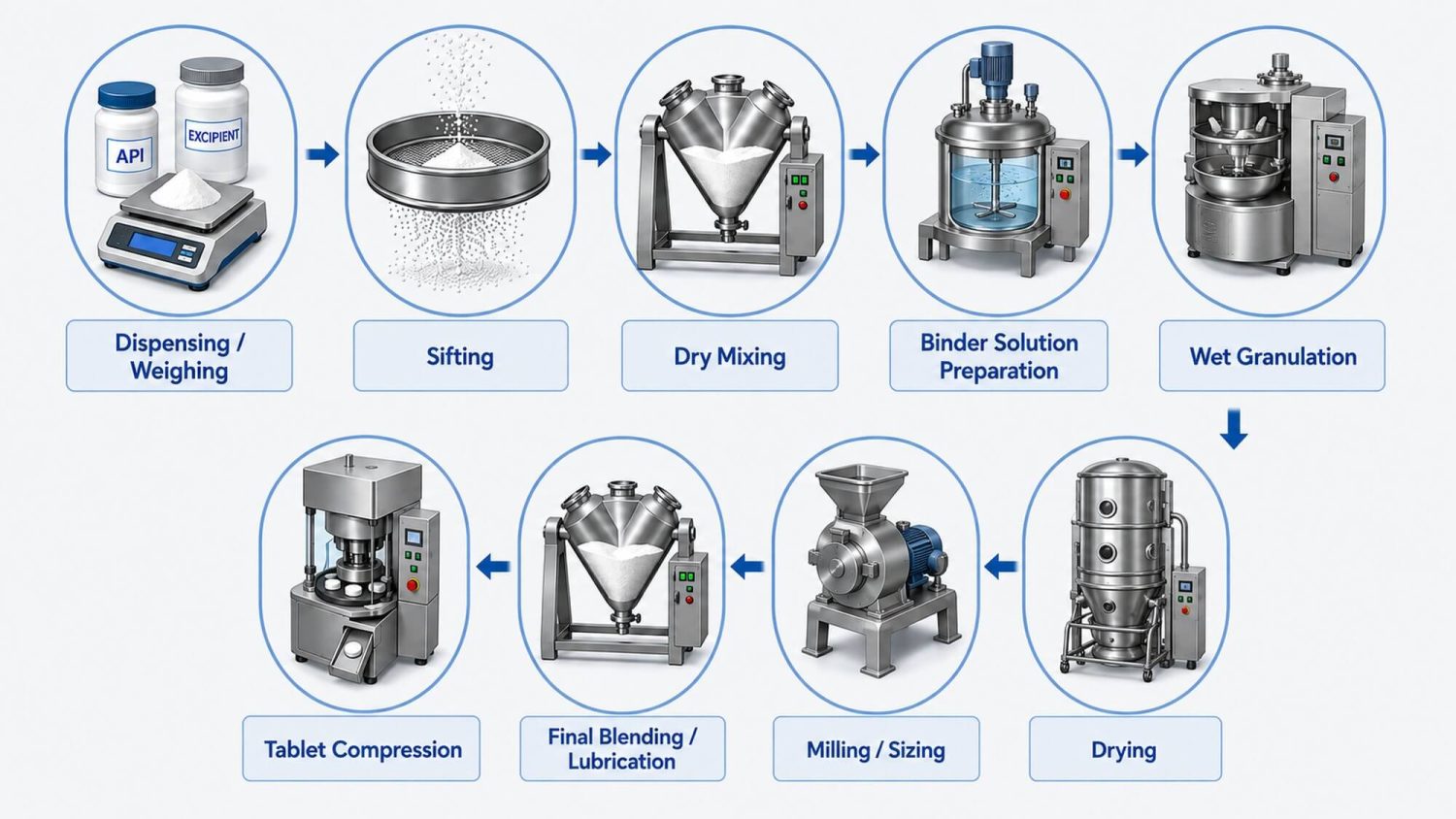
Compared to direct compression and dry granulation, this process is more complicated.
Step 1: Like dry granulation, the wet process starts with pre-sifting. This helps break up lumps and remove oversized particles before mixing.
Step 2: The API is dry-blended with the needed excipients in a high-shear mixer granulator or fluid-bed processor.
Step 3: After dry mixing, the granulator introduces water, solvent, or binder solution. The granulating liquid should spread evenly through the powder blend.
Step 4: The granulator keeps mixing until the wet mass reaches the right condition. During process development, operators may look at mixer torque or power and check how the wet mass looks and feels. The right mixing time depends on the formulation.
Step 5: The formed wet granules then move to a fluid-bed processor or another drying system. Drying removes the added liquid until the mass reaches the required moisture level. The temperature and drying time should be controlled so the API is not damaged.
Step 6: A mill and sieve bring the dried granules to the right size range. The granules then go to a final blender, where lubricant and any remaining excipients are added before tablet compression.
When Is Direct Compression a Suitable Choice?
Direct compression works well when the powder blend already flows well and stays evenly mixed during handling. The formulation can be used to directly produce acceptable tablets.
Dose level is another factor. Many APIs do not naturally flow or compress well and may separate during handling. In a low-dose formulation, there is ample room for suitable direct-compression excipients to offset these challenges. High-dose products are usually harder to handle. When the API makes up about 50% or more of the formulation, granulation may be used to improve the material before tableting.
These properties can show that a formulation may be suitable for direct compression, but they are only a starting point. Development trials help see how the final formulation behaves under actual production conditions.
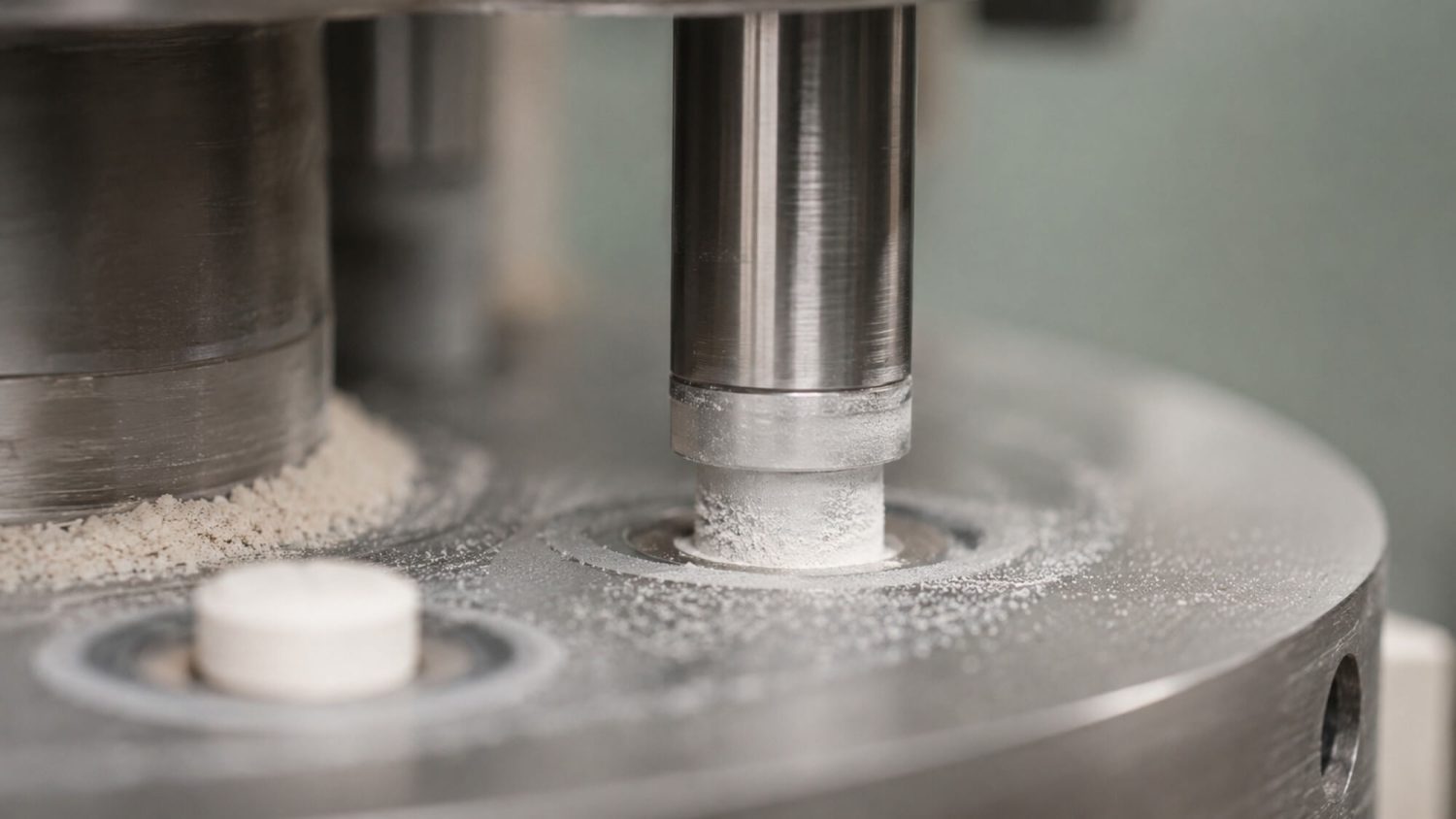
Direct-compression trials should show:
- The dies fill evenly, and tablet weight is consistent at the preset press speed.
- The blend stays uniform after normal transfer and time in the hopper.
- Tablets are strong enough without capping, sticking, or breakage.
- The process still works when API or excipient batches vary.
- The formulation fits the target dose and tablet size while meeting the required release profile.
Direct compression is also worth considering for materials that are sensitive to moisture or heat. The process does not use liquid and drying steps. But this alone does not mean direct compression will work. The formulation still needs suitable flow and compression properties.
Why Granulation May Be Needed Before Tablet Compression
Granulation is a common choice when direct compression is not feasible. The process may improve formulation flow or compression before it reaches the press.
- Fine powders may not feed smoothly into the tablet press. Turning the powder into larger granules can help it flow more easily.
- Many APIs may separate from other ingredients during transfer. Granulation helps the blend stay more uniform.
- During granulation, agglomeration brings smaller particles together into larger granules, which can improve powder flow.
- When producing high-dose products, granulation makes ingredients flow and compress well.
Once granulation is needed, the next step is to choose between wet and dry routes.
Wet Granulation for Stronger Particle Bonding
Wet granulation is useful when the powder does not compress well on its own. It adds liquid to help improve particle bonding and form granules.
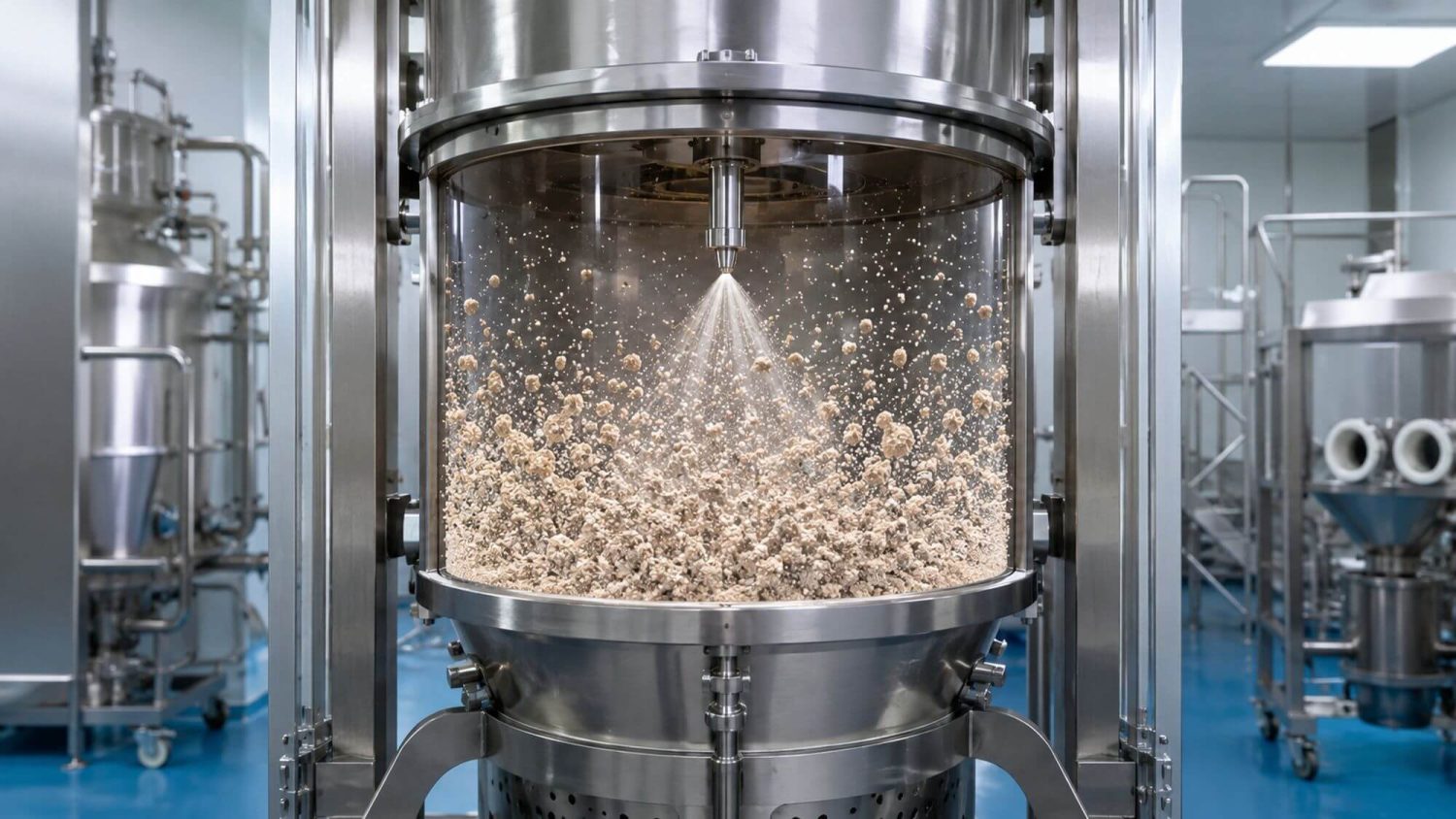
This method is most suitable when the formulation can tolerate:
- The selected granulating liquid;
- The wetting period during processing;
- The drying conditions that follow.
Wet granulation is a mature and widely used process. It can give better control when the powder needs a larger change before compression. The trade-off is a more complex process. It usually needs more equipment and floor space, while operating costs are also higher than direct compression or dry granulation.
Dry Granulation When Wet Processing Is Unsuitable
When your formulation is sensitive to moisture or heat and direct compression is unsuitable, dry granulation may be a good alternative.
This route has fewer steps than wet granulation because it does not use liquid or drying. But the material is compressed by roller compaction once before final tableting, so it may be harder to compress again.
For this reason, dry granulation should not be selected based on moisture or heat sensitivity alone. Trials are needed to make sure that the process produces consistent granules that can still form tablets with the required strength.
How to Choose Between Direct Compression, Dry Granulation, and Wet Granulation
You should first look at the formulation itself, then use development trials to see which route makes sense.
| Selection question | Direct compression | Dry granulation | Wet granulation |
|---|---|---|---|
| Does the blend feed consistently? | Must already feed reliably | Compaction may improve density and handling | Agglomeration may improve feeding |
| Does the blend separate? | API content must remain uniform through transfer and feeding | Granules may reduce separation; fines still need measurement | Granule and tablet samples must show uniform API distribution |
| Can the material form strong tablets? | Original blend needs adequate tabletability | Must form strong tablets after first compaction | Binder and granule structure must support compression |
| Can the material tolerate liquid and drying? | No granulating liquid or dryer | No granulating liquid or dryer | Wet and dried samples must remain chemically and physically acceptable |
| Which operations are added? | Blend preparation and tableting only | Compaction, milling, final blending | Liquid addition, granulation, drying, milling, final blending |
You may follow these four steps to choose a process:
1. First, define the target dose and tablet size. Then look at the required release, tablet strength, and whether the formulation is sensitive to moisture or heat.
2. See how the powder flows, whether it tends to separate, and how well it compresses. Particle size, density, and moisture also matter. You should also consider how much the API or excipients may vary from one batch to another.
3. Try direct compression first if it looks possible. Run a trial to see whether the powder feeds smoothly and the tablets eject cleanly.
4. If direct compression causes problems, turn to granulation. When the powder cannot be exposed to liquid and needs larger particles, test dry granulation. Wet granulation suits the formula that can tolerate wetting and drying.
Common Mistakes to Avoid When Choosing a Tablet Manufacturing Route
- Do not choose direct compression only because it has fewer process steps. You still need to confirm that the blend feeds well and produces good tablets at the planned production speed.
- Do not assume dry granulation and direct compression are the same just because both avoid liquid processing.
- Do not change the manufacturing route after one poor tablet result. First check whether the issue comes from the formulation, lubrication, tooling, dwell time, or tablet press settings.
- Do not add granulation directly. You should identify the material problem that granulation needs to solve.
- Do not order production equipment before formulation trials show which process steps are actually needed.
- Do not choose a process route based on only one API or excipient lot. Consider how material properties may vary between batches.
Frequently Asked Questions About Granulation and Direct Compression
Is dry granulation the same as direct compression?
No. Dry granulation and direct compression are different processes. Dry granulation compresses the powder into ribbons, then breaks them into granules before tablet compression. Direct compression has no granulation stage and compresses the final powder blend directly.
Can every powder blend be made into tablets by direct compression?
No. Some APIs have poor flow or weak bonding properties. This can lead to uneven feeding and inconsistent tablet weight. The tablets may also be too soft or break easily.
Which route uses the least equipment?
Direct compression usually uses the shortest equipment line. Dry granulation adds compaction and milling stages before tableting. Wet granulation requires more equipment because it includes liquid addition, granulation, drying, and sizing.
Key Takeaways
- Direct compression sends the final powder blend to the tablet press. Dry and wet granulation create granules, but they use different methods.
- Route selection depends on powder flow, segregation risk, compressibility, drug load, excipient choice, and sensitivity to liquid or heat.
- When tablet problems occur, find the real cause before changing the manufacturing route.
- Use representative material lots to test the selected process. Run the process on the actual production equipment at the planned speed.