Making a tablet is not just about pressing powder into a solid shape. Before tablet compression, all of the ingredients must be turned into either a powder or a granule. After forming tablets and as they exit the press, additional operations such as dedusting, inspection, coating, testing, and packaging are also necessary.
This article details the complete process of tablet manufacturing from raw materials to the finished pack. You will see what occurs at each stage, how the main production routes differ, and what one step should prepare for the next.
An Overview of the Tablet Manufacturing Process
The process of making tablets varies depending on how the formulation can best be processed prior to compression. Some tablet formulations can be compressed directly after mixing, while others require granulation (either dry or wet). However, regardless of the method used to make the granules, the process eventually converges with direct compression at the compression step.
A typical tablet-making process might look like this:
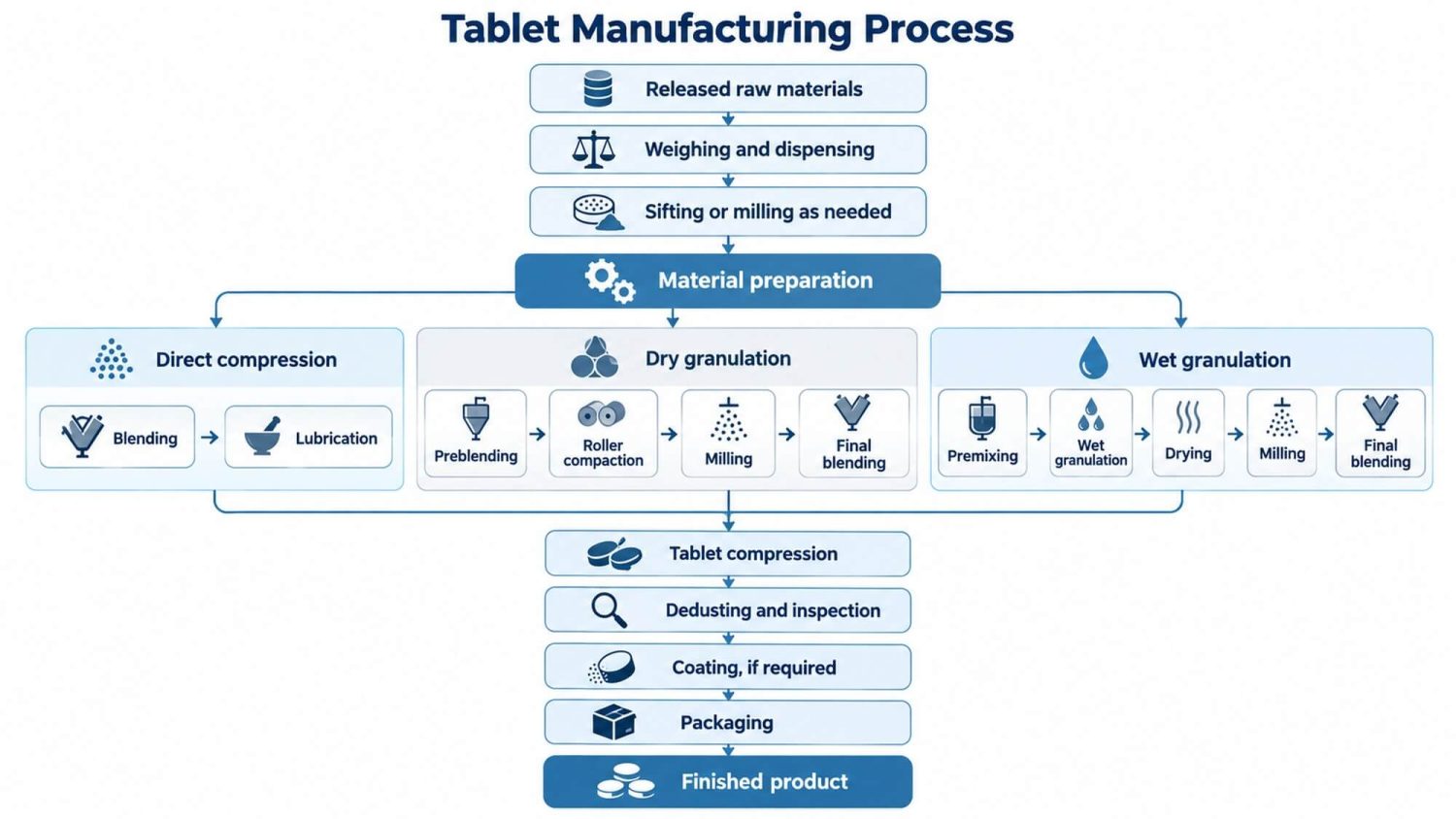
Quality checks occur throughout this entire process. For instance, the material must be inspected before compression. Also, the weight of the tablets and other properties must be monitored during production. Finally, the finished tablets undergo a series of tests before the lot is released.
Prepare and Measure the Raw Materials
Tablet production starts with testing and releasing the active pharmaceutical ingredient (API) and excipients for use in manufacturing. These ingredients are then accurately weighed and dispensed based on the batch formula. Mistakes at this stage can impact the whole batch, so it’s critical that the raw materials enter the process in the right quantity.
Since powders can aggregate during handling or storage, some raw materials need to go through pre-processing steps like sifting or milling prior to blending. Vibratory sifting is used to either break apart or screen out large lumps. Milling helps reduce the size of larger particles, especially when a certain particle size distribution (PSD) is required.
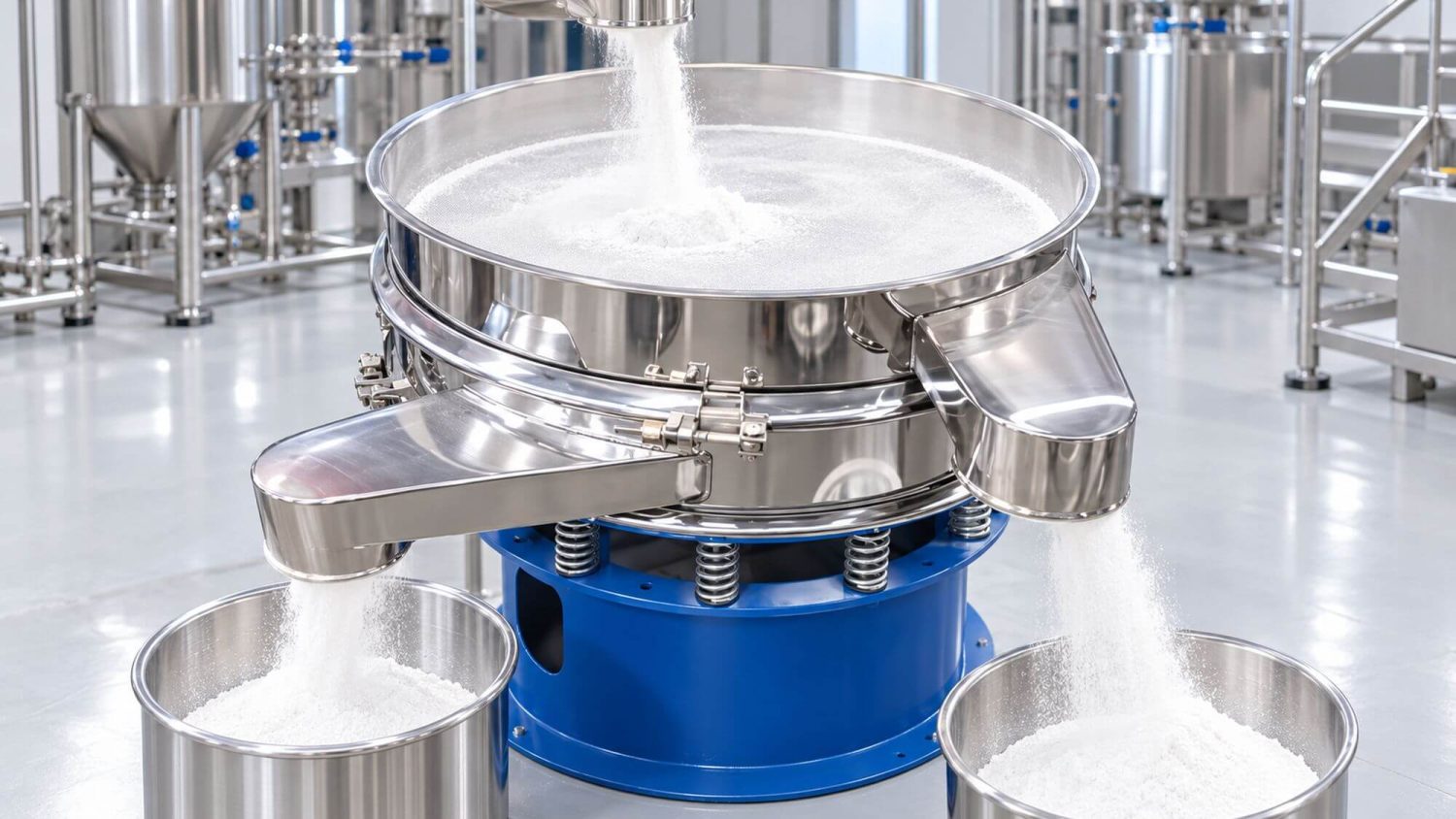
Not all ingredients are prepared identically. Free-flowing excipients can often be fed directly into powder blenders, while cohesive powders or sensitive APIs must first be conditioned using specialized equipment. The required pre-processing steps depend on the material characteristics.
Choose the Most Appropriate Processing Route for Compression
Following weighing and any required sifting or milling, there are several possible methods for getting the material ready for compression. The choice depends on whether or not the formulation will flow and compress adequately.
In commercial tablet manufacturing, the following methods are commonly employed:
- Direct compression: blending → lubrication → compression
- Dry granulation: preblending → roller compaction → milling → final mixing → compression
- Wet granulation: premixing → wet granulation → drying → milling → final blending → compression
Direct Compression
Direct compression follows the most direct path. Following blending, a lubricant is typically added at the end of the mixing phase. The blended powder is then directly fed into the tablet press without the intermediate granulation or drying steps.
This route can only be performed if the powder can flow well and compress into acceptable tablets. In cases where the powder does not flow or compress well, an additional preparation step must be carried out before tableting.
Dry Granulation
Dry granulation converts the powder into denser granules without adding any liquid.
The powder passes through a roller compactor and is pressed into ribbons. These ribbons are then milled into granules, which go through a final blending step before being sent to the tablet press.
Since no granulating liquid or drying step is involved, dry granulation may be used when wet processing is undesirable. However, because the material is already compacted once, it will still need to possess good compressibility to produce acceptable tablets.
Wet Granulation
Wet granulation introduces a liquid during processing to assist in the formation of granules from the powder particles. After the powder is initially mixed, water, solvent, or a binder solution is added during the granulation phase.
After that, the wet granules are dried and milled before final blending. Any additional lubricant and excipients can be added at this point.
Although this route is more extensive than the two discussed, it offers an additional way to improve the formulation before it is compressed into a tablet.
For a more in-depth comparison of these three routes, see our Granulation vs. Direct Compression: Which Route to Choose? article.
Blend and Lubricate the Material Before Compression
When the material arrives at the tablet press, the previous stages should have produced a ready-to-use powder blend or granules. The final preparation step is to ensure that this material remains homogeneous during handling and that it is lubricated before compression.
Keep the final blend uniform.
The active ingredient and excipients should be uniformly distributed while the batch is being discharged from the blender, transferred via intermediate equipment, and loaded into the tablet press hopper. A blend that appears homogeneous in the blender is not acceptable if it segregates under normal handling. This is important because each die is filled from the material that reaches the feed frame.
Add lubricant at the appropriate time.
Lubricants are generally added at the end of the blending process. Their function is to minimize friction between the tablet and the die wall so that the tablet can be easily ejected after compression.
Further mixing may not always be desirable once the lubricant has been added. Excess mixing after lubricant addition may decrease tablet hardness in certain formulations, and thus mixing time should be controlled rather than prolonged to ensure apparent homogeneity of the batch.
Before the material is released to the tablet press, you should verify that the material is capable of:
- remaining sufficiently homogeneous during transfer and loading;
- flowing through the hopper and feed frame without resulting in unstable die fill;
- containing homogeneously distributed lubricant with minimal additional mixing;
- providing a consistent mass of material in each die.
At this point, the material preparation process ends. There is no longer any activity aimed at changing the powder or granules, and the focus shifts to die filling, compaction, and tablet formation.
Compress the Powder or Granules Into Tablets
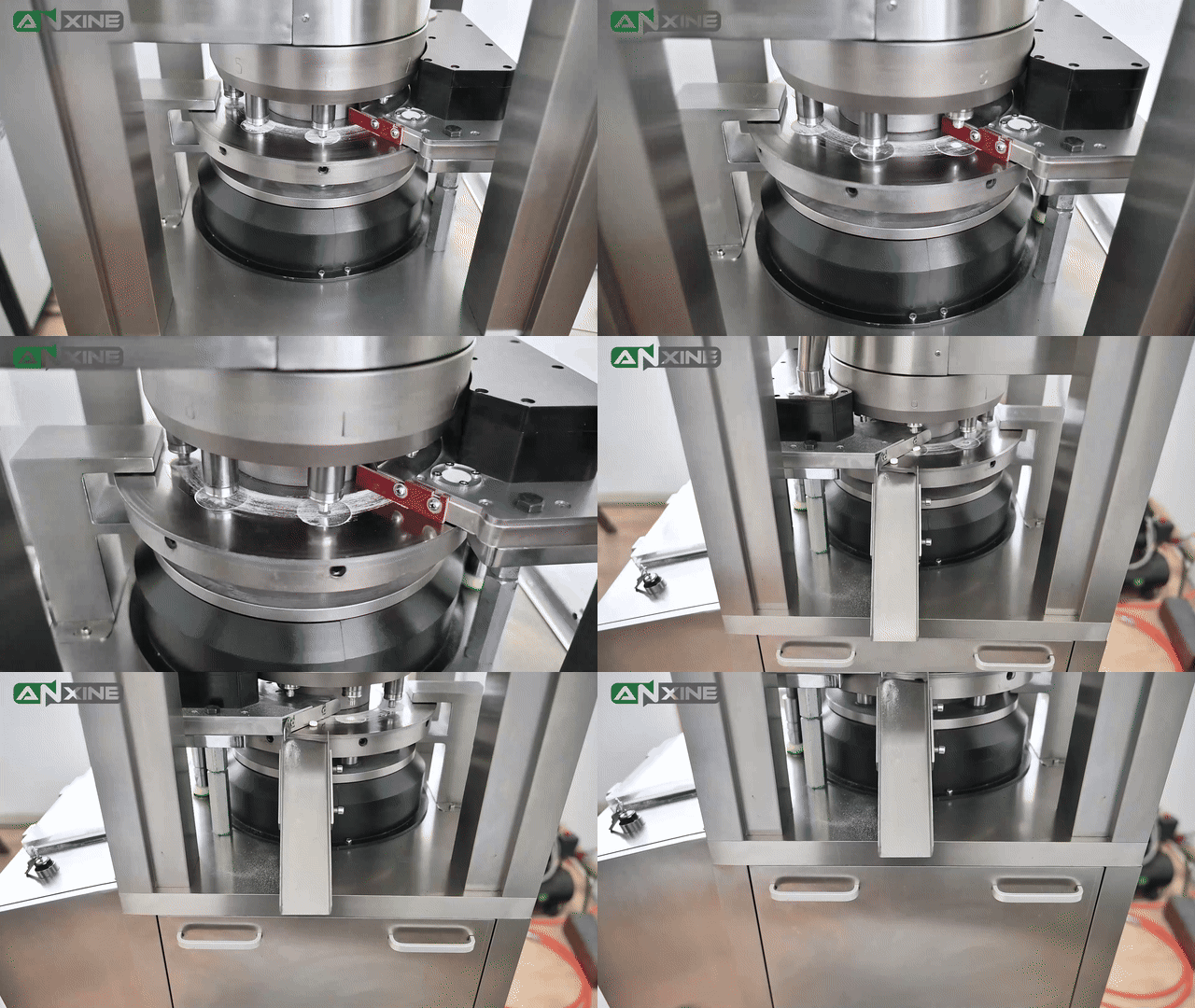
Now that you have prepared your material, it’s time to transform it into individual tablets. In a rotary press, this occurs continuously as the turret rotates through a series of steps:
Die Filling → Metering → Compression → Ejection
Die Filling and Metering
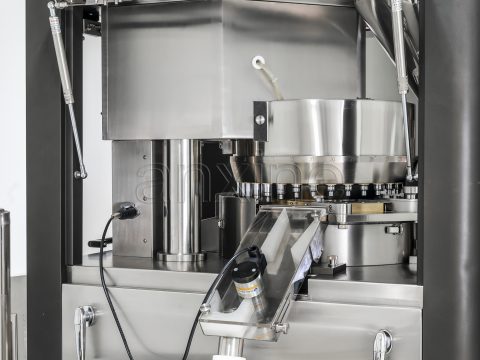
When the material is loaded into the hopper, it flows into the feed frame where the dies fill up as the turret turns. The die is filled with more material than will end up in the final tablet. The lower punch then moves up to the dosing level and leaves the desired amount of material in the die before the compression stage.
Compression
In this step, the upper and lower punches come together and compress the material in the die. Many rotary presses employ two stages of compression. First, pre-compression starts the compaction process and begins to pack down the powder bed. Main compression is when the final compaction takes place and forms the tablet.
Ejection and Take-Off
Once the material is compressed, the upper punch lifts away, and the lower punch moves up, pushing the tablet out of the die. Then, the take-off blade directs the tablet into the discharge chute, and the tooling cycles around the turret once more.
In addition to these basic steps, there are several other press adjustments to consider, including dosing, compression, turret speed, and feeder speed. You can learn more about those in our How to Press Pills: A Practical Guide to Tablet Press Settings guide. After the tablet leaves the press, it still must go through the rest of the post-compression processes before it gets coated or packaged.
Remove Dust and Inspect Tablets After Compression
Most tablets will have some residual powder or dust on them after leaving the press. Before further processing in coating or packaging, the tablets are cleaned and inspected for flaws.
A deduster moves the tablets along a vibrating or spiral track, removing loose powder from the tablet surface. This prevents excessive powder from entering downstream equipment, and also provides a cleaner surface for inspection.
At this stage, any tablets that have visible problems like cracks, chips, or incomplete formation can be rejected. This may be performed manually by an operator or automatically via a tablet inspection system.
Some production lines may include a metal detector after the tablet press or deduster, as part of the contamination control plan. Not all processes will require this, however, so its inclusion is determined by your process and quality control needs.
Coat the Tablets When Necessary
Not all tablets require coating. Once the tablets have undergone post-compression handling, they can proceed directly to testing and packaging. Coating may be applied to certain products to provide an additional layer or function to the tablet.
The coating may be used for purposes including:
- to protect the tablet from moisture, light or other environmental conditions;
- to mask an unpleasant taste or smell;
- to achieve targeted drug release in the gastrointestinal tract via enteric or modified release coatings;
- to enhance aesthetics or facilitate identification of tablets.
During a standard film coating process, tablets are placed in a coating machine and maintained in motion as the coating liquid is sprayed onto them. As the tablets tumble, a heated, controlled airstream evaporates the liquid carrier, leaving behind successive layers of coating.
This process is repeated until the desired coating endpoint is achieved. You should monitor relevant parameters, such as weight gain of coating, tablet appearance, etc., depending on the product and based on validated process parameters.
Package the Finished Tablets
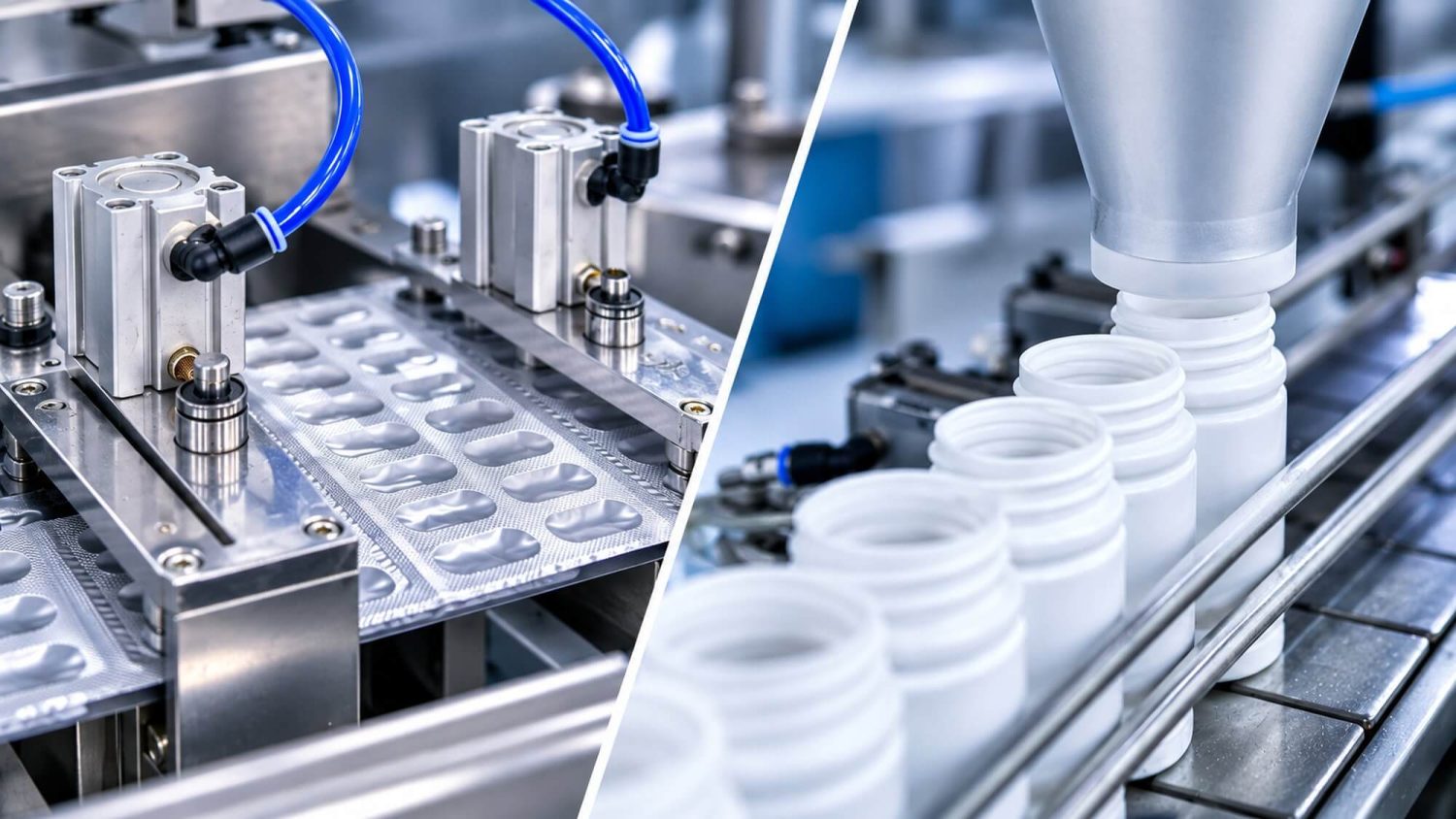
Once the tablets have passed the required checks, they can be moved into their finished package. There are two primary packaging formats that are typically used for finished tablets: blister packs and bottles.
Blister Pack
Blister packs are commonly used when tablets need individual unit protection and better protection from moisture and handling.
Tablets are fed into formed cavities, which are typically made from plastic or aluminum-based materials. A lidding layer is then sealed over the cavities to complete the pack. The packaging line may also include a step to add batch coding and any other required information prior to cutting the blisters and placing them into cartons.
Bottle Packaging
Bottles can contain multiple tablets that are dispensed together. Tablets are counted and filled into the container. Depending on the product, the line may also add a desiccant and attach an induction seal before capping the bottle. The bottles then pass through labeling, coding, inspection and cartoning.
The purpose of the packaging extends beyond simply containing the tablets; the packaging must provide a specified level of protection for both the storage and distribution of the product, for example, from moisture, light or physical abuse.
Check Tablet Quality Throughout the Manufacturing Process
Quality control isn’t just performed at the end of tablet production. Checks are incorporated into various phases so that issues can be identified early in the process before further materials move down the line.
| Production stage | Typical checks | Purpose |
|---|---|---|
| Before compression | Blend uniformity, moisture content, particle size | Confirms that the material can be processed by the feeder and press |
| During compression | Tablet weight, thickness, breaking force, appearance | Ensures that the tablet press is producing consistent tablets |
| After coating | Appearance, coating weight gain, coating-related specifications | Confirms that the coating process has ended |
| Finished tablets | Assay, content uniformity, disintegration or dissolution | Confirms that the final tablet meets the finished product specification |
| Packaging | Count, coding, labels, package integrity | Ensure that the correct product is packed properly and securely |
Since not all products require the same in-process checks, these requirements depend on the product, dosage form, process, and final product specification.
These results can also help identify the start of a deviation. For example, if the tablet weight fluctuates, you may need to look at feeder or die fill. If there is a change in the tablet’s hardness, you might want to review the compression parameters or incoming material.
Finished-product testing provides another verification step prior to releasing the batch. It doesn’t replace earlier manufacturing checks; it confirms that the completed tablets meet the required quality standards.
How the Full Tablet Manufacturing Process Fits Together
In general, the process becomes easier to understand when you look at what goes in, what happens, and what should come out of each stage.
| Stage | What goes in | What happens | What should come out |
|---|---|---|---|
| Raw material preparation | Released API and excipients | Ingredients weighed, dispensed and pre-processed where necessary | Materials ready to go further on |
| Material preparation | Powders and excipients | Direct compression, dry or wet granulation | Final blend or granules |
| Compression | Blend or granules | Filling of dies and compaction of material between punches | Uncoated tablets |
| Post-compression handling | Tablets leaving the press | Removing loose powder, inspection of tablets | Clean tablets |
| Coating (if required) | Uncoated tablet cores | Application of coating and drying | Coated tablets |
| Quality control | Materials and tablets at different stages | In-process and finished product tests for compliance | Results used for process control and batch release |
| Packaging | Finished tablets | Tablets packed in blisters/bottles/other appropriate system | Finished packs |
A good tablet manufacturing process is one in which the materials are properly controlled from the time they enter the process until the final product leaves it. There are multiple routes a tablet formulation can take in order to reach that end product, but each pathway must produce a consistent product that meets the desired quality. From raw material processing to the finished package, this is how a tablet is manufactured.