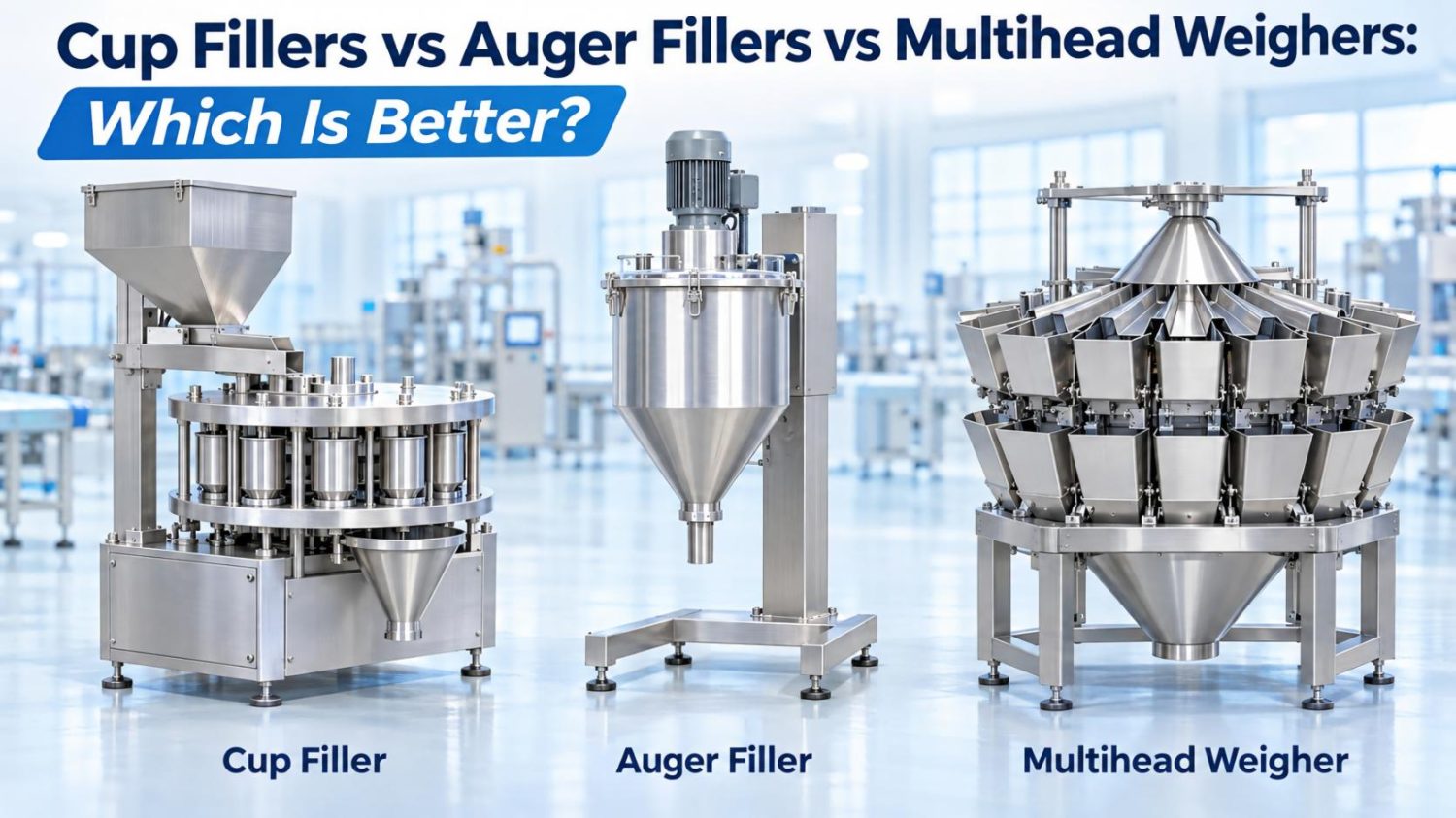
When you want to pack dry products, such as powders and chips, the selection could be various based on different dosing methods. A volumetric cup filler, auger filler, and multihead weigher are usually common choices. They measure and control the dose in different ways. This difference can affect filling accuracy, product giveaway, production speed, or product damage. Thus, the right selection should be based on your products and production requirements. But before making your choice, you should know what their main differences are.
How do volumetric cup fillers work?
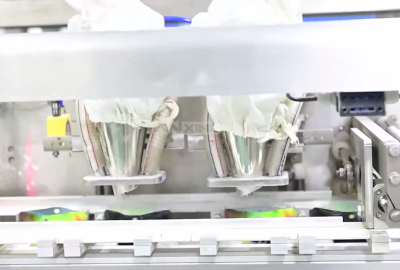
A volumetric cup filler measures products by volume with a measuring cup. The cup could be designed as a fixed amount or adjusted flexibly to control different filling amounts.
The working process of a volumetric cup filler usually follows four steps.
- Filling. Product flows from the hopper into the measuring cups.
- Leveling. Excess product is removed, so the cup can contain a consistent volume.
- Discharging. The filled cup releases the measured product into a bag or container.
- Repeating. The cup comes back to the filling position for the next filling cycle.
The fill weight depends on cup volume and the bulk density of products. The fill weight can be estimated with the following formula.
Estimated fill weight ≈ Cup volume × Bulk density
If a cup holds 200 mL of content with a bulk density of 0.5 g/mL, the estimated fill weight is near 100 g. If the bulk density increases to 0.55 g/mL while the cup volume doesn’t change, the estimated weight is 110 g.
In real production, the fill weight is influenced by many factors, including product flow and cup filling. Therefore, you should test the machine with your product. Then, you can better know whether it can meet your target consistently.
How do auger fillers work?
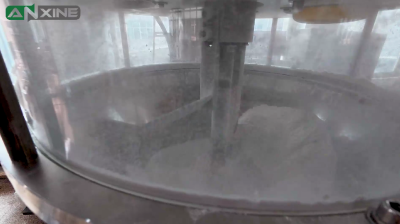
An auger filler is equipped with a rotating screw to move and meter powder into different packages. Some models also include an agitator to improve powder flow inside the hopper. Compared to a volumetric cup filler, it controls the dose by the number of screw revolutions. The speed influences the powder dispensing, while screw design and powder flow characteristics also need to be considered.
The process usually follows four steps.
- Feeding. Powder flows from the hopper into the dosing part.
- Screw rotating. The auger rotates inside the tube. Its flights carry powder toward the discharge outlet.
- Adjusting the dose. You can set parameters, including the number of screw revolutions, rotation speed, or dosing time, to control the filling amount.
- Discharging. The measured amount is discharged and filled to the package. The screw then stops or moves to the next dosing cycle.
More screw revolutions can deliver more product when the screw fills consistently. Other factors include the screw’s diameter, pitch, and rotational speed.
How do multihead weigher work?
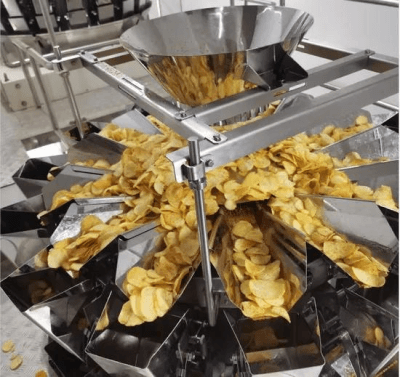
A multihead weigher is a weighing machine used to fill products into packages by calculating weight. Common models have 10-head, 14-head, and 16-head weighers. They can be used for products such as snacks, nuts, candies, and seeds. The machine can be integrated with other packaging machines, including VFFS machines.
It usually works as follows.
- Product distribution. Products flow to many weighing hoppers after entering the machine.
- Separated weighing. Each hopper measures the weight of its product content.
- Calculation. The controller receives the weight of each hopper and sums them up with different groups to meet the preset weight. The machine would select the ones that are the nearest to the preset weight.
- Discharge. The selected hoppers open, and their contents drop into the package. The unselected hoppers may keep the contents for the next weighing cycle.
For example, your required fill weight is 500 g, and four hoppers contain
| Hopper | Measured weight |
|---|---|
| A | 120 g |
| B | 135 g |
| C | 160 g |
| D | 205 g |
In this case, the controller can select the combination of B + C + D to meet your required fill weight. However, it does not guarantee a perfect final package weight.
Which machine offers better filling accuracy?
This is usually a high consideration during selection. Filling accuracy is important to get product content with the same weight.
| Filling method | Main accuracy concern |
|---|---|
| Volumetric cup filler | The same cup volume can have different weights when bulk density or cup filling changes. |
| Auger filler | Powder density, flow, and screw filling can change the content filling. |
| Multihead weigher | Feeding consistency, product characteristics, and combinations among different hoppers. |
How should you check the machine accuracy before buying?
There is no one accuracy number that suits every machine. The result depends on many factors, such as the machine design, product, operating speed, etc. So, you may ask suppliers to test your product. Then, collect the packages and compare
- Average fill weight against the target.
- Standard deviation of package weights.
- Average giveaway above the target.
- Number of packages over your specified weight limits.
- Results at constant production speed, not only during a short production.
Then, you can know if the machine meets your requirements or not. For packaged goods in the United States, NIST Handbook 133 provides procedures for checking package net contents, including average-content and individual-package requirements.
Is your product powder, granule, or fragile?
For filling performance, you should consider the powder properties and movement.
Auger filler: better for powders, but not every granule.
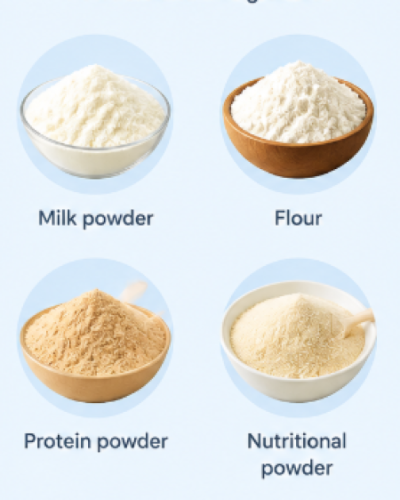
An auger filler is usually used to fill powders, like milk powder, flour, etc. Its rotating screw moves material during the process. It may cause friction, compaction, or particle breakage. It is really important for fragile pharmaceutical granules, coated particles, or nutritional ingredients that can’t be broken.
Volumetric cup filler: check compression and mechanical contact.
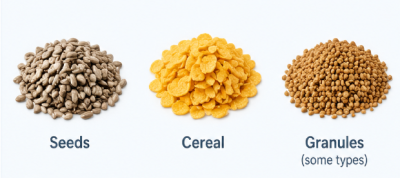
This type is ideal for solid and free-flowing products such as seeds, cereal, and some granules. It features a simple structure and requires fewer transfer steps, but product damage may occur when the cups fill or the cups discharge. In addition, if you want to fill large, fragile, or irregular products, testing is usually needed.
Multihead weigher: control impact during feeding and discharge
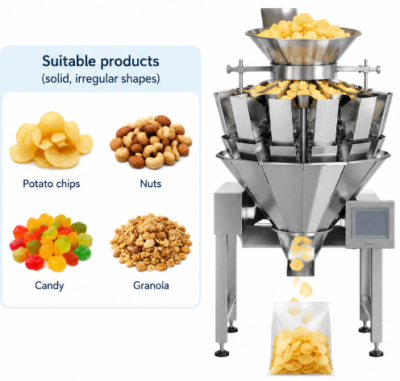
A multihead weigher can fill irregular solid products, such as potato chips, nuts, candy, etc. However, fragile products can crack, chip, or break when they move through the equipment. Therefore, you should check drop height, feeder vibration, and discharge path before selection.
Here is a quick selection chart for you to have a basic understanding.
| Product | Typical method | Main concern |
|---|---|---|
| Potato chips and thin snacks | Multihead weigher | Drop height and impact |
| Nuts and hard candies | Multihead weigher or cup filler | Collision, chipping, and pinching |
| Uniform and robust granules | Volumetric cup filler | Compression and leveling |
| Protein powder and milk powder | Auger filler | Powder flow, compaction, and dosing consistency |
| Fragile pharmaceutical granules or coated nutritional products | Test first | Breakage, abrasion, and loss of coating |
Do you change product frequently?
Changeover and cleaning should be considered. They have a big impact on production efficiency and labor costs.
If you run one product for a long time
When the product and package size keep the same for processing, frequent changeovers are less important. You may focus more on operation, maintenance and cleaning.
- Volumetric cup filler. The same cup setup may work for a long time if the product’s bulk density is stable.
- Auger filler. Pay attention to residue. It can build up around the screw and outlet.
- Multihead weigher. Stored settings can support long-time production, while feeding and weighing parts still need regular maintenance.
If you change products or pack sizes frequently
The design of the dosing parts decides if the changeover is easy or not. Some machines may require new parts, more cleaning, or extra checks when changing pack sizes or contents.
| Factor | Volumetric cup filler | Auger filler | Multihead weigher |
|---|---|---|---|
| Changeover | Cup size may need to be changed. | Screw may need changing | Settings may change. |
| Cleaning | Cups and product-contact areas | Screw, tube, and outlet | Multiple feeding and weighing parts |
| Main concern | Bulk density | Powder residue may require more cleaning. | Product feeding may require extra checks. |
These differences depend on the design of equipment and product. Some machines have quick-release parts or easy-clean designs that make the changeover and cleaning much easier.
Which machine meets your budget?
The machine price covers a large part of the budget. Public listings show a broad range of prices. The figures below are budget references according to Made-in-China, not like-for-like quotations.
| Machine | Common purchase price | Typical budget level | Main cost part |
|---|---|---|---|
| Volumetric cup filler | About $3,000–$9,000 | Lower entry cost | Cup design and automation level |
| Auger filler | About $4,000–$23,000 for listed semi-automatic and automatic models | Low to mid-range | Screw design, powder handling, and weighing controls |
| Multihead weigher | About $6,000–$19,000 for some listed units | Mid to higher | Number of weighing heads, feeding system, and packaging integration |
Note: These are not fixed price rankings, just for reference. Actual quotes can be different depending on design and suppliers.During the operation process, the cost of operation, maintenance, and upgrading needs also need to be checked. A machine with a low price does not mean cheaper to operate. It is necessary to evaluate the whole production process and check the following factors.
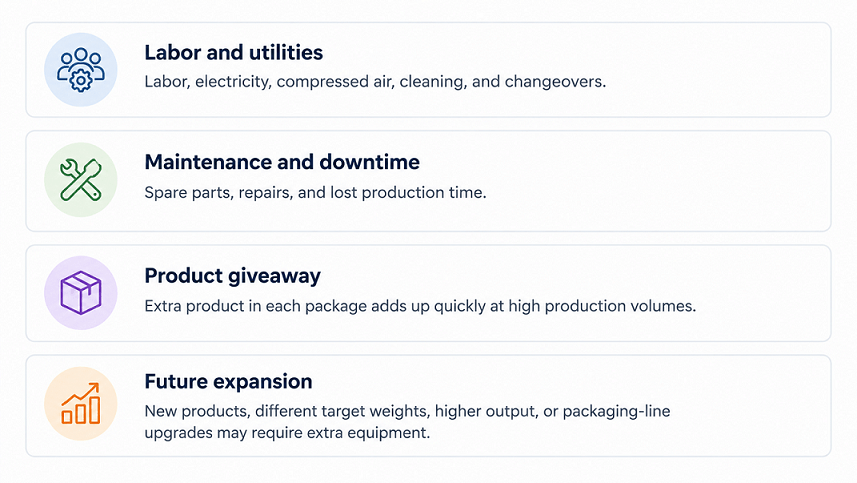
Then, you can know how much it would cost.
- If you have a low budget, a basic cup filler is often chosen when your products have stable bulk density.
- If you have a higher budget, an automatic auger filler or a more automatic cup filler may be suitable. Don’t forget to compare changeover time, labor, and filling performance.
- For a wide range of investment, a multihead weigher may be selected for high accuracy.
Volumetric cup filler vs auger filler vs multihead weigher: quick decision
The chart below lists the three machines and their differences. So, you can have a quick selection.
| Factor | Volumetric cup | Auger filler | Multihead weigher |
|---|---|---|---|
| Measuring method | Fixed volume | Screw rotation | Actual weight |
| Best suited products | Free-flowing solids | Powders / controlled-flow products | Free-flowing pieces & granules |
| Bulk-density sensitivity | High | Medium–high | Lower direct effect |
| Powder handling | Limited | Strong | Product-dependent |
| Irregular products | Limited | Limited | Strong |
| Fragile products | Product-dependent | Often less suitable | Can be configured for demands |
| Changeover | Simple | Tooling may be needed | Recipe-based on many systems |
| Initial investment | Lower | Medium | Higher |
| Best fit | Simple, stable products | Powder dosing | High-output, weight-critical production |
No one machine is best for every product. Cup fillers may suit free-flowing products with stable bulk density, and auger fillers are often suitable for powders. Multihead weighers can handle discrete products such as snacks and nuts. Actual filling accuracy and production speed depend on the product, target weight, machine model, and operating conditions. You’d better test your actual product before making a final decision.


