Industrial powder grinders are used in many production processes. They crush large solid materials into smaller particles or fine powder. Then the materials could be prepared for further processing, such as mixing, granulation, filling, etc. More uniform particles can lead to more stable production and better quality. Therefore, a right powder grinder is important for your products.
Consider material factors before selection
Material properties directly affect grinding quality. A machine that handles well for one material may not suit another. So, it is important to understand the basic characteristics of the material and make a wiser choice.
Material hardness
Material hardness influences how easy it is to break the material. Hard materials, such as chemical crystals, need a strong impact or compression force. Soft materials need less force but may deform instead of breaking. A mismatch between hardness and machine type can reduce efficiency. The machine may also wear out faster. This increases maintenance costs and may lead to unstable output.
Material moisture
Moisture content has a strong influence on the grinding process. Dry materials are easier to break and flow smoothly. Materials with high moisture tend to stick together or stick to machine parts. For example, when the moisture content is high, powder may build up. This can block screens or reduce output capacity. In some serious cases, production has to stop for cleaning. Many manufacturers would control moisture at a low level before grinding to maintain stable operation.
Heat sensitivity
Some materials are sensitive to heat. During grinding, friction and high-speed movement can increase the temperature inside the materials. If the material is sensitive to heat, it may melt, degrade, or lose effectiveness.
This is common in pharmaceutical and food areas. For example, sugar can melt under high temperatures and become sticky. Some active ingredients may degrade when exposed to heat. This can affect product quality. In such cases, low-temperature grinding methods or air-based systems are often used.
Fiber or oil content
Materials with high fiber or oil content behave differently during grinding. Fibrous materials do not break easily into fine powder. Instead, they may form long strands or wrap around moving parts. For example, herbs or plant roots often contain fiber. They may require cutting or shearing before fine grinding.
Oily materials like nuts also require treatment before grinding. Otherwise, Oily seeds or nuts may release oil during grinding. It can cause clogging and reduce efficiency.
Target particle size
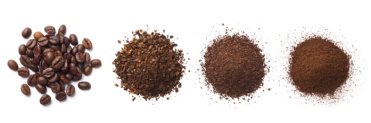
When selecting a powder grinder, you should have clear production requirements. Target particle size is one of the most important factors. It determines the type of grinder and its configuration. Different grinders feature different granularities. Take the Anxine WF series and CFZ series for example. WF models can produce particles from 0.4 to 3.0mm, while the other produces granules from 0.8 to 3.0mm. Therefore, if you have a requirement for the smallest particle within 0.4mm, the WF is a good choice. A clear particle size range avoids repeated adjustments and improves efficiency.
Required output
The output refers to how much material needs to be processed per hour. A machine with low capacity may not meet your production demand. This would delay the whole production line. On the other hand, a machine with much higher capacity than needed may increase cost and reduce efficiency at low load.
In addition, capacity also depends on material properties. Too hard or wet materials often reduce actual output. Therefore, it is common to leave some margin when selecting capacity.
Demanded uniformity
Uniformity refers to how consistent the particle size is in the final product. Some applications require a small particle size difference. For example, in pharmaceutical production, a uniform particle size is important to get a consistent dosage and have the same effectiveness in pills. In food production, it affects taste and texture.
Machines with classification functions, such as air classifier mills, are often used when high uniformity is required. If uniformity is not very critical, simpler machines such as hammer mills may be enough. A clear requirement could avoid over- or under-selection.
Compliance
In the pharma and food industries, equipment must meet strict regulatory standards, such as GMP. These requirements affect machine design and materials. They include
- Surfaces must be easy to clean and not have dead corners.
- Materials must be food-grade and non-contaminating, such as stainless steel.
- The machine should support cleaning validation and documentation.
If your machine doesn’t meet these requirements, it can lead to compliance issues or product rejection. Many machine manufacturers directly put the GMP compliance on the shop page. If you don’t find it, connect to the supplier and check if the machine is certified or not.
Customization
When some functions or designs can’t meet your production needs, customization is a good idea. But you should confirm it with your supplier first. Common customization includes
- Machine structure. Some materials need special internal designs. For example, heat-sensitive materials may need a cooling jacket or an air cooling system.
- Smooth integration. The grinder is usually not used alone and needs to connect with other equipment, like mixers. If you find the inlet or outlet height is not suitable, you can ask your supplier to adjust it.
- Control function. The adjustment could be flexible. You can customize speed control to adjust particle size or automatic start and stop with other machines.
After-sales support
This is also related to your grinding efficiency. You need to carefully check what after-sales support your supplier can offer. If trouble occurs, like a part is broken, but you can’t get the new one in time, it will delay your production and cause a loss.
What types of powder grinders can you choose from Anxine?
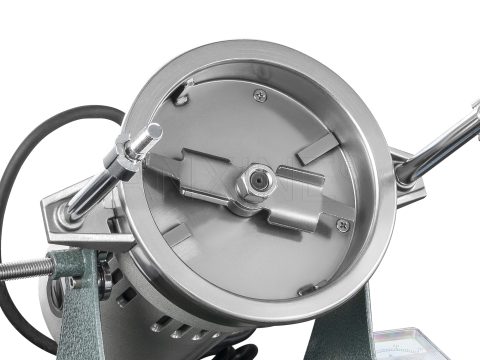
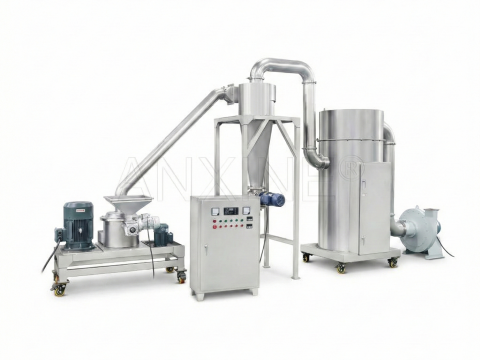
As a leading machine manufacturer in China, Anxine has helped dozens of clients get high-quality powder grinders. We offer cone mills, automatic continuous grinders, superfine grinders, etc. Whether you run a small or large-scale business, there is one model to meet your needs. Here is a chart about our grinding equipment for your reference.
| Model | WF series | CFZ series | SF series | CF-15 | YF3-1 |
|---|---|---|---|---|---|
| Type | Automatic continuous grinder | Industrial crusher | Automatic grinder with dust collector | Superfine grinder | Desktop powder grinder |
| Capacity | 2-800kg/h | 15-1000kg/h | 80-800 kg/h | 40-200 kg/h | Continuous operation |
| Granularity | 0.4mm-3.0mm | 0.8-3.0mm | 0.4mm-3.0mm | 80–320 mesh | 0.5-1.0mm |
| Rotary speed | 3400-7000r/min | 300-3600r/min | 3400-3800r/min | based on the configuration | 2800r/min |
| Power | 1.1kW-11kW | 1.5kW-5.0kW | 2.2-11kW | 5.3 kW | 2.2kW |
| Dimensions | varied | varied | varied | 4,000×1,200×2,700 mm | 550x170x530mm |
Besides, Anxine offers a comprehensive 1-year warranty service. If you need part replacement, we can provide them for free with no shipping cost. Moreover, if you have problems that can’t be solved by yourself, our professional technicians will go to your factory and assist you in running the machine smoothly. If you have any questions, feel free to call us.