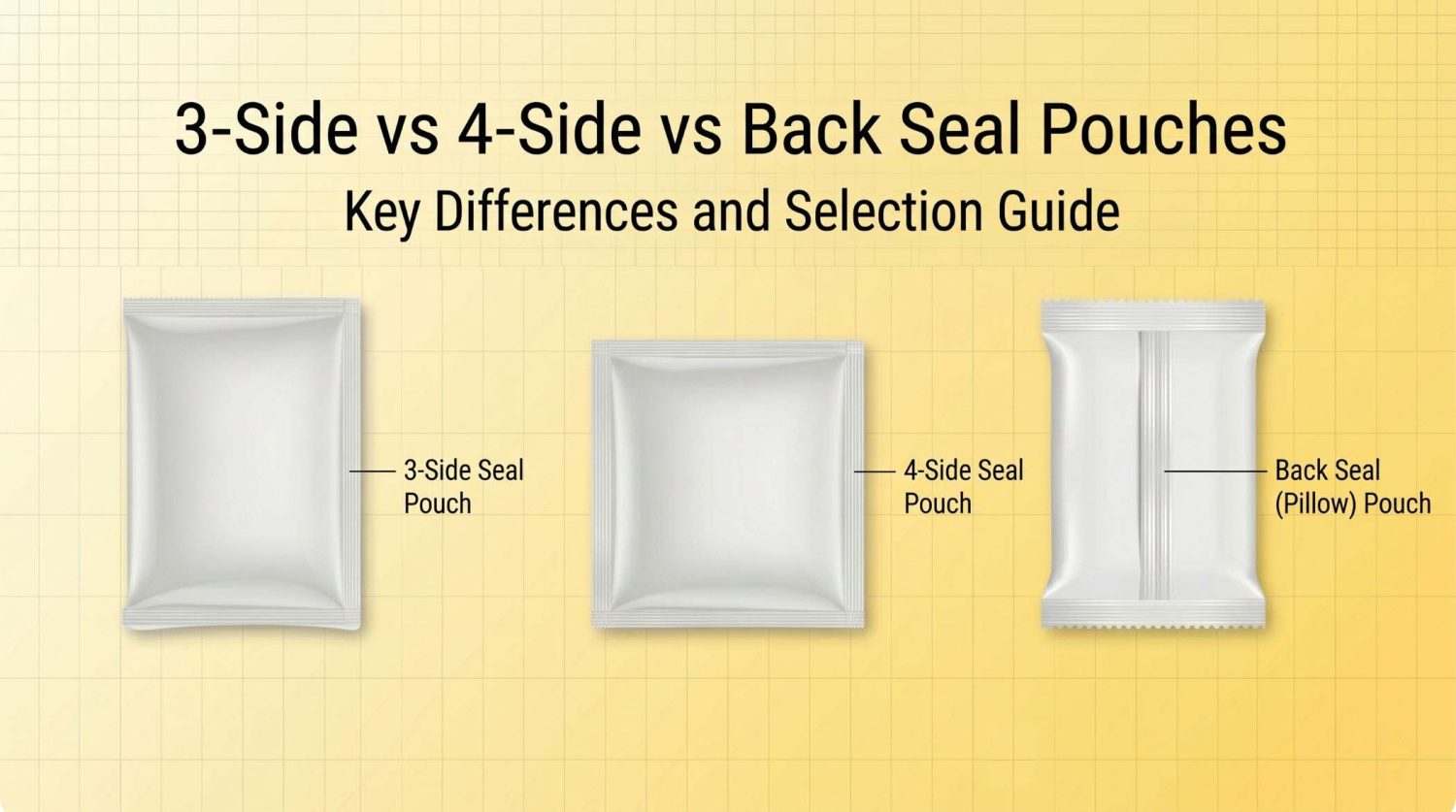
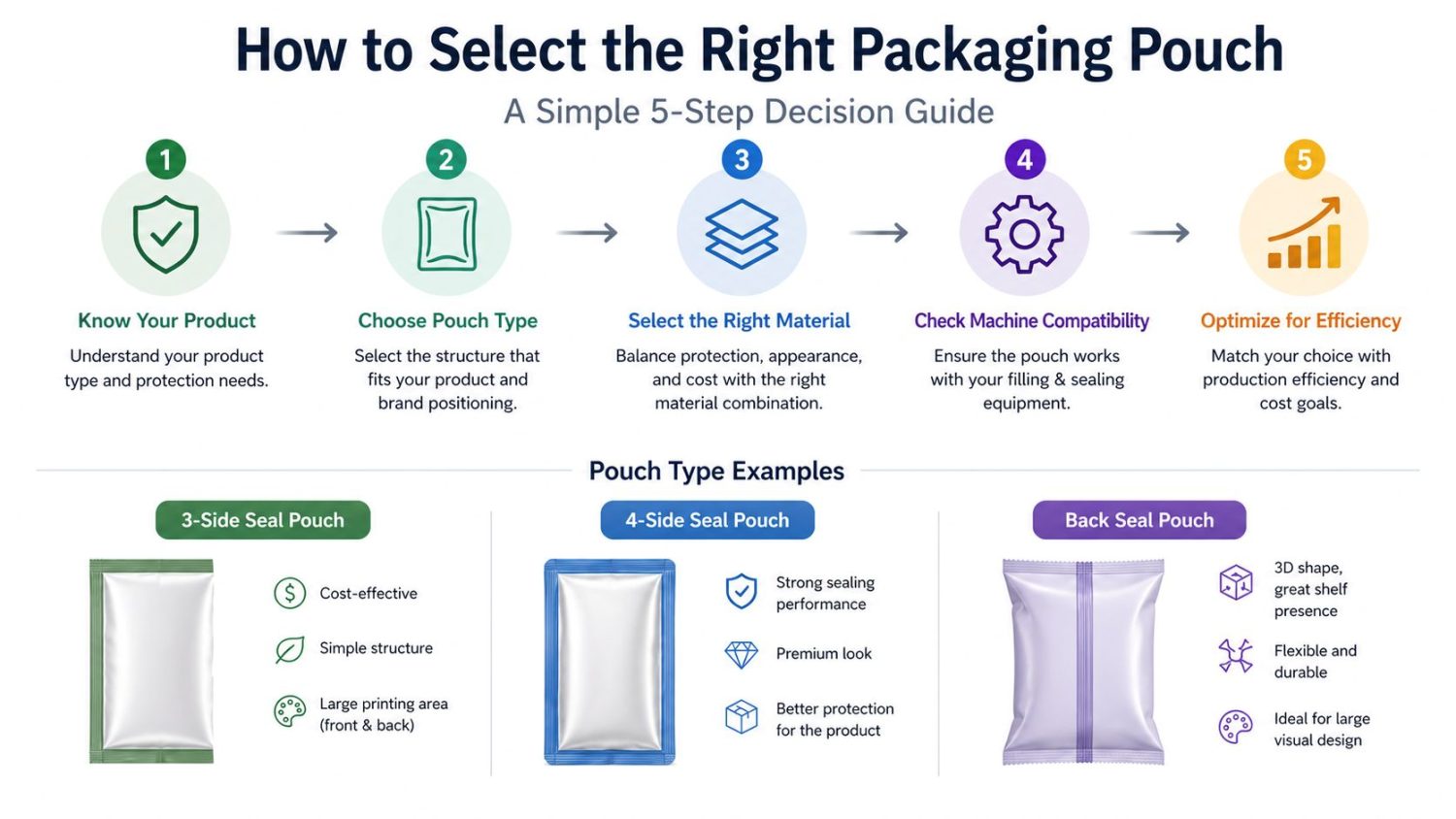
Pouches with side seals are popular in product packaging. They are widely used in cosmetics, food, and the pharmaceutical industries. The most common pouch sealing types include 3-side seal pouch, 4-side seal pouch, and back-seal pouch. But what are the differences between them? How do they influence the production line?
Wrong selection leads to material waste, product damage, efficiency reduction, and a series of operational issues. If you are unsure how to choose the right design for your product, this post will help you make a decision.
Understanding 3-side, 4-Side, and Back Seal Pouches
To make things clear, the 3-side seal, 4-side seal, and back seal pouches here refer to their finished form after filling and complete sealing.
3-Side Seal Pouch
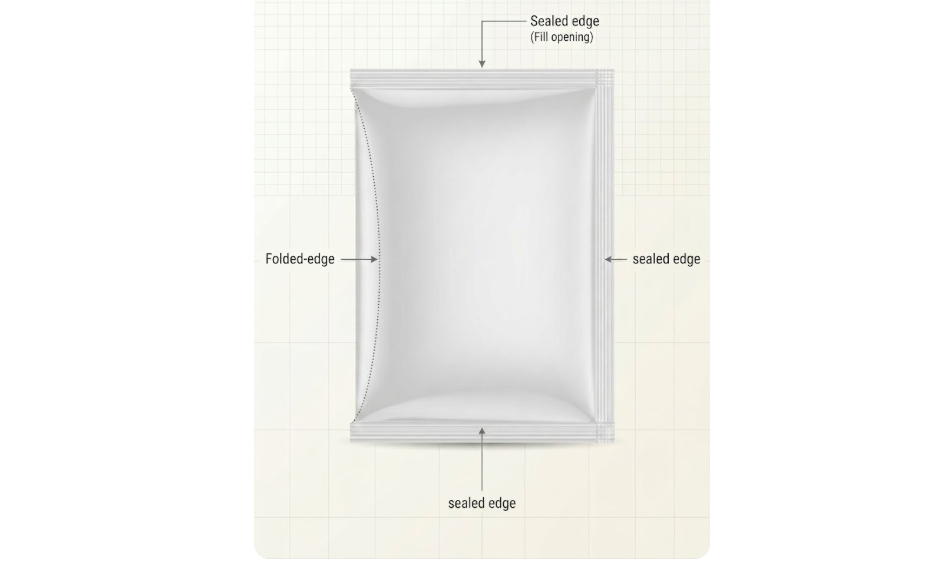
A three-side seal bag, as shown below, is a flat pouch formed with one folded edge and three sealed sides. It cannot stand upright.
Before filling, this type of pre-made pouch is called a fold-over pouch, with 2 sealed sides, 1 folded bottom, and 1 open side for filling. It is made from one piece of film.
So, if you want a final package with three sealed edges, you should choose a “fold-over pouch” or “2-side seal pouch”, rather than a “three-side seal pouch”.
4-Side Seal Pouch
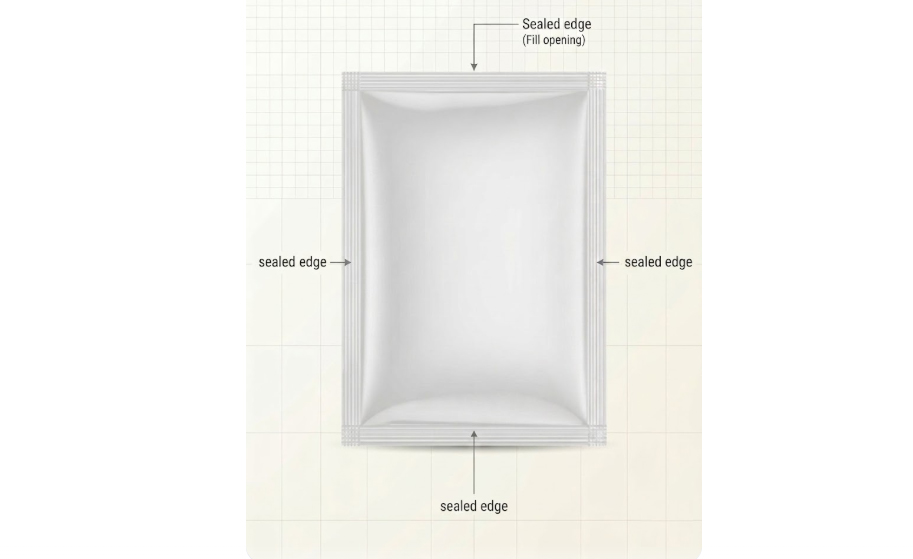
A 4-sided seal pouch, as the name implies, is a square-shaped pouch in its final form with all four edges sealed. It also can’t stand upright.
The pre-made pouch of it has 3 pre-sealed sides and 1 open side for filling. The pouch is made from two pieces of film. Once filled and finally sealed, the package becomes sealed on all four sides.
Back Seal Pouch
A back seal bag, also known as a center seal pouch, T-seal pouch, fin seal pouch, or back seam pouch, features a vertical seal along the back center.
As a pre-formed pouch, it is made from one piece of film, formed with one bottom sealed side, a central back-sealed fin, and one open side for filling.
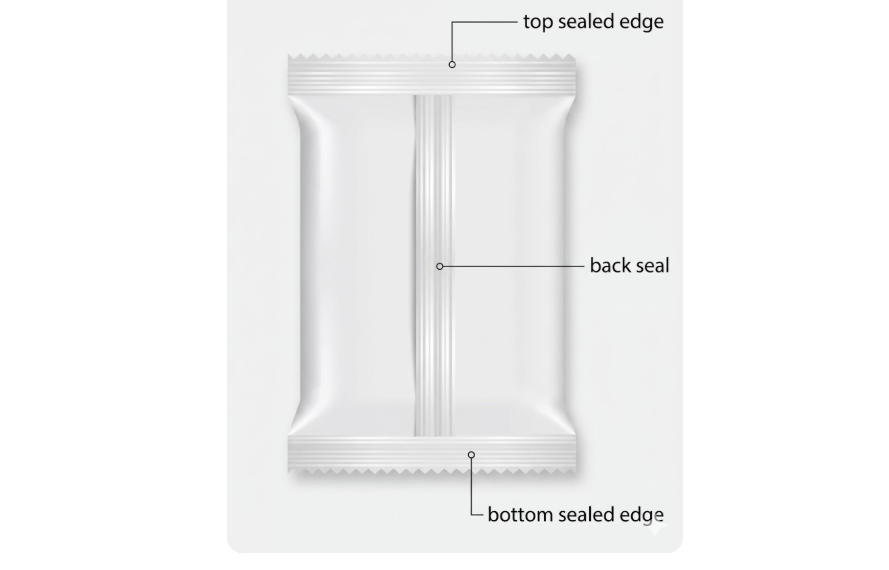
Table 1: Differences Between 3-Side and 4-Side and back seal pouches
| Feature (Finished From) | 3-Side Seal Pouches | 4-Side Seal Pouches | Back Seal Pouches |
|---|---|---|---|
| Structure | 2 pre-sealed sides, 1 folded bottom, and 1 open side for filling | 3 pre-sealed sides and 1 open side for filling | 1 bottom sealed side, a central back sealing fin, and 1 open side for filling. |
| Filling Space (same size comparison) | Medium usable space | Smaller usable space for its full-edge sealing | Larger usable space |
| Appearance | Flat shape, one folded side, slightly uneven | Flat square shape, all sides sealed, neat and even | Pillow shape, with back seam, looks more 3D |
| Best Use Case | Low-cost, single-use packaging | Better-looking retail packaging | Mass production, snack packaging |
Common Packaging Pouch Size and Applications
These types of pre-made pouches are widely used in packaging, especially in industries such as food, cosmetics, and pharmaceuticals. In practical production, the size of the pre-made bags is customizable. You can select a suitable size based on the product size, material, packaging equipment, and way to display.
Due to the differences among different applications, suppliers usually provide a range of typical sizes for reference. But it’s not the standard size.
Table 2: Size and Application Reference
| Finished Form | Pre-made Form | Typical Applications | Common Size Range (Reference) |
|---|---|---|---|
| Three-side seal | fold-over pouch, 2-side seal pouch | Seasoning sachets, sample packs, snacks, small pharmaceutical packs | 20×30 mm ~ over 200×300 mm |
| Four-Side Seal | 3-side seal pouch | Pharmaceutical strips, facial masks, functional small sachets | 30×50 mm ~ 150×220 mm |
| Back Seal | center seal pouch, T-seal pouch, fin seal pouch | Snacks, candy, grains, powders | 20×80 mm ~ 200×350 mm |
Note: Pouch names can be different in different stages, industries, and manufacturers.
Priority to Select the Right Packaging Pouch
Don’t these packaging pouches look quite similar, especially the three-side seal pouch and four-side seal pouch? The differences are so small, why not just choose the most cost-effective one?
In fact, the choice is not only about cost. It is also about product protection, appearance, and production efficiency. You can make the decision based on the following priorities.
Can It Properly Protect Your Product?
Different products require different kinds of protection. For example, liquid or semi-liquid products such as sauces and shampoos need high sealing performance to prevent leakage. Powder products like seasoning powders and milk powder focus more on moisture-proofing to protect product performance. Puffed foods like chips require an inflatable packaging to form a 3D structure to ensure the product’s integrity.
Among the 3-side seal bags, 4-side seal bags, and back seal bags, the 4-side seal bags offer the best structural sealing performance. The back seal bags provide the highest structural flexibility. As for leak-proofness and moisture-proofness, they are also related to the packaging materials.
What Visual Look and Brand Impact Do You Want?
- 3-side seal: more basic in appearance; It can be printed continuously on both front and back, though the visual effect can be interrupted due to the folded edge.
- 4-side seal: more structured and refined in appearance; the available printing area is relatively limited with less flexibility.
- back seal: more 3D, commonly used in snack packaging, with a more functional appearance. It supports continuous printing design with greater design flexibility.
Except for printing design, shelf display performance should also be considered. Retail products such as instant coffee sachets should be easy to display on shelves and clearly present product information. In contrast, for products that are not for retail, like pharmaceuticals sold in cartons, cost efficiency and practicality can be the highest priority.
What Material Is Right for Your Packaging?
For pre-made pouch packaging, the material can affect the appearance and determine its functional performance.
- Protection Performance
Different materials perform differently in the functions of moisture-proof, oxygen-proof, and leak-proof. These properties directly affect the shelf life. For example, aluminum foil has excellent barrier performance and is suitable for moisture- and oxygen-sensitive products, while PE can just provide basic sealing. - Visual Appearance & Texture
Material also affects visual effect and tactile impression. Kraft paper features more eco-friendly, while plastic materials are easier to print on with more flexibility of design. Also, their hardness is different, which affects both protective performance and the flexibility of pouch shaping. - Laminated Structure Design
In the real market, laminated materials are widely used because they combine the advantages of different materials. For example, an outer layer for printability, a middle layer for barrier performance, and an inner layer for sealing performance.
Table 3: Key Material Examples
| Function Dimension | Common Materials |
|---|---|
| protection Performance | PE / AL / NY / EVOH / CPP |
| Appearance & Texture | Kraft paper / PET / BOPP / Matte film / Metallized film |
| Mechanical Strength | NY / PET / PA / multi-layer laminates |
| Barrier Performance | AL / EVOH / PA / Metallized film |
| Sealing & Processing Performance | PE / CPP / LLDPE |
Is Your Pouch Compatible with Your Filling & Sealing Machine?
Most pouch-filling and sealing machines can handle common pouch types available on the market, including 3-side seal, 4-side seal, and back seal pouches. Therefore, when selecting the right pouches for your production, pouch type is not the only consideration.
What else do you need to consider?
- First, your product characteristics. Is your product liquid, semi-liquid, powder, or granular? Different machines can handle different kinds of products. The horizontal bag-feeding sauce packaging machine can handle a wide range of products, including granules, powders, and liquids. Some machines are designed for a single product type, such as powders or dry granular products.
- Second, the pouch size and volume that your machine can handle. Every machine has its pouch size range, and maximum filling volume. A wrong selection will lead to material waste and production delays.
- Finally, production efficiency. Packaging machines also vary in output capacity, ranging from 20 to 100 bags/min. Therefore, it is important to select the right machine based on your production requirements when designing your production line.
Sealing Machines for Multiple Pouch Types
In the last section, we discussed how to select the right pouch for your product based on your packaging machine. However, this is actually what needs to be considered when designing the production line. Thus, let’s take a look at some of the most common types of packaging machines available on the market.
Below are types of packaging machines classified by working principle. They are all capable of the three types of pouches, so they can also be referred to as a 3-sided seal pouch machine, 4-sided seal pouch machine, or back seal machine, depending on their application.
Horizontal Pouch Filling and Sealing Machine (HFFS)
Horizontal pouch filling and sealing machines use pre-made pouches, like the ones made from aluminum foil and plastic film. They automatically open, fill, and seal pouches continuously. They can handle most of the basic pouch types and different products, such as granules, powders, and liquids.
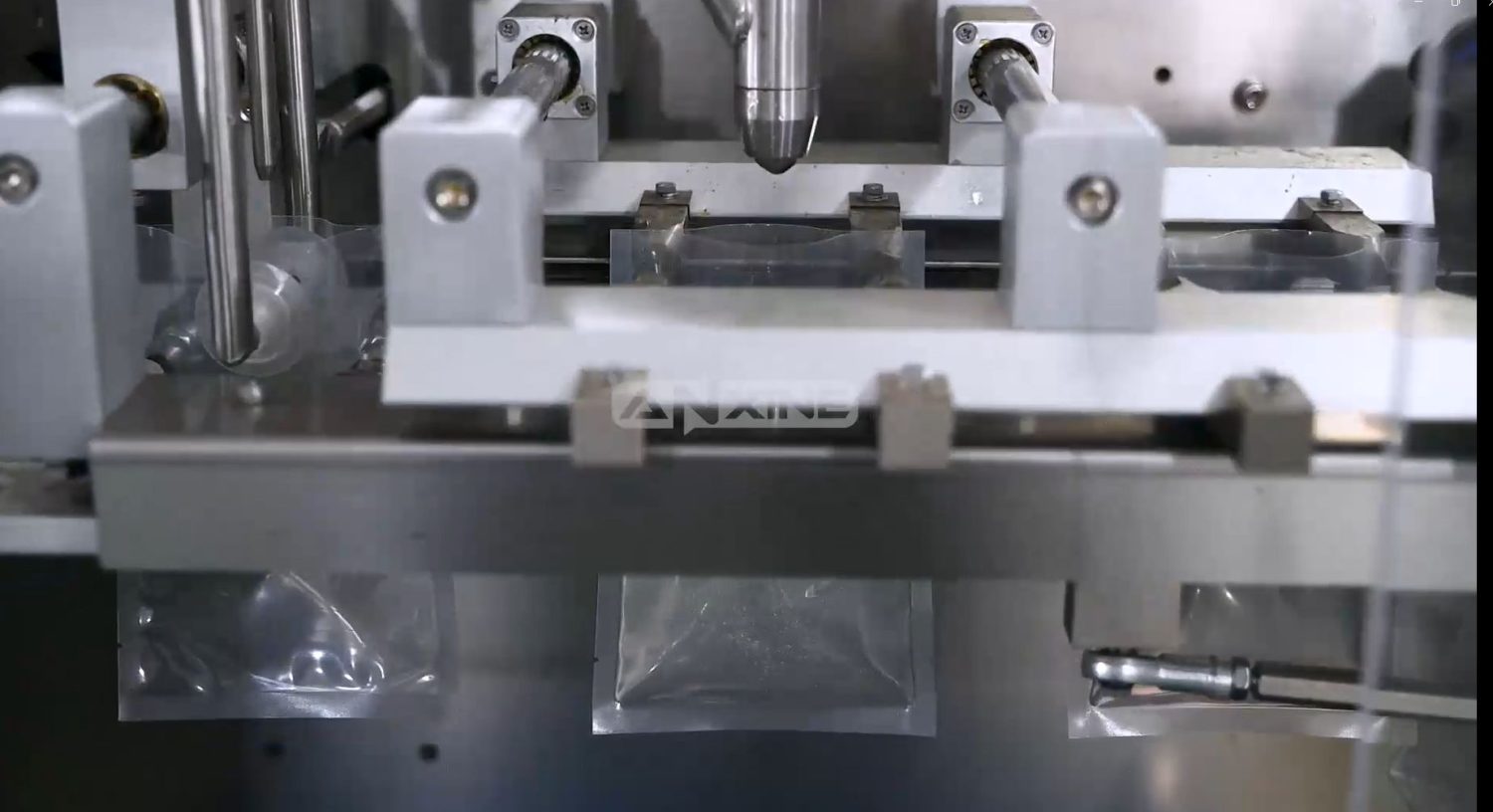
The video below demonstrates how the horizontal pouch filling and sealing machine works.
Vertical Form Fill Seal Machine (VFFS)
A Vertical Form Fill Seal Machine (VFFS) doesn’t use pre-made pouches. Instead, it makes bags from continuous rolls of film. For example, in a 4-side seal sachet packaging line, after the bags are formed, the machine automatically measures, fills, seals, and cuts to complete the packaging in a continuous process.
The machine is designed for a wide range of products, including free-flowing powders, granules, liquids, and pastes. It can also be designed to support 3-side, 4-side, or back sealing. This integrated packaging process improves compatibility between packaging and products and production efficiency.
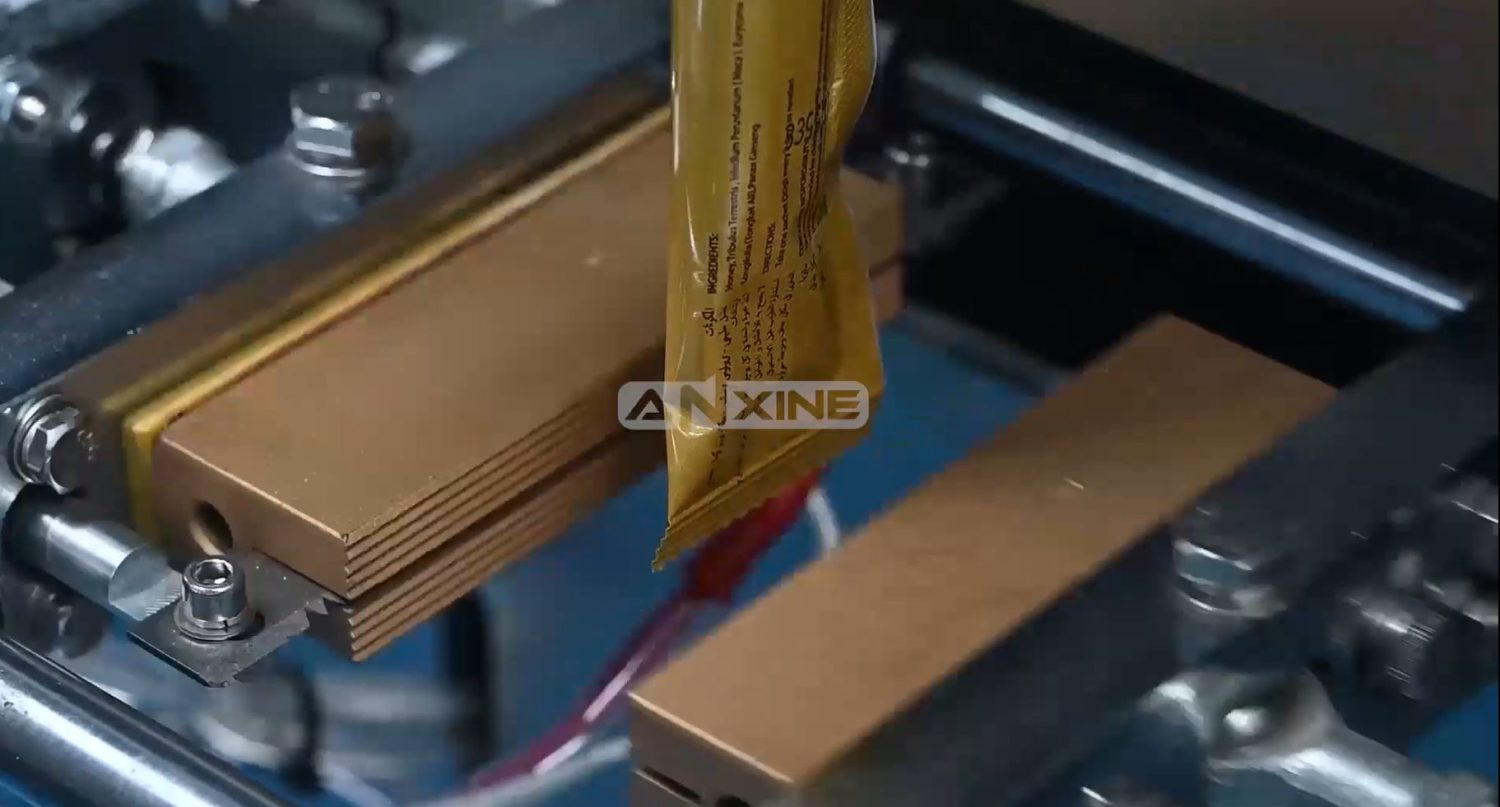
If you want to know the complete workflow of the machine, please click to watch the video.
Rotary Pouch Filling and Sealing Machine
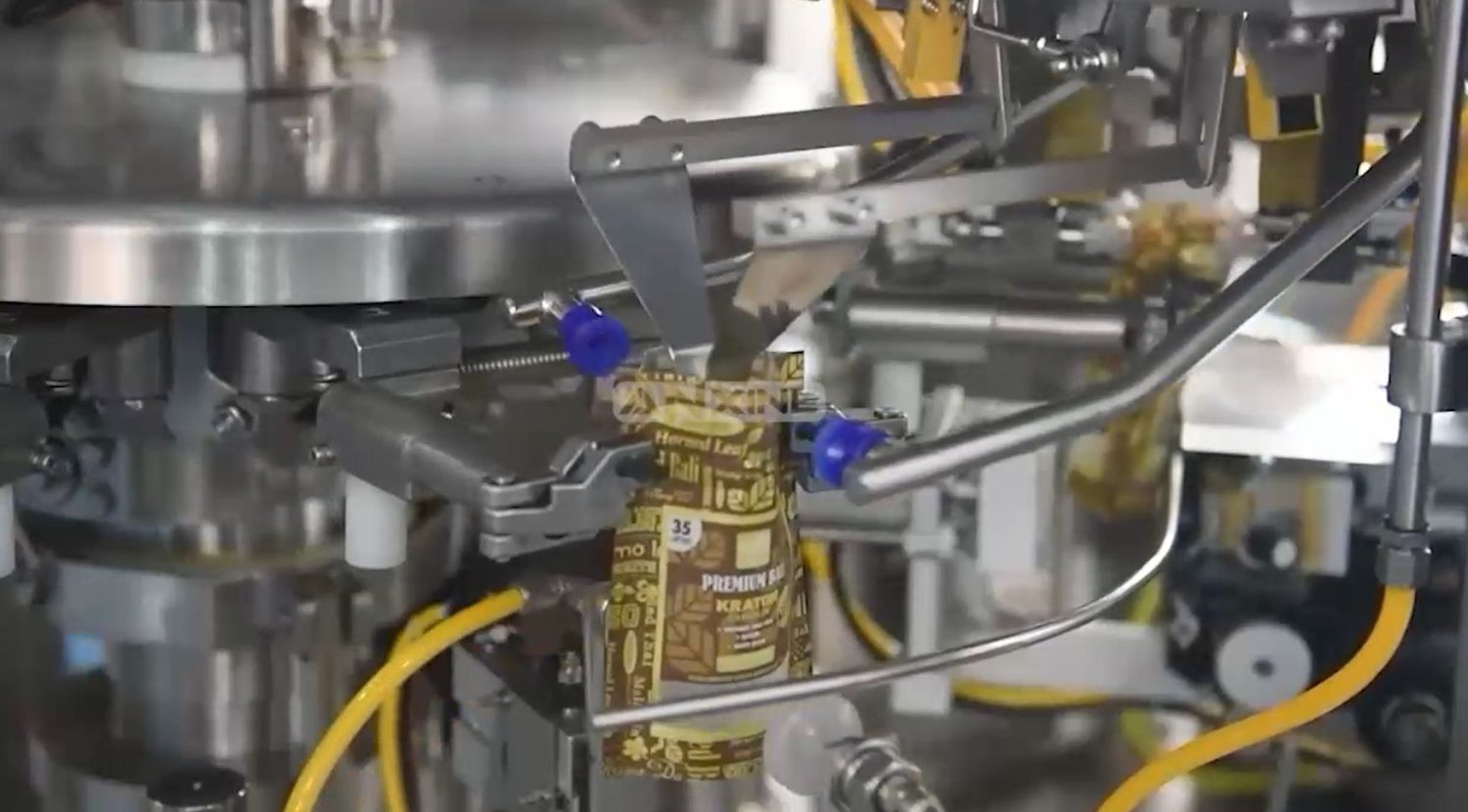
The most noticeable feature of the rotary pouch sealing machine is its rotary structure. The working stations in the rotary system work together to complete the packaging, including the processes of pouch feeding, opening, filling, sealing, and discharging. The machine is able to handle various types of pre-made pouches and different materials.
Band Sealer Machine
Different from filling and sealing machines, band sealer machines are used to seal pre-filled pouches. There are many types of band sealer machines, including horizontal models for dry products and vertical models for liquid products, or both. In addition, some are integrated with extra functions like air suction and inflation, and data printing to meet different packaging requirements.
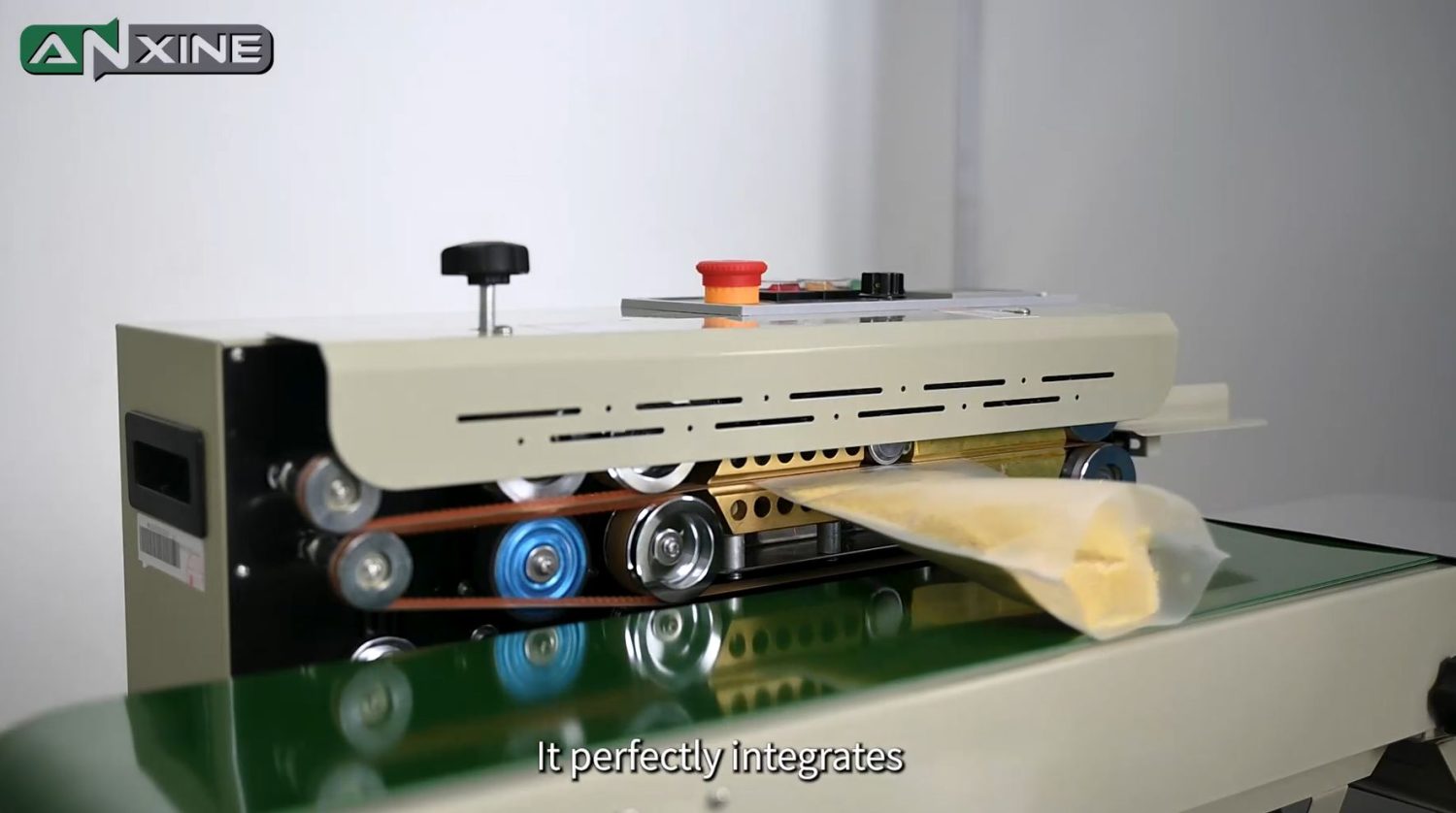
To get a more detailed idea of how it works in practice, take a look at the video below.
Six Functional Design Features for Pouch Packaging
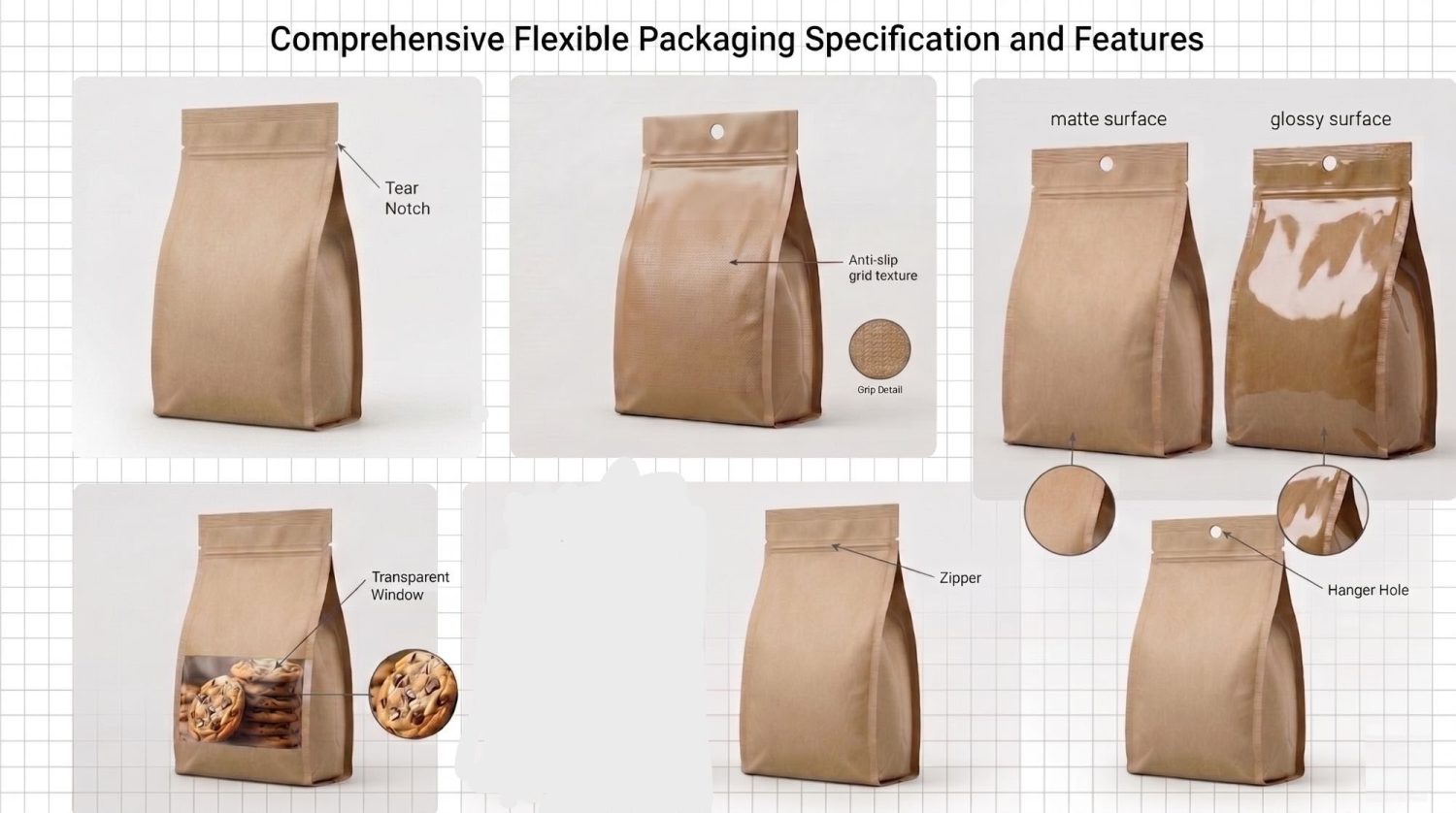
Good packaging means not only good protection, but also user-friendly functions. Good designs can improve product competitiveness in the market. Below are commonly used designs for 3-side seal, 4-side seal, and back seal pouches.
- Easy-Open Tear Notch
Designed for easy opening by hand without extra tools such as scissors or your teeth. They are usually added to one side or both sides of the bag.
- Resealable Design (Zipper / Press-to-Seal)
The design of the zipper or press-to-Seal allows the pouch to be resealed to protect the product. It’s especially widely used in the four-side flat pouch market.
- Transparent Window
With a transparent Window to show what consumers can get inside, the design increases consumer trust and product appeal.
- Hanger Hole / Punch Hole
A suitable hanger hole makes a big difference in product presentation and functionality, especially for retailing.
- Matte or Glossy Surface Finish
A matte finish brings a subtle effect on packaging, while a gloss finish brings a shiny effect with a smooth feel. Different designs can lead to different brand perceptions.
- Anti-slip Texture
It is especially suitable for liquid or frequently used products, such as laundry detergent and pouch yogurt.
Final Word
This post provides a clear overview of the key differences and applications of each side pouch: 3-side, 4-side, and back-sealed pouches. We hope it can provide you with some useful reference, especially when you are designing your packaging plan. If you have further questions about how to choose a pouch packing machine, please feel free to reach out to our team at Anxine. We are always here to help you.


